From Jens Fiederer on Google+ today, a follow-up to my posting on feel like (here), with an antedating of feel like + NP (as in I feel like sushi ‘I feel like eating sushi’), from the 1970 quote in my posting back to 1889. And with a Stanford connection.
Archive for February, 2012
Antedating
February 20, 2012The Chink files
February 20, 2012Two items: first, a recent flap about sports reporting using the expression Chink in the armor in stories about Chinese-American (well, Taiwanese-American) basketball phenom Jeremy Lin; and second, e-mail to me objecting to my characterizing Chink as an epithet specifically for the Chinese (with my correspondent maintaining that it applied to all people of East Asian descent — because of their slit eyes).
Head on a bed of penguins
February 19, 2012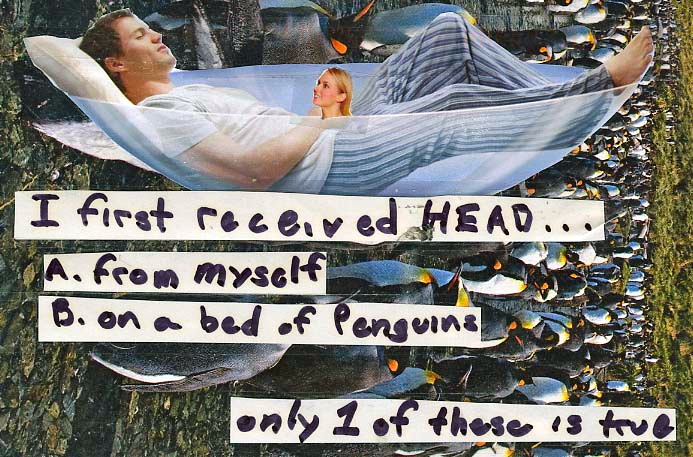
Punnies #21
February 19, 2012Today’s Bizarro, with more puns:

The second pun turns on word division (compare ice cream vs. I scream), with the extra twist that the indefinite article a(n) is usually attached to the following word and pronounced as a unit with it — so than the [n] of an is usually syllabified with the following word, making an ice and a nice phonetically identical.
The third plays on the convention of using obscenicons to represent swearwords.
Of course, all three depend on cultural knowledge: among other things, that Brussels is in Belgium, that Brussels sprouts are a vegetable, that the man in the first panel is planting something, and that the scene and his costume suggest Belgium (what makes it preposterous is that he’s planting pig snouts); that the costumes and dwellings in the second panel are appropriate for Eskimos and that Eskimos live in cold, snowy climates; and that Men’s Wearhouse (itself a pun) is the name of a men’s clothing store.
I feel like sushi
February 19, 2012A recent Rhymes With Orange:
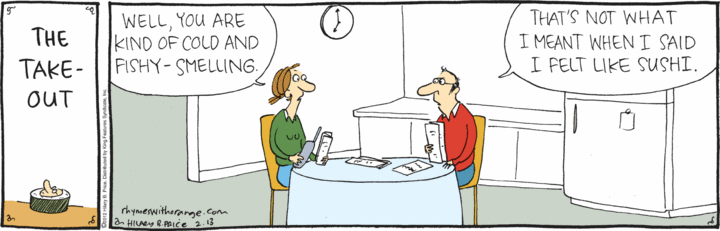
Among the many uses of the verb feel is is the one OED2 glosses as:
to feel like (doing something): to have an inclination for
with the usage note “(? orig. U.S.; now common)” and the usage label “colloq. or vulgar” (I wouldn’t say that vulgar is appropriate now, even if it was in 1989, but colloquial is about right). In the cartoon, this sense competes with a sense in which the subject of the verb is the source of a touch perception (with the experiencer of this perception optionally expressed by a PP in to). (more…)
Gay venery
February 18, 2012Over in the lgbt precinct on Facebook, Michael Thomas asked:
why is there no such thing as a hive of homosexuals?
More generally, what’s the term of venery for queerfolk?
Dildo lamps?
February 18, 2012(Not about language.)
A recent card from Chris Ambidge depicted a man in a bathtub, surrounded by dildos (image now available on my X Blog, here, along with eight other images of men in bathtubs) — including an enormous black number and an enormous red one, 9 or 10 inches long. Chris wrote that in a sex store he and a friend had once been encouraged by the owner to, um, toy with the idea of turning such an item into a lamp.
Unfree variation again
February 18, 2012Announcement of a talk at Stanford this coming Tuesday, with abstract:
Investigating a Syntactic Analysis: Revisiting Raising-to-Subject
Scott Grimm, Stanford UniversityVerbs such as “seem’” or “appear’” allow an alternation between infinitival and finite sentential complements. An example typical of those considered in the literature is given in (1) (Davies and Dubinsky 2004).
(1a) Barnett seemed to understand the formula.
(1b) It seemed that Barnett understood the formula.The standard treatment in generative syntax of this alternation is the raising-to-subject analysis [Subject-to-Subject Raising, or SSR], which is introduced to account for the observation that the surface subject of (1a) is taken to be the subject of the embedded verb (‘understand’), a relation that is established in different ways in different syntactic theories. In the instantiation which gives this phenomenon its name, the subject of the embedded verb “raises” to become the subject of the matrix verb.
This analysis assumes that (1a) and (1b) are meaning-equivalent and claims that the choice of infinitival or finite sentential complementation is a syntactic matter. Much recent work in syntax has shown that comparable alternations are influenced by a variety of semantic, pragmatic, and/or usage factors. For instance, the dative alternation has been shown to be affected by syntactic weight and animacy (Bresnan et al. 2007), as well as information structure constraints (Snyder 2003).
Based on an examination of corpus data, I show that the two constructions in (1a) and (1b) can also be distinguished once a broader array of examples are systematically evaluated. The two constructions manifest significant distributional asymmetries in terms of (i) their information structure preferences and (ii) whether they align with statements based on direct, i.e. experiential, evidence, or indirect evidence, e.g. inferences…
bedbug / bed bug
February 17, 2012In the midst of the NYC Bedbug Panic of 2010 — see Tara Parker-Pope, “The Curious World of Bedbug Research” in the Health section of the NYT blog 8/30/10 and the full story, “They Crawl, They Bite, They Baffle Scientists”, by Donald G. McNeil Jr. in Science Times — came two comments in the blog on spelling:
[comment #19] I understand that entymologists refer to them as bed bugs (2 words) not bedbugs, as the author of this article uses. Apparently if the animal is an actual bug, it should be 2 words. Dragonfly is an example of an insect that is not really a fly, so they merge it into one word.
FROM TPP — Yes we have heard about this from a few readers. The Webster’s New World College Dictionary, which is our definitive source when something’s not specifically addressed by the NYT stylebook, spells it as one word. So for now, it’s bedbugs in the New York Times. But I agree the argument for bedbugs as two words is compelling. [AMZ: there is no argument here, only assertion.]
(Larry Horn on ADS-L waggishly suggested that entymologists constituted an instance of folk entomology. Certainly, some confusion between entomology and etymology is common, common enough to merit an entry in Brians. The orthographic combo entymology is also reasonably common, as you can see from a Google search — apparently as an error for entomology.)
[comment #74] Bed bugs is TWO words – not one. The general rule for writing out common names of insects is as follows. If the insect name is a misnomer (e.g., the dragonfly is NOT a fly and neither is a damselfly), then the whole name is written as one word. If it is not a misnomer, then it is written as two words (e.g., house fly, which is a real fly). The bed bug is a “true” bug and therefore is two words.
Homactu
February 16, 2012Something I stumbled on this morning while searching for something quite different:

That’s Homactu, a portmanteau of homme ‘man’ and actu, a slang clipping of actuel ‘present, current’ (with a suggestion of fashionable modernity). Elsewhere, Homactu advertises itself as devoted to L’univers de l’homme actuel. Ok, with an emphasis on men’s fashion, grooming, hair styles, etc. — with a decidedly gay take on things, including lots of homoerotic photography, like this intense shirt-lifting young man:

Not just homme, but homo as well.
(Two postings, from many, on shirt-lifting: on this blog, here; and on AZBlogX, on the collage “Exposure”, here.)