Archive for January, 2012

A bunch of condescending pedants

January 26, 2012

Via Tim McDaniel, this Saturday Morning Breakfast Cereal:
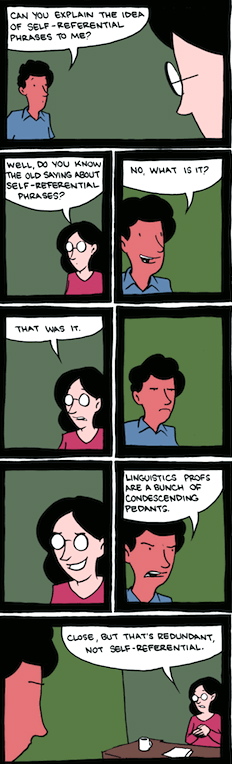
(Maybe I should create a new postings category Stereotypes of Linguists.)

The professor believes that all pedants are condescending, so that condescending pedant is a redundant, pleonastic, phrase. But quite likely the student intends condescending to be a appositive rather than intersective modifier (see the pilotless drone discussion here) — reinforcing the component of condescension in pedant, rather than narrowing the reference of the noun. From the pilotless drone posting:

You might think that even the appositive reading of “pilotless drones” would be stupid, since drones are all pilotless. But look at the explicitly appositive version: “drones, which are pilotless”. This isn’t stupid at all; it REMINDS us, in a helpful way, that drones are pilotless. In general, even when the denotation of Adj is included within the denotation of N, appositive Adj N can do useful discourse work. As a bonus, since intersective Adj N is stupid in this situation, the potential ambiguity is eliminated in practice, in favor of the appositive reading.

(Of course, labeling condescending pedant as a redundancy is itself condescending pedantry, so the professor’s last sentence has the flavor, if not the actual form, of self-referentiality.)

Extraction from adverbial subordinate clause

January 26, 2012

Ira Glass on public radio’s This American Life #454, Mr. Daisey and the Apple factory (first aired 1/06/12):

Mike Daisey. His one-man show about Apple is going back on stage this month in New York at the Public Theater. The full show has this entire other story line about Steve Jobs that you will have to buy a theater ticket if you want to hear.

See anything notable about that last sentence? Many people don’t, though there’s some tradition in the syntactic literature for treating it as problematic.

(more…)

Reportage

January 25, 2012

Steve Kleinedler (of the American Heritage Dictionary) has pointed me to a story in the Chicago Tribune today in which he’s interviewed by reporter Heidi Stevens about on-line mistakes and peeves about them:

Nitpicking grammar in the digital age

With more and more communication happening digitally, is it time to stop the grammar gripes?

Steve’s first appearance:

“It’s almost impossible to speak for 30 minutes and not make a speech error,” says Steve Kleinedler, executive editor of the American Heritage Dictionary. “As someone who has had his grammar picked apart based on radio interviews, it’s sort of scary.”

(Kleinedler once had the audacity to say, during an NPR interview about the American Heritage Usage Panel, “Every year, we send out the panel a ballot full of questions asking their opinions.” This earned the scorn of one Arnold Zwicky, blogger, who took issue with “send” being followed by “out.” Apparently this is a dative alternation. Or something.)

“No one can stand up to that scrutiny,” Kleinedler contends. We agree.

Wow. I’m the bad guy, the nasty nitpicking blogger.

(more…)

gay gazebo

January 25, 2012

(The tiniest of postings, put up only because it tickles me.)

Over on ADS-L, Stephen Goranson has antedated the word gazebo from the OED’s 1752:

Unto the painful summit of this height
A gay Gazebo does our Steps invite.

From “An essay on the pleasures and advantages of female literature … and three Poetic Landscapes” by Wetenhall Wilkes (1741). (ADS-Lers are into antedating as a kind of sport.)

I was charmed by the alliterative gay gazebo (with, of course, an older, non-sexual, sense of gay, plus the great word gazebo). The poem continues, less excitingly:

From this, when favour’d with a Cloudless Day,
We fourteen Counties all around survey.
Th’ increasing prospect tires the wandring Eyes:
Hills peep o’er Hills, and mix with distant Skies.

The geek voice?

January 25, 2012

Arne Adolfsen recently reported on Facebook that he’d been hearing the hit television show The Big Bang Theory. (Yes, hearing, not listening to, and certainly not watching. The show goes on in a room next to the one he’s in. He avoids it, because he hates the very obtrusive laugh track, an antipathy I sympathize with.) He’s formed the opinion that all of the male characters are gay, because of the way they talk [because of the phonetics of their talk. which is all he has to go on — see comments]. (Possibly relevant fact: Arne is gay.) Yet they’re all presented as straight — and awkwardly pursuing women — and the actors playing them all seem to be straight in real life [which is to say: there’s an apparent disjunction between orientation as perceived from phonetics and orientation as presented in the story — again, see comments]. Where does Arne’s impression come from?

(more…)

“a word now shunned”

January 25, 2012

From the Sunday Review section of the NYT this Sunday, a thoughtful piece by Joe Nocera on Porgy and Bess (on the occasion of a new Broadway production):

Variations on an Explosive Theme

‘Porgy and Bess’ supplies a prism through which African-Americans have viewed their own history

When George Gershwin’s “Porgy and Bess” — arguably the most important piece of American music written in the 20th century — first opened on Broadway in 1935, the opera’s libretto was littered with a word now shunned as an antiblack slur. The African-American residents of Catfish Row, the only slightly imaginary block in Charleston, S.C., where the opera is set, used it liberally, and so of course did the white characters during their occasional menacing visits.

Nocera goes on to tell the story of the show’s creation, the tension between its character as an opera and as a musical, the casting of black singers in it (the version I have on my iTunes is from the 1952 revival, with Leontyne Price, William Warfield, Cab Calloway, and Maya Angelou), its reception over many productions since 1935, attitudes towards the book (which focuses on the street life of poor Southern blacks), and attitudes towards the use of nigger (or Nigger) — the word now shunned — in it.

All this without using the word. The Times avoids the word, except in titles (like The Nigger of the Narcissus) and in quotations from speech, and the paper dislikes coy avoidance strategies like the N-word and the N-bomb — and really detests asterisking (n****r). So writers have to fall back on even greater indirection, as Nocera has done here.

(On obscenity — and slurs — in collision with literary merit, with links to discussions of nigger, see here.)


Disclaimer for all occasions

January 24, 2012

In the Sunday Review section of the NYT on Sunday, the lead story “I Disclose … Nothing” by Elisabeth Rosenthal, on hard truths about disclosure statements, with a big graphic by Jennifer Daniel (graphic designer and illustrator, and an art director at the Times). All text, with smaller and smaller type sizes as it goes on:

(more…)

Accusative subject

January 24, 2012

Wilson Gray on ADS-L 1/21/12, quoting from “an anti-SOPA rant”:

(1) The US government is deciding that THEY can decide what me (as a Canadian not subject to American law) can do.

Wilson found this me as subject bizarre, but I noted that subject me is moderately common, under certain circumstances.

(more…)

abdominable

January 24, 2012

First came this story from the Onion (11/2/05):

Yeti Releases Abdominable Crunch Workout Video

That’s the complex portmanteau abdominable: abdominal (as in abdominal muscles) + abominable (as in Abominable Snowman, a.k.a. Yeti).

(more…)

Dubious ad

January 24, 2012

An ad that appeared on my Facebook page this morning:

Ultimate Infidelity Test

Womans Panites & Mens Underwear Tested To Expose Cheating Partners. 100% Accurate & Indisputable

Just a typo — TI reversed to IT — but the error doesn’t inspire confidence in a product that looks dubious to start with. (It offers semen detection and DNA testing.)

Reversals of adjacent letters are in fact very common in handwriting and typing; LINGUSITIC(S) for LINGUISTIC(S) is so frequent that I no longer collect examples of it, and then there are:

Manhattan Calm Chowder
out of the office toady
THREE SEASOSN
Arnlod
iTuens
aslo