Today’s Rhymes With Orange, with a song burlesque and a definitely imperfect pun:
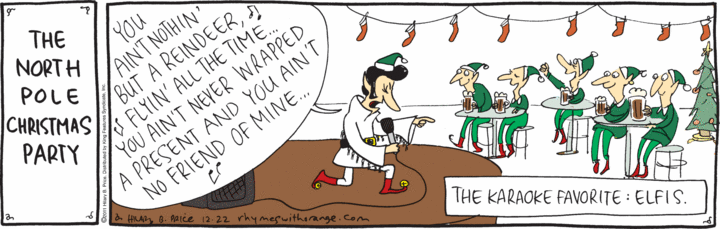
Elvis has left the building. Move on.
Today’s Rhymes With Orange, with a song burlesque and a definitely imperfect pun:
Elvis has left the building. Move on.
This morning the SyFy channel (formerly the Sci Fi channel) is showing Tibor Takács’s 2005 made-for-tv horror flick Mansquito. Yes, a man-mosquito hybrid, created by an accident in a pharmaceutical lab which was searching for a way to cure the highly contagious and fatal Gillian virus. Radioactivity is involved, and both an experimental subject (a prisoner) and one of the experimenters are affected. (Wikipedia entry here, imdb entry here.)
The movie clearly owes a debt to David Cronenberg’s 1986 version of The Fly (a re-make of the 1958 film), though both these man-fly-hybrid flicks turn on teleportation rather than radioactivity.
An odd choice for a film for the Kwanukkahmas season. Maybe it should be seen as a diversion.
From Mara Chibnik in e-mail writes with an account of chocolates she’s been given for the holidays, including one chocolate bar that puzzled her:
Firecracker (chipotle, salt and popping candy)
What’s popping candy, she wondered.
Today’s Zippy, about giving people what they want:
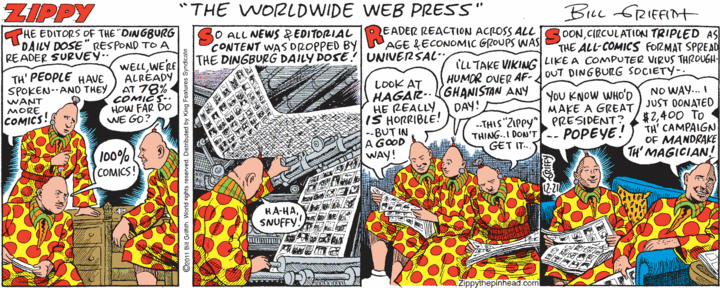
The Funny Times is sort of what the Dingburgers have in mind, but it combines cartoons with humorous writing, all culled from a variety of publications. Rarely subtle.
And aren’t we already seeing Popeye and Mandrake the Magician in contention for the U.S. presidency?
From the Undergear people (exceptionally, only the upper-body shot), as captioned by me:

And then via Tané Tachyon:

CHRISTMAS PENGUINS
They plod from
Patagonia to Monterey
Each year for
The holiday.
While searching for Ann Daingerfield photos, I’ve come across lots of others that bring back memories, including this one from 1982:
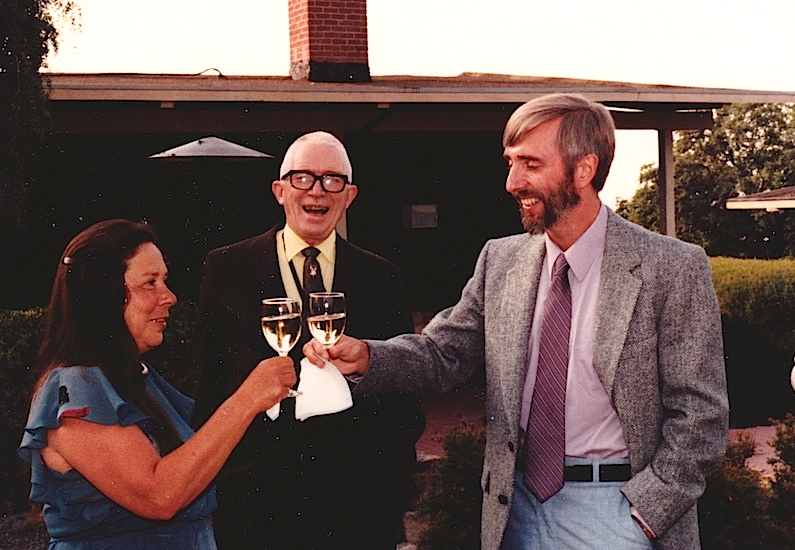
Tamara Hareven, Preston Cutler, and me, with Tamara and me offering a toast to the MSSB (the Mathematical Social Sciences Board) at the “graduation ceremony” at the Center for Advanced Study in the Behavioral Sciences, where Tamara and I were fellows in 1981-82.
Over on Language Log, Geoff Pullum has been fulminating over fresh citings of the Urschneeklon Eskimo N: on English gradations of social inadequacy, in “Eskimos again, this time seeing the invisible” (here), and on Japanese gradations and subtleties of sexual perversity, in “Octoporn” (here). And now, on ADS-L, in a discussion of bracketology, from a posting by “Otherwise” on the Scholars and Rogues site, about Rick Perry and George W. Bush:
To those of us not intimately familiar with Texas, Perry seems just like W. But I am told by my Texas friends they are very different. Eskimos have twenty words for snow. Texans must have twenty different types of asshole.
Only twenty? That’s a modest figure in the Eskimo Snow world.
In an extended vivid dream last night, some colleague said, bitingly, of a paper of mine:
I dislike what you say and how you say it, but I like that you said it.
The paper was about a dozen specific words (none of which I can remember, of course; I never think to take notes in dreams), but I can’t recall what aspect of them was at issue, beyond its not being their phonology: morphology, syntax, usage, sociolinguistic status, etymology, whatever.
In my dream, I did mount a reply, but that too has vanished in the mists of memory. I don’t think I commented on the metacritique — that there is value in clearly saying things that the critic believes to be wrong.
(Not about language.)
Following on Alain Delon and Victor Webster, I move to hunky Adrian Paul:
Adrian Paul Hewett (born 29 May 1959), better known as Adrian Paul, is an actor best known for his role on the television series Highlander: The Series as Duncan MacLeod. (link)
In Highlander, Paul spent a good bit of time shirtless or nearly so. But in the tv series Tracker, he started out as an apparition in nothing but his underwear, showing off his body and his equipment. Hunk City.
(more…)
(Not about language.)
Assembling a Christmas present for my grand-daughter, I’ve been unearthing and scanning in photos of her Zwicky grandmother. Like my Rice grandfather before me, Ann Daingerfield Zwicky died about 20 years before Opal was born, and Opal’s become curious about this person who was so important in her mother’s life and mine (small voice: “Tell me about my grandmother”). But in this case, there’s photographic evidence — and a great many stories, some of which I’ve been telling here. (There are no photographs of my grandfather Rice, and a very few stories, only via my grandmother, whose husband died when she was in her early 20s; she herself died 50 years ago.)