Archive for November, 2011

Learning to curse

November 20, 2011

From Aaron Karo’s Ruminations.com:

I accept the idea that my son will use curse words when he grows up. My goal is to make sure he does it well and in the proper context.

Reasonable idea. But define “grows up”: how’s he supposed to learn how to use them?

(And is this a language and gender thing, available only for boys?)


The mother-in-law solution

November 20, 2011

The Mark Parisi Off the Mark cartoon that was posted here originally has been removed because it violated copyright. Here’s a description of its content:

Main image: White-haired woman, gagged and feet bound, in a large skillet on a stove, while a younger woman holds the skillet and sprinkles salt (or pepper) on the older woman. Voice balloon coming from the left:

Mmmm! Honey, that smells just like my mother’s cooking!

You don’t see a lot of ambiguities turning on possessive ‘s (my mother’s cooking ‘my mother’s cookery’) vs. reduced-auxiliary ‘s (my mother’s cooking ‘my mother is cooking’ — itself ambiguous between my mother referring to the person doing the cooking and to the thing being cooked). In this case, it’s crucial that like is also ambiguous, between a preposition (combining with an NP object and meaning, roughly, ‘resembling’) and a subordinator (combining with a clause and meaning, roughly, ‘as if’).

That gives three principal readings for that smells just like my mother’s cooking:

(a) ‘that smells just the way my mother’s cooking smells’

(b) ‘that smells just as if my mother is cooking something’

(c) ‘that smells just as if my mother is being cooked’

The speaker intended reading (a) (or, just possibly, reading (b)), but reading (c) corresponds to what’s happening in the cartoon: the addressee is cooking her mother-in-law. With apparent relish.


Swans

November 19, 2011

[A poem on the occasion of this image, sent to me by Chris Ambidge:]

Les cygnes

Where are the swans of
Yesteryear, royal
Signs — imperious elegant
Petulant?

They’ve become boats,
Carnival creatures, soap logos —
Adorable, reassuring.

How did they go this way?
Wann ist der letzte Schwan gefahren?

Rex Slinkard

November 19, 2011

More Bay Area art news: a current show (11/9 – 2/26) at the Cantor Arts Center at Stanford, “The Legend of Rex Slinkard”. From the press release:

This exhibition of more than 60 works includes oil paintings, charcoal drawings, and pen-and-watercolor sketches that convey the breadth and strength of Slinkard’s short-lived artistic development.

A self-portrait from ca. 1914-15:

(more…)

Rigo at SFMOMA

November 19, 2011

From the Bay Area section of yesterday’s New York Times, a story (“Award Unites Artists, Collectors and a Museum” by Reyhan Harmanci), about the SECA Art Awards and a forthcoming show at the San Francisco Museum of Modern Art, illustrated by one of the works from the show, a study for “Looking at 1998 San Francisco From the Top of 1925” by Rigo 98 (now Rigo 23):

(more…)

More found poetry

November 18, 2011

Following up on my latest found-poetry posting (here), and an earlier one (here), and a link to the “roof rats in the ivy” poem (here): two earlier finds:

Hermaphrodite Frogs
Found
In Suburban Ponds
(NYT Science Times 4/10/08, headline p. D2)

Fruit bats make
A clicking sound
With their tongues to
Help them navigate their
Way to the fruits
They feed on.
(NYT Science Times 9/20/11)


The Food Issue, with pesto

November 18, 2011

The Food Issue of The New Yorker (Nov. 21st), with lots of great writing about food, including a hilarious piece by Calvin Trillin on his experiences as a summer chef — Trillin should be declared a National Treasure — and a delightful “Talk of the Town” piece by Adam Gopnik on the Thanksgiving turkey and the turkey-eagle competition for national bird (with the turkey famously championed by Benjamin Franklin). From Gopnik (p. 46):

The phrase that Franklin, John Adams, and Thomas Jefferson chose for the motto on the national seal, “E Pluribus Unum: — one out of many — was familiar to the founders from a popular British magazine of the day, but it likely derived from a recipe  found in a once famous poem often attributed to Virgil, “Moretum.” The poem describes a farmer making something rather like pesto: he pestles together cheese and garlic and herbs and oil, and sees that, though the whole is something quite new, each little green or cheesy bit doesn’t completely blend in but keeps its own character. Out of many, one — without betraying the many.

So the Thanksgiving meal should really be turkey with pesto — home-grown vanity and courage served with a pluralist topping.

(more…)

Accents

November 18, 2011

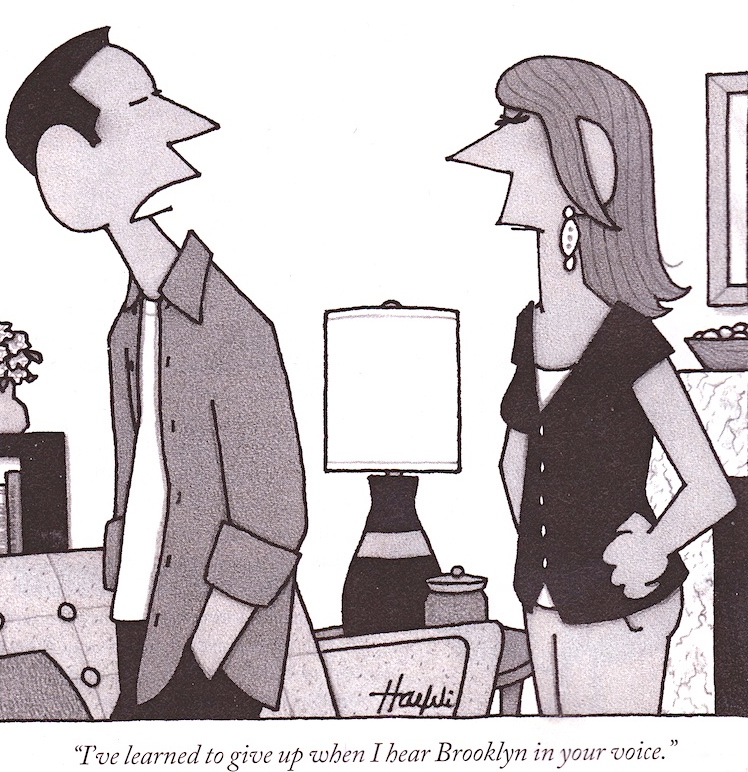
Haefeli cartoon in the latest New Yorker (November 21st):

The power of accents. Everybody knows, at some level, that our speech styles vary according to social context — who we’re talking to, about what, for what purposes — but most of us tend to assume that this variation is under conscious control, that people “put on” accents for some purpose, though linguists point out again and again that this degree of control is essentially impossible, that almost all of this style shifting has to be unconscious. But other people are often sensitive to these shifts, though again almost entirely at an unconscious level.

In the cartoon, the “Brooklyn” in her voice is surely not something she’s projecting willingly, but he’s aware of it and interprets it consciously. But not necessarily accurately — though it makes a wry joke.

Prairie Flandrins

November 17, 2011

The continuing story of the Flandrin pose (on AZBlogX, here, and on this blog, here), now from Cowboy Fantasy: A Picture Book (“Color and black & white semi-nude and nude male physique photography”, Prairie Visions Photography, Lincoln NE, 2009), two photos of the model Rico:


Found poetry

November 17, 2011

Adapted from a letter to the NYT Book Review on November 13th (from Scott Lahti of North Berwick ME):

The Remarkable History of
The Passion of Joan of Arc

Thought lost forever,
It was discovered in 1981
In a janitor’s closet
In a Norwegian
Mental institution.

(The reference is to Carl Theodore Dreyer’s 1928 silent film, starring the French stage actor Maria Falconetti.)