Archive for June, 2011

It doesn’t always stay in Vegas

June 22, 2011

(A little bit about language, but mostly penguin stuff.)

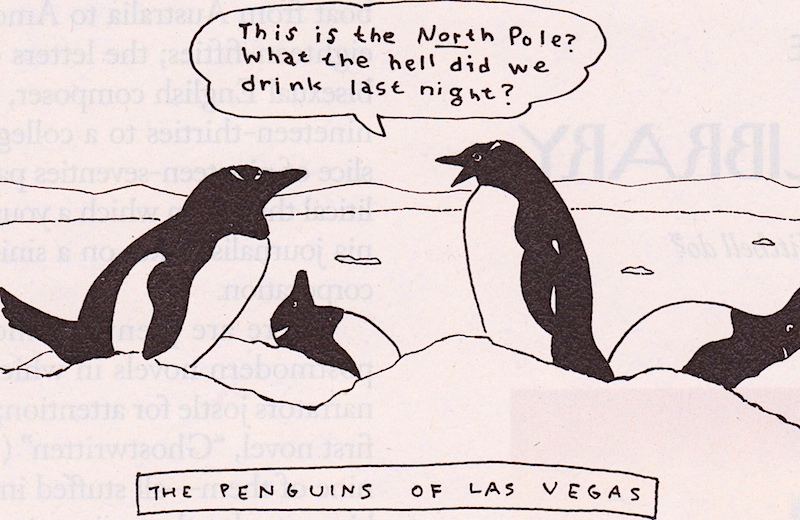
From Michael Shaw in the New Yorker, 7/5/10, a cartoon illustrating that not everything that happens in Vegas stays in Vegas:

Mark Liberman looked at the Happens In, Stays In snowclone in Language Log on 6/9/08, here. With a follow-up by Josh Millard on his own blog, here.

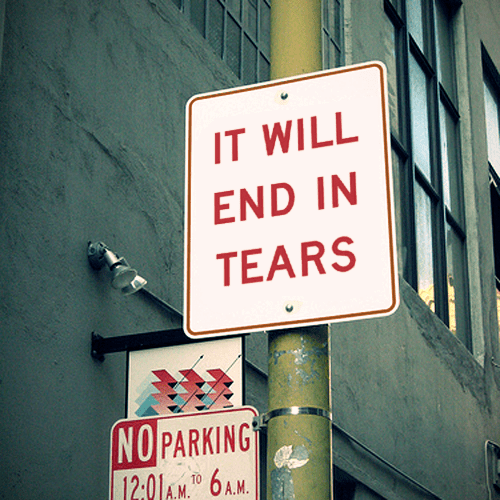
The penguins should have heeded this warning:

(Hat tip to Chris Ambidge.)

From the Cambridge Idioms Dictionary, 2nd ed. (2006):

It’ll (all) end in tears.
something that you say which means something will end badly and the people involved will be upset
She only met him in May and they were married by July. It’ll end in tears, you’ll see.

Really more of a saying or catchphrase than an idiom, but those are hard lines to draw.

Dinosaur awesomeness

June 21, 2011

(Link from Karen Davis) a Dinosaur Comics on modifier inflation over time and on portmanteaus (or portmanteaux):

Awesometastic looks like awesome with the libfix -tastic (though most of the -tastic examples have a noun as first element: carpet-tastic, scab-tastic, dicktastic, etc.). But then playful word formation is, well, inventive.

A pain in the grammatical butt

June 21, 2011

The English word buttocks presents a problem for speakers: in the standard language, it’s both formally plural (with final /s/) and grammatically plural (rejects singular determiners like a, takes plural verb agreement: *a buttocks, Kim’s buttocks were/*was perfectly symmetrical). However, buttocks plays a double role semantically:

it denotes a matched pair of body-parts (NOAD2’s definition for buttock: “either of the two round fleshy parts that form the lower rear area of a human trunk”; buttocks gets only a subentry here: “the rump of an animal”); this is buttock, roughly ‘ass-cheek’, seen in left buttock vs. right buttock

and it denotes the two as a unit — roughly, ‘ass, butt, bottom, behind, backside, rear end, …’ (for which I’ll use the gloss ‘butt’) — in which case it acts somewhat like a plurale tantum (cf. pants), plural formally and grammatically, but singular in reference, and somewhat like formally plural singular nouns (shingles the disease, linguistics, etc. — there are several subtypes of these, well studied)

How to reconcile this double role?

(more…)

More libfix inventory

June 21, 2011

Over on Language Log, Mark Liberman takes up (in “Whatpocalypse now?”) the libfix -pocalypse (in sportspocalypse, in particular), adding to the items in my recent inventory of postings, which I was pretty sure was incomplete (it’s not easy to assemble these lists, since many relevant postings don’t use the term libfix). The items that I missed concern libfixes that originated in portmanteaus and have the playful, ostentatious, or creative tone of what Geoff Pullum and I called expressive morphology (link in my previous posting).

(more…)

Anatomical portmanteaus

June 19, 2011

Brian Crane’s Pickles strip from June 15:

(Hat tip to Jon Lighter on ADS-L.)

Cankles for women, a fralp for men. The anatomical portmanteaus of aging.

Data points: sloppy identity 6/19/11

June 19, 2011

Over on Language Log, Mark Liberman has posted about “sloppy identity” in anaphoric expressions, using an ambiguous exchange in a cartoon as a starting point:

(A) Woman 1 [talking about romance with her husband]: I close my eyes and imagine he’s Tom Hanks.

(B) Woman 2: What if he’s doing the same?

Do the same in Woman 2’s question can be taken in (at least) three ways: as referring to Woman 1’s husband imagining that he’s making love to Tom Hanks (the gay reading, which then becomes the comic point of the strip, since this wasn’t what Woman 2 intended); as referring to Woman 1’s husband imagining that he’s making love to a celebrity (parallel to Woman 1’s imagining that she’s making love to a celebrity); and as referring to Woman 1’s husband imagining that he’s Tom Hanks. This is an exceptionally complex example — more complex than the standard examples in the literature on syntax and semantics — but the second interpretation clearly illustrates “sloppy identity”, with a shift, between the speakers, in how Tom Hanks enters into the love-making.

Simpler examples from Mark’s posting:

George is losing his hair, but Bill isn’t [losing his hair].
Sally forgot her mother’s birthday, but Julia didn’t [forget her mother’s birthday].

The first would normally be understood as having sloppy identity, while the second is ambiguous between strict and sloppy readings (you just have to know the context).

(I was a bit startled to discover that sloppy identity hadn’t come up on Language Log before this posting of Mark’s. On this blog, I’ve touched on it only one time, briefly (here).)

Now, from my files, another example about as complex as the cartoon example. From the tv show Bonanza:, the character Hoss speaking:

You can’t blame yourself for that [the death of the addressee’s father], no more than I can.

This would at first appear to be straightforward  — Hoss takes no blame for the addressee’s father’s death  —  but in context it’s to be understood as something like

You can’t blame yourself for that [the death of the addressee’s father], no more than I can blame myself for this.

with this referring to the addressee’s being crippled. And in the episode this stunning shift in implict referents works. Most of the time, sloppy identity isn’t problematic (and it’s something of a marvel that it isn’t), though of course you can use it to float a joke, as in the cartoon exchange.
Doing a solid

June 19, 2011

From John Jeremiah Sullivan’s “You Blow My Mind. Hey, Mickey!” (“A journey to the flip side of Disney”), in the New York Times Magazine of June 12, p. 29:

An anonymous person, evidently the veteran of a staggering number of weed-smoking experiences in the park, had done a solid for the community and laid out his or her knowledge in a systematic way [on a website]. It was nothing less than a fiend’s guide to Disney World.

I understood the slang nouning in do a solid (for someone), as having solid ‘favor’ (nouned from the adjective solid), and felt vaguely that I’d heard it before. (more…)

Raping and punking

June 18, 2011

Item 1: a Ms. magazine blogger asking me about the use of rape ‘vanquish, beat’ in certain communities and contexts.

Item 2: (from Ben Zimmer on June 12, a link to) the story about Dallas Mavericks owner Mark Cuban proclaiming

Our fans punked the shit out of the Miami fans.

after the NBA finals in which the Mavericks beat the Miami Heat.

The two items are connected.

(more…)

Arts and crafts in the mail

June 18, 2011

Readers who know my interests are given to sending me links to oddities I might not otherwise have come across. Two recently: from Elizabeth Daingerfield Zwicky, for a men’s underwear posting on a men’s sewing blog; and from Mark Mandel, with an X-rated cake.

(more…)

Information overload

June 18, 2011

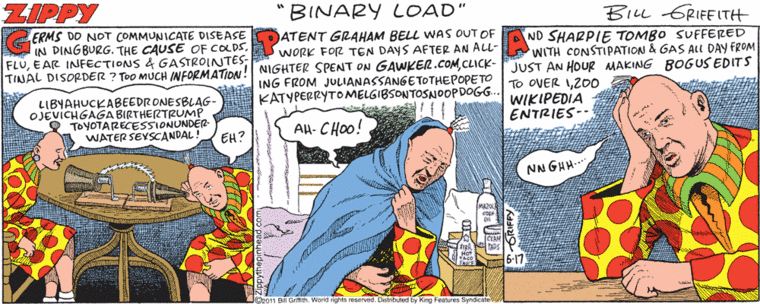
Yesterday’s Zippy has the Dingburgers suffering from infections and other disorders caused by Too Much Information:

(Patent Graham Bell and Sharpie Tombo — the latter combining the names of two brands of pen — are entertaining names.)

Ah, the plague of TMI. As if the news media weren’t enough, there are the social media, blogs, Wikipedia and other sources, …It’s enough to make you sick.