Archive for June, 2011

Sweet daddies

June 17, 2011

From the Undergear people this morning, a Fathers Day offer of free shipping, with this image:

I’ve posted often about Undergear, here, on Language Log, and on my X blog. The company is a source of entertainment in remarkable underwear for men, soft porn (the target audience is gay men), and (if you select wisely) excellent briefs, boxers, and so on.

Though the e-mail that brought this image to me was headed “Who’s Your Daddy?” (which can be read as a double entendre), the Sweet Daddy image takes the high road in approaching Fathers Day for gay men — and avoids hackneyed tie-ins to golf, sports fandom, tools, and war. Suits me, since I admire sweet daddies and enjoy seeing them (as do many other people, male and female, gay and straight; there’s a huge assortment of websites devoted to the subject, including one specifically for photos and videos of Hot Men with Babies).

(more…)

Participant roles of subjects

June 16, 2011

On Language Log, Mark Liberman has returned to the antique (and deeply inadequate) assumptions of school grammar, in a piece on Stanley Fish’s recent booklet “How to Write a Sentence: And How To Read One“:

in his tour of great sentences, there’s almost no syntactic analysis — and neither is there any careful analysis at any other level of linguistic structure. Nor is there any advice to the reader about where or how to learn more about the structure and function of these “little world[s] made cunningly” …

This is probably just as well, because what little linguistic analysis Prof. Fish gives us is full of assumptions from old-fashioned grade-school grammar, about whose inadequacies he’s curiously incurious. If he were writing about about the body, he’d be enthusing about the precarious balance of the four humours; but since he’s writing about syntax, his central assumption — obviously false and curiously unexamined –  is that sentences are all about agents, actions, and (optionally) things acted upon

As a contribution to this discussion, I offer a file I’ve been assembling for some years (for introductory syntax courses) confronting one piece of the Agent-Action View of syntactic organization, in which the building blocks of syntax are identified semantically — as agents, actions, and (optionally) patients (things acted upon) — rather than (correctly) by syntactic category (like NP and V) and syntactic function (like subject, predicator, and (direct) object). This piece is the association between subjects and agents, which is much more complex than in the Agent-Action view: in the real world, agents are sometimes expressed by non-subjects (as in the by-phrases of agentive passives) and subjects very often denote non-agent participants in some situation; concomitantly, the predicators in clauses with non-agentive subjects don’t denote actions (but other sorts of situations).

There’s still some relationship between subjects and agents, but that relationship isn’t identity.

On to the inventory of the participant roles of subjects.

(more…)

Cave painting

June 15, 2011

Today’s Zippy, with several points of linguistic interest:

There’s Lasko, the Dingburg version of Lascaux. And the reversal in Burgdingus. And the rhyming name Ale, Quail & Email Society (what an unlikely assortment of interests!). And the art critics talking entirely in teenspeak (the truncated “I was, like, totally!” is especially nice). And the name Calvert Astroboy, which might be entirely made up or might be a play on a name I don’t recognize (I do have a friend who uses the handle Astroboy; he’s an astronomer). And, finally, the slang punked ‘ripped off’ (in this context; ‘tricked’ or ‘humiliated by being tricked’ in other contexts).

Space aliens

June 15, 2011

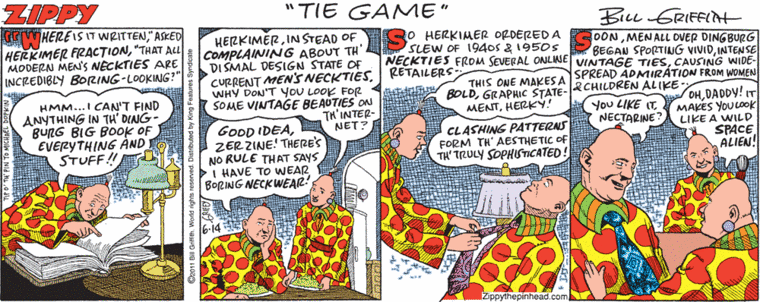
Yesterday’s Zippy:

I have a friend who has in fact assembled quite a collection of vivid vintage ties. But what especially caught my eye in this cartoon was space alien in the last panel.

(more…)

Package vocabulary

June 14, 2011

Just posted on my X blog: “Today’s remarkable underwear”, with more ways of referring to a man’s genitals. In a description of Pulse mesh underwear:

A perfect men’s underwear pick for those who like to show off the goods.

Then in a description of Male Power’s Super Sock:

It’s not a jock (there are no legstraps), it’s not a thong (there is no butt strap), just a waistband and pouch that holds your boys.

And, most indirectly of all, in a description of the Good Devil Suspend Pouch:

A perfect pouch that covers the essential areas and holds everything in place …

(more…)

Sunday punnies

June 12, 2011

#15 from Don Piraro:

The first is a straightforward phrasal overlap portmanteau (see my posting on Boomchickadee, with an inventory of POP postings). The last plays on the very close phonetic relationship of lawn and law ‘n’ (representing law and) — amounting to phonetic identity for some people some of the time.

Mathematician portmanteaus

June 11, 2011

From the NYT in January, a piece about Vi Hart (and her entertaining math doodling videos):

She calls herself a full-time recreational mathemusician, an off-the-beaten-path choice with seemingly limited prospects. And for most of the two years since she graduated from Stony Brook University, life as a recreational mathemusician has indeed been a meager niche pursuit.

It’s the portmanteau mathemusician.

(more…)

Portmanteaus: The Sharp tv ads

June 11, 2011

Alerted by Victor Steinbok, I went to view recent ads for very very big Sharp LCD tvs. These spot ads (easily available on-line) describe the sets as viewmongous, as magnormous, and as spectacularge. The first and last of these are especially satisying portmanteaus phonologically: view + humongous giving viewmongous, spectacular + large giving spectacularge.

(more…)

Product names

June 11, 2011

Letter to the New Yorker, June 13 & 20, from Casey Lambert of Princeton NJ:

[In “Test-Tube Burgers”, May 23, Michael] Specter writes, of lab-grown meat, that “the first word most people blurted out to describe their feelings was ‘Yuck.’ ” But the “yuck factor” derives from the words used to describe the product: “in-vitro meat,” “cloned beef,” and “test-tube burgers.” Clearly what is needed is a new word for cultured protein. If we are able to consume millions of hot dogs (what? dogs?), burgers (misspelled German citizens?), bowls of Grape Nuts (really?), and cans of Spam (don’t even ask); if we can make a multi-million-dollar industry out of Yoplait and Activia; if we can come to love wasabi, sushi, and tandoori, then, surely, we can embrace a novel meat product with a name like Newtein, Newtrient, or Protean.

Well, it’s complex.

(more…)

Inventory of libfix postings

June 11, 2011

(Long promised, but now delivered: an inventory of postings — including a few still in my “to blog on” list — on English libfixes, arranged roughly in the order of their appearance.)

Several postings look at the relationship between portmanteaus and libfixes, and several point out that many libfixes behave very much like elements of compounds rather than ordinary affixes. Several also note that many (though not all) of the libfixes are playful in character.

This is not an inventory of libfixes and things that might be libfixes, but an inventory of ones that have been posted on. Michael Quinion’s affixes site (here) has a number of others not covered here, and there are still more.

(more…)