Archive for April, 2011

Two libfixes sharing a spelling

April 18, 2011

On Nancy Friedman’s Fritinancy blog on April 13, a posting on the libfix -nomics, taking off from the headline “Flawed Tigernomics”, about Tiger Woods’s foundering golf-course business. Friedman remarks that

“-nomics” continues to be the go-to suffix for every trend in search of a pseudo-scientific reason for being.

and goes on to cite a slew of –nomics words (well, -((o)n)omics words) that have sprung from economics over 50-plus years, all having something to do with economics, money, business, or accounting. The publication of Freakonomics in 2005 triggered an avalanche of fresh coinings — Geckonomics, Socialnomics, Spousonomics, Emotionomics, newsonomics, and so on — using the ‘money’ libfix, which is pronounced with /a/ in the penultimate syllable. (Ben Zimmer has a collection of examples here.)

Meanwhile, a separate libfix developed from the model genomics, ‘ the study of organisms in terms of their full DNA sequences, or genomes‘ (from Ben Zimmer’s Word Routes column on the coinage culturomics; Language Log discussion here). There’s even a Wikipedia page on -omics coinages in biology. But culturomics ‘the application of high-throughput data collection and analysis to the study of human culture’ takes the libfix — which is pronounced with /o/ in the penultimate syllable — in a new direction.
Trochee-trochee, Grelling-Nelson

April 17, 2011

Sending copies of an xkcd cartoon on the plague of trochees, especially double trochees (Language Log discussion here), to friends, I reflected, not for the first time, that trochee is indeed a trochee (´ˇ), but so are dactyl and iamb, while anapest is a dactyl (´ˇˇ). Well, there’s no reason to expect that a predicative word (an adjective, or, in this case, noun) should be self-descriptive, but there’s a certain intellectual pleasure in playing with the fit or misfit between different properties of linguistic expressions when the semantics of their use vs. mention is involved.

(more…)

Very dear to me

April 17, 2011

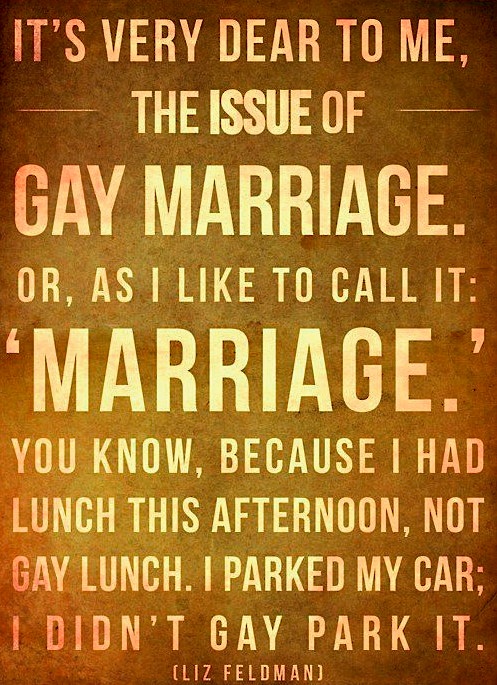
Via Facebook friends, this image of a quote from writer and comedian Liz Feldman:

Feldman’s point, made with humor, is that she wants marriage between people of the same sex to be viewed as simply marriage, using the same term that we use for marriage between people of opposite sexes who happen to be, say, of different races or ethnicities or nationalities or of significantly different ages or of significantly different educational levels, or both over 60, or both under 20, or both of the same status (or different statuses) with respect to divorce or widowhood — all of these being socially significant properties of married couples, but for which we have no ordinary-language terms. That is, Feldman wants to normalize marriage between people of the same sex (as do I, under the heading of “marriage equality”).

But of course there are many people who vehemently resist the normalization of such marriages, and consequently reject unmodified marriage as a term embracing them. (In fact, they seem to massively prefer gay marriage as the relevant term, presumably because it injects sexuality — and by implication, sexual acts — into the vocabulary, while same-sex marriage is neutral in the matter.) So a dispute over the status of relationships in the law plays out in part as contention over vocabulary.

Bulges

April 17, 2011

From brand-name maven Nancy Friedman (a.k.a. Fritinancy) a few days ago, a link to JeanPants from Japan Trend Shop (“Tokyo’s gadget and lifestyle select shop”), pictured here:

There are two obvious selling points here: the bulge and the material, though the perky ad copy focuses on the latter:

(more…)

Wonderful spam

April 16, 2011

In the mail from Chris Ambidge, a 1940s ad for Spam, seen in a color version here:

(This is intransitive get up ‘(a)rise from bed’, of course, not get up ‘become erect’.) The delight of the ad is its enthusiasm for Spam.

(more…)

Back to the ’50s

April 16, 2011

In today’s Zippy, Zerbina is fixated on Allen Ginsberg’s Howl and the recent movie about it (on this blog, here), and she and Zippy consider recapturing the ’50s:

Note the stereotypes of beatnik slang in “Like, gone, baby”.

Libfix fun: -cation

April 15, 2011

From Victor Steinbok ten days ago, the innovation girlcation ‘a vacation with the girls, i.e., with female friends’, following on the widely reported mancation, both of these suggesting a new libfix that started with straightforward portmanteaus (staycation and daycation) involving vacation.

(more…)

Spelling your neologisms

April 14, 2011

Over on Facebook, Michael Thomas posted on my wall with two words he’d invented (claiming that his husband Aric said he had to tell me — I’m the go-to guy on language — about them):

Approxomathmatics: the study of close enough; see ‘government work’

Approxomattox — somewhere around Pennsylvania

I queried the spelling of the first, suggesting approxomathematics (since it preserves the spelling of one contributor to the portmanteau, mathematics), though on reflection I think approximathematics would be even better (since it preserves as much as possible of the other contributor, the adjective approximate).

Mike objected, asking if it was bad to misspell your own neologism, indeed if it was even possible.

(more…)

Rebranding

April 14, 2011

Via Dennis Lewis on Facebook, a link to a Huffington Post piece “Social Conservatives Will Defeat The Gay Agenda By Inventing New Words” (by Jason Linkins, April 11). What’s being proposed is not lexical innovation but a shift in the terms to be used in the domain of homosexuality, substituting other existing terms for those used by gay people (especially the term gay itself)  — a shift referred to as rebranding by some social conservatives.

(more…)

Were the World Mine

April 13, 2011

This weekend: two more viewings of the film Were the World Mine, a gay musical based on Shakespeare’s A Midsummer Night’s Dream and set in a boys’ school. (I got the DVD many months ago, watched it again on Sunday as is, and then once all the way through with the film-makers’ comments.) It’s a teen love story and immensely sweet — very affecting for me.

(more…)