Overheard at Gordon Biersch a few days ago, one man to three others: “Let’s hoist a few brewskis.” (Well, GB is a brew pub.) Notable features: the verb hoist specialized for lifting a glass of something (usually something alcoholic, and especially beer) to drink, and then extended to convey simply ‘drink’ such a thing; brewski used for the count noun beer; the slang or colloquial status of both of these features; the American English character of them; and the association of them, especially brewski, with masculine contexts.
Archive for April, 2011
Hoisting a few brewskis
April 22, 2011Metrical note
April 21, 2011In my recent posting on double trochees and the Grelling-Nelson Paradox, I noted that trochee is a trochee, as are Grelling, Nelson, Arnold, Zwicky, and double. But trochee is prosodically different from the rest, in the same way that robot in the double trochee Robot ninja! is prosodically different from ninja. There are two sets:
trochee-type trochees: robot, iamb, jetpack, wombat, cowboy, bobcat, teenage, …
trophy-type trochees: double, dactyl, ninja, ferret, dentist, pizza, scrapple, turtle, mutant, …
But still for most purposes they all count as metrically equivalent.
Leering sushi
April 21, 2011Just silliness.
Dinner Monday at Three Seasons, random conversation with the staff (Monday is a slow night), during which the server Francisco got on to people who look at the (extensive) menu and then ask for something not on it that they have a yen for, often something wildly unlikely in a place like Three Seasons (fusion Vietnamese, plus a limited sushi menu), like a cheeseburger, mac and cheese, or a chicken salad sandwich. Francisco said that he’d recently been asked if they had special hand rolls, and he had to say no, though he admitted to us that he had no idea what they were. The bartender, the sushi chef, and I explained the concept of te-maki (as opposed to hosomaki, which the restaurant offers under the name sushi rolls, in addition to Vietnamese fresh spring rolls, which are wrapped in rice paper rather than seaweed of Japanese maki). Illustrated:
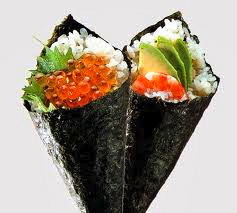
I then entertained the staff by imitating a customer leeringly asking for “special hand rolls” in a wink-wink nudge-nudge voice, complete with facial expressions. Sexually suggestive, instantly “dirty”: evoking hand job, special massage (a common euphemism for sexual massage, sometimes specifically for prostate massage), and the phallic imagery of rolls.
Then I said that I really liked te-maki, and the sushi chef said he actually liked to make them, so he made me two (tuna and salmon), and then on Tuesday two more (yellowtail and a spider roll, with fried soft shell crab). Yum.
Robert Vickrey
April 21, 2011Not long after the death of magic realist painter George Tooker comes the death of another major painter in this school. From the NYT yesterday, by William Grimes: “Robert Vickrey, Magic-Realist Painter, Dies at 84”:
Prices continue to rise
April 20, 2011This morning I puzzled over a report of a “rule” saying that the (intransitive) verb rise can occur only with animate subjects, so that Speed limits rise is incorrect (also Prices rise and The standard of living has risen). I appealed to readers for some insight into this nutty non-rule, adding that I recalled some past discussion of Prices rise, but couldn’t pin it down.
Jan Freeman came to the rescue, exclaiming:
This is the LL post I thought you must mean, but it’s yours! (On “rise” v. “increase”)
Oh my, the pitfalls of memory!
C > M conversion in the popular media
April 20, 2011Neal Whitman sends a link to this Penn Jillette video on his exchange with Grammar Girl Mignon Fogarty about which is the better porn title: “Men Who Crave Big Cocks” or “Men Who Crave Big Cock”.
A nutty non-rule
April 20, 2011From Ben Zimmer, a link to the Wichita Eagle Grammar Monkeys site, with a posting on “Nutty non-rules of grammar”, beginning:
Recently I [Lisa McLendon, who maintains the site] got a voice mail message from a reader saying that the verb “rise” could be used only with animate objects [that is, only with subjects denoting an animate thing], and thus our headline “Speed limit may rise to 75 mph” was incorrect, and it should have said “Speed limit may be raised to 75 mph.” Turning aside the issue of changing a perfectly good active-voice sentence to a wordier passive, I was intrigued, because I’d never run across this “rule” before. After all, bread rises. The sun rises. No one seems to complain about those.
Nucular postings
April 19, 2011Over on Facebook, Kathryn Burlingham asks of the linguists in the crowd:
Have you ever heard anyone say that the proper pronunciation of “nuclear” as nookleear, is in part a way to distinguish the energy from the cell part, which is properly pronounced nookyoolar? A friend dumbfounded me with this explanation recently.
Basket : moose knuckle :: butt : ?
April 19, 2011The gay artist Tom of Finland celebrated
fabulously muscled hyper-masculine guys displaying their broad shoulders, gigantic biceps and pecs, remarkable tight abs, slim masculine waist and hips (so their bodies make giant Vs, with their hard dicks the point of the whole display, and Xs when their legs are spread), erect nips (showing arousal and reinforcing those hard dicks), and crotch bulges.
Truth, memory, and stories
April 18, 2011From Geoffrey O’Brien’s review of Iphigenia in Forest Hills: Anatomy of a Murder Trial by Janet Malcolm, in The New York Review of Books, 4/28/11:
A law court is not a bad vantage point for taking note of folly and charlatanry, but Malcolm does not exempt anyone from bias: “We go through life mishearing and mis-seeing and misunderstanding so that the stories we tell ourselves will add up.” Stories want to resolve themselves despite all obstacles; Malcolm’s peculiar mission, here as elsewhere, is to point out the cost of such resolutions, to zero in on those details that don’t fit the main story and are thus discarded, and in the process to make manifest the unreconcilable gap between an acceptable master narrative—the version that everyone must agree on in order to keep moving forward—and the specific qualities of what actually happens.