Archive for February, 2011

And still they come

February 13, 2011

There seems to be no end to books proposing to fix people’s lives by fixing their “grammar” (in that all-embracing sense of grammar — my slogan is It’s All Grammar — that I frequently complain about), usually incorporating any number of factual errors and fallacious assumptions about language and language use and displaying at best regrettable, at worst harmful, shameful attitudes about linguistic variation and social life. I collect these things, usually trying to get them used, so as not to give financial suppport to the authors or their publishers.

Latest to heave into my view (hat tip from Elizabeth Daingerfield Zwicky) is Grammar Sucks: What to Do to Make Your Writing Much More Better, by Joanne Kimes with Gary Robert Muschla, as discussed in a guest blog on Sociological Images by Josef Fruehwald, a grad student in linguistics at Penn who blogs on language variation and language attitudes (among other things) here.

(more…)

Reptile dysfunction

February 13, 2011

From “Better Drug Ads, Fewer Side Effects”, a NYT op-ed piece by Ian D. Spatz (February 10), on direct-to-consumer drug ads on tv:

Nearly 14 years later [after such ads were allowed], with parents confronting uncomfortable questions from their young children about “reptile dysfunction” and nearly $5 billion a year spent on TV ads for treating everything from toe nail fungus to cancer, critics, the medical community and even the drug companies themselves are wondering if there is any way to put this genie back in its lamp.

Yes, reptile dysfunction, which originated as either a simple mishearing or an eggcornish reshaping of unfamiliar material (erectile, in particular) to something that contains more familiar parts (reptile), or perhaps one on some occasions and the other on others. And, probably, as deliberate word play on still other occasions.

(more…)

SemFest 12!

February 11, 2011

It’s that time of the year, time to gear up for Stanford’s annual Semantics Festival (SemFest), scheduled for March 11 this year. I submitted an abstract, it was accepted this morning, and here it is (just remember this is an abstract, which had to fit on one page, not an actual paper):

Categories and Labels: LGBPPTQQQEIOAAAF2/SGL …

That’s Lesbian, Gay, Bisexual, Pansexual, Polyamorous, Trans (Transgender, Transsexual, Tranny), Queer, Queer-Friendly, Questioning, Eunuchs, Intersex, Other, Asexual, Androgynous, Allies, Friends, 2-Spirited, and Same Gender Loving. The Big Tent in the SIP domain (Sexuality / Sexual Orientation, Gender / Sexual Identity, and Sexual Practices), constructed through an initialism that piles up labels for categories in the domain.

In domains of sociocultural significance – foodstuffs and clothing are two others I’ve looked at – we see several common themes:

(1) There are folk categories and any number of more technical or specialized categorizations,

(1a) each serving some purpose (the categories serve a role in, for instance, welcoming people to Pride events, speaking to them for social-service purposes like AIDS prevention, creating groups for political action or socialization, etc.),

(1b) and each grounded in some set of beliefs and attitudes (in this case, medical, legal, religious, psychological, etc.).

(2) The lines between these are permeable, with categorizations moving back and forth between contexts of use and changing in time.

(3) The categories don’t cover the domain fully and aren’t always mutually exclusive.

(4) Though some of these categories are labeled, in ordinary or (semi)technical language, many taxons (especially the larger taxons, like SIP) are unlabeled.

(5) Ordinary speakers (and, usually, “scientific” or other specialized analysts) have access to the categories only through the labels, and are likely to assume that the labels are the categories (gay “means” so-and-so), to analytic and social confusion.

(6) The categorizations (and accompanying labels, as in the putative basic vocabulary in the initialism above) compete with one another and are often at cross purposes.

(7) The categorizations, especially at the higher levels, may be in dispute: do they represent (socioculturally or psychologically) real groupings?

(8) The labels pick up associations (or connotations) from their contexts of use, at least as individual speakers experience these, and so are promoted or disfavored.

Two cases in point: the story of homosexual (not in the SIP initialism above) and a bit of the story of gay.
Cultural contamination

February 11, 2011

(Not about language, but culture.)

On KQED’s Forum, hosted by Michael Krasny, on Wednesday: “Anthony Tommasini’s Top 10”, an engaging interview with the New York Times music critic about his personal ranking of the top 10 classical music composers in history (Bach came in first, with Beethoven narrowly edging out Mozart in the next two slots). Then came the callers with their comments — among them a woman who went on at some length about the “Ode to Joy” from Beethoven’s Ninth as an intensely moving masterwork.

But then she added that after she read that the “Ode to Joy” was Hitler’s favorite piece of music, the work lost all of its attraction for her.

It had become contaminated by the association with Hitler.

(more…)

The far reaches of analogy

February 11, 2011

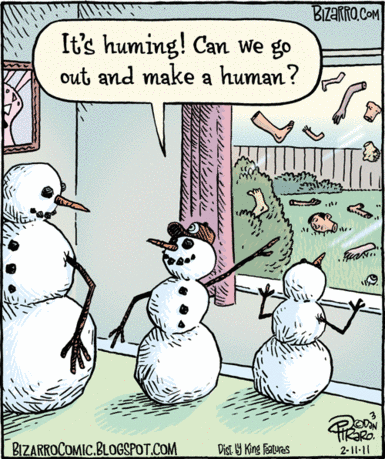
Today’s Bizarro:

Turnabout — rather grisly in this case — is fair play, with huming created on analogy with snowing, using the pairing of human with snowman. (For me, that would give huing rather than huming; but Piraro seems to have treated human as if it were hume-man.)

But human and snowman aren’t really parallel, historically, morphologically, or prosodically, though some people have come to treat the second syllable of human as if it were the noun man — giving rise to a jocular or hyper-serious counterpart huwoman, and a “gender-neutral” substitute huperson.

[Historically, human is based on Latin homo ‘person, human being’, as in Homo sapiens; the m belongs to the stem, not to a formative man. The word has an unaccented final syllable — compare pagan and veteran — while compounds with second element man (like snowman) generally have this element bearing an accent, though a weaker accent than the first element. The accentual facts are, however, complex, because some compounds in -man have lost the accent on the second element — seaman and chairman, for example — and others have variable accent on the second element

Prounced balls

February 10, 2011

In writing to friends about my posting on Harry Baals, I repeatedly wrote

Baals prounced balls

with PROUNCED for PRONOUNCED, an omission error in which I “skip ahead” from the first O in PRONOUNCE to the material following the second (leaving out NO). This particular typo — using typo for inadvertent spelling errors in handwriting as well as typing — has plagued me for years; I have to think carefully about spelling PRONOUNCE.

The effect of skipping ahead is to telescope the spelling of an expression. I’m prone to telescoping, for instance GAY MALE telescoped to GALE (in typing, 11/9/09) and GAY PORN telescoped to GORN (in handwriting, 1/10/11).

Then there’s the case of WITHE for WITH THE, which I reported on on Language Log in 2008.


Scientific metaphors

February 10, 2011

From the NewScientist of January 22, “Farming helps slime mould spores survive” by Bob Holmes:

(more…)

A Swedish basket case

February 10, 2011

Via John Lawler, this February 2 news from Sweden (in The Local: Sweden’s News in English):

Swedish body finds ‘Boxer’-clad
cartoon ‘offensive to men’

(more…)

Fortune cookies go electronic

February 9, 2011

The Mandarin Gourmet, just up the street from my place in Palo Alto, for many years supplied fortune cookies with fortunes from a not very large selection of very traditional fortunes, but a while ago they moved to a much larger and more inventive selection. A few days ago I got this modern marvel:

You have a charming way with words. Send email to a friend.

I know, so 20th century. Now it would be “Text a friend.”


More annals of nouning

February 9, 2011

Although it’s hard to judge these things, my impression is that nonce nouning has become a feature of vernacular speech and writing; for some recent examples, see my discussion of Ryan North’s (of Dinosaur Comics) writing style, here, and of the nouning of horny in Scenes From at Multiverse, here.

Now, in the tv series Supernatural, one of the two main characters asks someone about recent events in town, even strange things, adding:

We’ve had a lot of experience with strange.

(more…)