Archive for February, 2011

Dingburg portmanteau

February 18, 2011

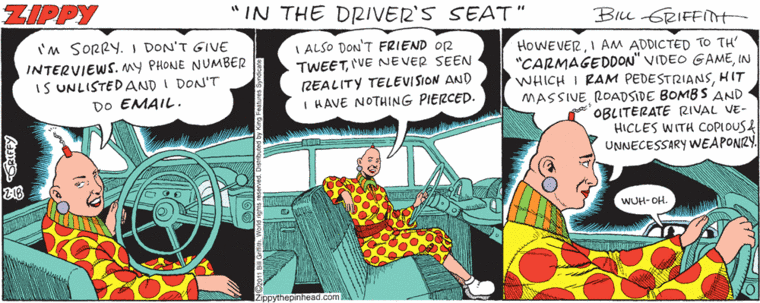
She’s mostly not plugged in, but there’s one video game that suits her:

This is Bill Griffith’s Zippy the Pinhead cartoon, so of course the violent vehicular combat game Carmageddon, with its portmanteau name (compare carchitecture, here), is real, not some fevered fiction of Griffith’s: first released in 1997, now in a series of three, with overall sales of around two million.

Chinese Abbott and Costello

February 18, 2011

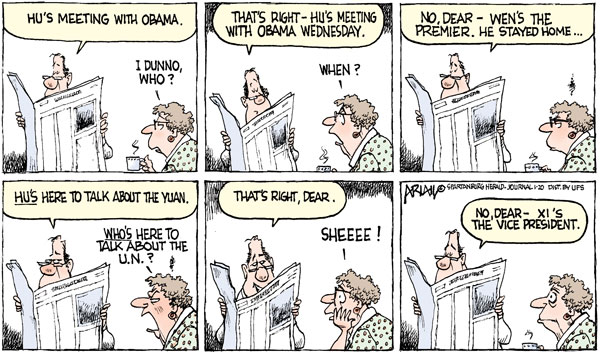
Passed on by Victor Mair, a version of “Who’s on first” (editorial cartoon by Robert Arial):

Compare Mair’s assemblage of puns on yuan on Language Log, here.

Chinese lazy susan

February 17, 2011

In the Bay Area section of the NYT on February 11, Bernice Yeung’s “Lost for Years, a Trove of Chinatown Art Is Tracked Down”:

It’s a modern detective story, set in San Francisco’s atmospheric Chinatown.

It took an out-of-the-blue e-mail and some old-fashioned legwork, but Sue Lee of San Francisco’s Chinese Historical Society of America has solved a mystery that had stumped scholars of Chinese-American art for decades: the case of the missing Jake Lee paintings [depicting Chinese-Americans in a variety of activities].

… The paintings [originally displayed in Kan’s Restaurant, founded by Johnny Kan in 1972] are the focal point of Ms. Lee’s exhibit [on the gallery space at the historical society]. But the show is also an homage to Mr. Kan, who is credited with introducing Cantonese fine dining to Americans, and inventing the restaurant-sized lazy susan.

(more…)

Short shot #58: sunseed

February 17, 2011

Reported by Victor Steinbok on ADS-L: sunseed for sunflower seed, as here:

Argentina is a leading exporter of sunflower oil, and it is seen producing 2.8 million tonnes of sunseeds this season. The birds have a taste for sunseeds and also pick on corn kernels from the cobs, often ruining them.

(Steinbok adds that the story is about damage to sunflower and other crops from flocks of hungry parrots and pigeons.)

Searching on {“sunseed”} pulls up lots of references to Sunseed Farm in Ann Arbor MI (which sells all sorts of things other than sunflower seeds) and some for the Sun Seed Co. (which sells a variety of seeds), but also a few for “black oil sun seed”, that is, black oil sunflower seed.

(Searches pull up some other stuff, for example sunroot and sunchoke, alternative names for the Jerusalem artichoke, also known as earth apple and topinambour. The Jerusalem artichoke is a species (Helianthus tuberosus) of sunflower grown for its edible tubers; Jerusalem in the name is often taken to be a folk-etymologization of Italian girasole ‘turn-sun’.)

Now, how to get from sunflower seed to sunseed (or sun seed)? It could be a matter of truncation, a telescoping of sunflower seed. Or a simple truncation of sunflower. Or it could be the result of a reanalysis in which flower is taken to refer only to the flowers, in which case sun is understood as naming the plant, so that it can then be used, in a kind of back-formation, as an element in a compound with seed.

Brevity is part of the story in any case. And any of these routes would allow free-standing sun to refer to the sunflower plant, as here:

I love sunflowers and plan on growing a lot again this year, but I’ll be pulling any volunteers in the main beds, and the suns will have their own area. Also the residue will go into the long term compost piles that I just heap and let sit for years in the woods.

Just thought I’d pass this on in case any body else plants suns in their beds with other stuff.

BTW, some people commented that they always grow suns with their other stuff and haven’t noticed anything detrimental. [The reference is to the reputed growth-suppressing effects of all parts of the sunflower plant.]
 

Power postcard

February 16, 2011

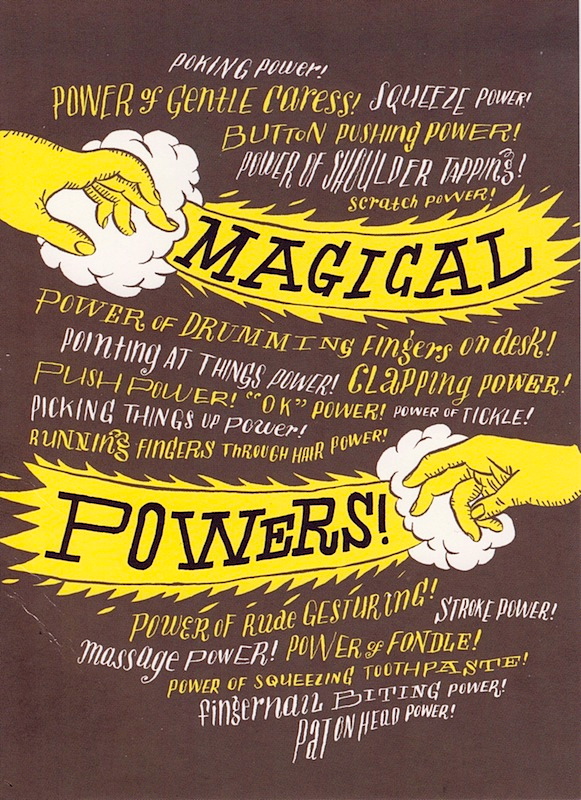
From Ray Fenwick‘s Hi: 30 Postcards, this powerful item:

What first caught my eye were the nounings in power of tickle and power of fondle. But there are also what might be V + N compounds, although some or all of them could be N + N, given a pervasive V/N ambiguity in English: squeeze power, scratch powerpush power, stroke power, massage power. (On some V + N compounds, see this posting on cry face and its relatives and this mention of fish house, wash house, and the like.)

Otherwise, the power expressions are either compounds with nominal first elements (poking power, button pushing power), many of them with phrasal first elements (picking things up power, running fingers through hair power), or else phrases with postnominal PPs in of (power of drumming fingers on desk, power of rude gesturing, power of squeezing toothpaste). These are the two most common ways of combining a nominal dependent with a noun head in English.

TIA or whatever

February 16, 2011

Over on Language Log, Mark Liberman reported on (in a posting entitled “Heavy burtation”)

one of the most widely discussed aspects of the Grammy Awards ceremony … the painful-to-watch on-camera aphasic episode of Serene Branson, a reporter for CBS news

It’s distressing indeed, and some of the responses to the story are even more distressing, amounting to infantile mockery of the sort directed at crips and retards. (Even on Language Log. The LLoggers have now spent some time deleting the worst of the dreck, though this means checking the comments every few hours.)

It’s not clear what the ultimate cause of Branson’s on-camera aphasic episode might have been, but it certainly looks like the immediate cause is a disturbance in blood flow to parts of the brain, which itself could result from any number of sources: a mini-stroke (either ischemic or hemorrhagic) or other insult producing temporary aphasia, or (very likely) some event leading to a transient ischemic attack (TIA) with temporary aphasia as one of its symptoms. These things can be very hard to diagnose, and the symptoms will be different depending on where in the brain the blood flow is disturbed.

(more…)

A little more on optative if … only

February 16, 2011

In my brief posting on optative if … only, in examples like

If only you had asked, I would have explained.
If you only had asked, …
If you had only asked, …

I focused on the truncated (protasis-only) versions of such examples and how they have become conventionalized as free-standing optatives. But I merely asserted that all the examples, truncated or not, were in fact optatives, distinct from ordinary conditionals with only in them. That assertion — which amounts to a claim that these sentences have a special sense or use of only in them (as distinguished in the OED) — could use some defense.

(more…)

U and I

February 15, 2011

From e-mail from me to Nicholson Baker back in November:

… my John Updike story.

When I graduated from high school in 1958 (and was going on to Princeton), I went looking for a job, and tried the Reading Eagle newspaper (in Reading PA), since I’d been a hot high school newspaper kid. Turns out they had a copyboy position open and sent me around to interview for it.

I was interviewed by every fuckin senior editor, at some length. Then got the job, and quickly was shifted to being a reporter (a “floater”, as in Calvin Trillin’s comic novel of the same name). Eventually I asked one of the editors why everybody had interviewed me and was told that they’d passed me on from one to another because I struck them all as being so much like John Updike, who’d been their copyboy when he was an undergrad at Harvard.

So in a way John Updike got me my first job. (Updike grew up in Shillington, a couple of miles away from where I grew up, in West Lawn and Wyomissing.)

(Did write Updike about this, but of course he didn’t answer.)

Baker and I were exchanging mail (and talking on the phone) about which as a restrictive relativizer. So why was I telling him my John Updike story?

Because Baker is the author of the remarkable U and I, described back in November in Wikipedia this way:

U and I: A True Story (1991) is a non-fiction study of how a reader engages with an author’s work: partly an appreciation of John Updike, and partly a kind of self-exploration. Rather than giving a traditional literary analysis, Baker begins the book by stating that he will read no more Updike than he already has up to that point. All of the Updike quotations used are presented as coming from memory alone, and many are inaccurate, with correct versions and Baker’s (later) commentary on the inaccuracy given in brackets.

From the publisher’s copy:

Baker has constructed a remarkable edifice that is at once a tribute to Updike and a disarmingly, often hilariously frank self-examination — a work that lays bare both the pettiest and the most exalted transactions between writers and their readers.


Rhymes

February 15, 2011

Report from Rick Porter here:

Grammys 2011: Cee Lo Green, his puppets and Gwyneth Paltrow steal the show

(more…)

Moments of joy

February 14, 2011

Yesterday, my iTunes, on random selection, brought me variation 25 of Brahms’s Variations and Fugue on a Theme by Handel, as performed by Emanuel Ax: 35 seconds of what I think of as unhinged joy (I have several playlists of music of joy, with this Brahms variation in the first). It made my morning; I went back and played the whole Brahms set, in two versions (by Ax and by András Schiff).

This was day 2 of my beginning to come out of two afflictions, a long-standing bronchitis that got quite nasty about ten days ago and banged up fingers (the two fingers that were already damaged), which were badly bruised but not broken (though they had to be velcro’d to each other to make typing possible).

Day 1, Saturday, had a lot of joy in it too, supplied by Gilbert & Sullivan.

(more…)