Two volumes of bookish cultural history that I’ve been reading: Willis Goth Regier’s Quotology (Univ. of Nebraska Press, 2010), about quotations, and Anthony Grafton’s The Footnote: A Curious History (Harvard Univ. Press, 1997), about, obviously, footnotes. Both packed with fascinating detail, though their style and audiences are rather different.
Archive for 2011
Quotes and footnotes
January 7, 2011Pancake Circus
January 7, 2011A Zippy about Pancake Circus:

But: yes, Nestor, there is a Pancake Circus. In Sacramento CA; photo by Tom Hulse here:

From a Yelp review:
Pancake Circus isn’t a place you visit for the food. It is about the ambience, which is something like a cross between a Tom Waits fever-dream, and a senior-home casino trip gone wrong.
It’s unintentionally ironic, and a wee bit creepy. But, simultaneously, it’s sentimental and authentic in the best possible ways. The waitresses call the regulars by name, and know their orders by heart.
Griffy and Zippy’s kind of place. And it’s a circus of sorts.
Pancake Circus is a N+N compound with the head N, circus, understood metaphorically, as in a circus of pancakes ‘(a place supplying) a great number or variety of pancakes’.
A famous pinhead
January 7, 2011Recently arrived: a dvd of Tod Browning’s Freaks (1932), now a cult horror classic (which I’d previously seen on tv as a late-night movie). Cover art:
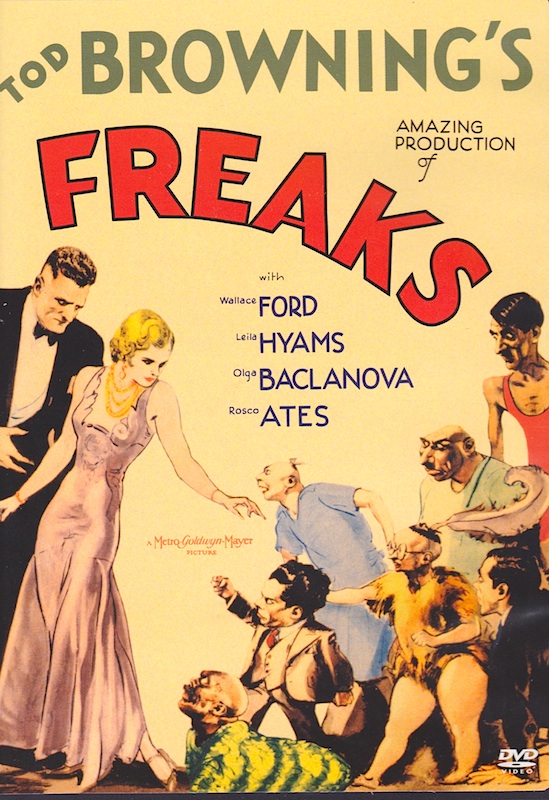
From the Wikipedia page on the movie:
Director Browning took the exceptional step of casting real people with deformities as the eponymous sideshow “freaks,” rather than using costumes and makeup.
… In the film, the physically deformed “freaks” are inherently trusting and honorable people, while the real monsters are two of the “normal” members of the circus who conspire to murder one of the performers to obtain his large inheritance.
And the freaks exact their revenge.
Among the freaks is a microcephalic called Schlitzie, in the center in the cover art, and in a photo here:

Schlitzie was possibly born Simon Metz, in the 1890s or early 1900s, and died (then under the name Schlitzie Surtees) in 1971. His parents hid him from the world in shame until they could sell him to a traveling sideshow, and he spent most of his life in sideshows, circuses, funhouses, and carnivals, exhibited in a muumuu and presented as a female (or left androgynous), and billed variously as a Pinhead, The Missing Link, the Last of the Aztecs, the Monkey Girl, or What Is It? In Freaks, Schlitzie and two other microcephalics are referred to as pinheads. (The connection to Zippy the Pinhead is pretty clear.)
Schlitzie’s complex life story is summarized in his Wikipedia entry. Child-like and affectionate (sometimes described as a charming three-year-old), he found a home for himself in the circus.
Pseudonyms 2: Samuel Steward
January 6, 2011Continuing the pseudonyms theme, I turn to the remarkable character Samuel Steward, the subject of Secret Historian: The Life and Times of Samuel Steward, Professor, Tattoo Artist, and Sexual Renegade by Justin Spring (Farrar, Straus and Giroux, 2010), which was nominated for a National Book Award this year (but was aced out by Patti Smith’s touching Just Kids).
Back on August 26, the NYT Arts section had a piece (“Sexual Outlaw on the Gay Frontier” by Patricia Cohen) about the book and the man. The section on his pseudonyms:
The novelist and professor at a Roman Catholic university [DePaul] who was born in 1909 into an austere and puritanical Methodist household in Ohio was Samuel M. Steward. But as the author of gay pulp fiction, he went by Phil Andros and a half-dozen other pseudonyms; Hells Angels in Oakland, Calif., who used him as their official tattoo artist, called him Doc Sparrow; readers of his articles in underground newspapers and magazines knew him as Ward Stames. To a close circle of artistic friends like [Thornton] Wilder, [artist Paul] Cadmus, Gertrude Stein, Alice B. Toklas, Christopher Isherwood, the photographer George Platt Lynes and others, he was simply Sammy.
Spring’s book lists (p. x) some of the pseudonyms Steward published under: Donald Bishop, Philip Cave, John McAndrews, Phil Sparrow, Philip Sparrow, Ward Stames, D.O.C., Ted Kramer, Biff Thomas, as well as Phil Andros.
As someone who had sex with an enormous number of men (some of them very famous) and kept records of his encounters, he was a valued source of data for Alfred C. Kinsey’s Sexual Behavior in the Human Male (1948) (a book from which I learned an enormous amount about sex as a kid, starting around age 9; astonishingly, it was available on the shelves of the Reading PA public library and wasn’t stolen or defaced).
I have four Phil Andros books: $tud (1966), Below the Belt (1982), Different Strokes (1984), Shuttlecock (1992). Literate porn with a male hustler as its central character. (There are several more available as used books, but at exorbitant prices: My Brother, My Self; Greek Ways; Roman Conquests; Boys in Blue; The Joy Spot.)
Steward edited the letters from Gertrude Stein and Alice B. Toklas to him and combined them with a long memoir, with photographs, in Dear Sammy (St. Martin’s, 1977).
And now we have An Obscene Diary: The Visual World of Sam Steward (edited by Justin Spring, with extensive notes: Antinous Press & Elysium Press, 2010), a great big book of drawings (almost all sexual, many pornographic) and sexual photographs of men (some of them showing Steward having sex with them), plus some cards from the detailed records he kept. There’s even a photo of “the mock reliquary containing a lock of pubic hair Steward had kept after his 1926 sexual encounter with the film star Rudolf Valentino” (page number unknown; the pages are unnumbered).
Pseudonyms
January 6, 2011Back in July on Language Log, Victor Mair posted on Sun Yat-sen, saying among other things:
Like most Chinese with any pretensions to cultural dignity, Sun Yat-sen has many names (the renowned 20th-century author Lu Xun had over a hundred). His real (genealogical) name was Sūn Démíng 孫德明 (Sun Virtue-Bright). Sun Yat-sen, the name by which he is best known in English, is actually derived from the Cantonese pronunciation of one of his pseudonyms, 逸仙 (Leisurely Immortal; pronounced Yìxiān in Modern Standard Mandarin). Most ironically, the name by which he is best known in China, Zhōngshān 中山 (Middle Mountain) is based on his Japanese name, Nakayama Shō 中山樵 (Woodcutter Nakayama).
As a person with many names — as I noted in a November posting, I post under my real name, but for many years signed postings to soc.motss with a large collection of pseudonyms — I am touched with the reference to cultural dignity, though I can’t say that my pseudonyms are at all dignified.
Fired for something
January 6, 2011From Yahoo! Sports blogs on January 4 (hat tip from Chris Vinyl):
ESPN fires announcer for calling female colleague ‘sweet baby’
By Chris Chase
Falsely masculine names
January 5, 2011More from David Rakoff’s Half Empty:
At eight years old, in the Canadian Rockies and faced with the prospect of an enclosed gondola that traveled up to the summit of a mountain, I wept in fear, as I was often wont to do, even as I understood myself to be in surroundings of unconscionable majesty and loveliness; magnificent peaks rising through the pine-scented air, with adorable, nut brown chipmunks scampering about. After what must have been a trying interval of patient parental psyching up, I finally marshaled myself and got on. In the snack bar at the top, tears all dried, my father made me a medal in one of those machines that presses letters into a metal disk–part sheriff’s star, part one of those plastic cogs one used to put over the central post in a turntable to play a 45. DAVE THE BRAVE it read. Everything about it was counterfeit, from the rhyming slogan’s required shortening of my name into the falsely masculine Dave, to the lightness of the cheap, soft aluminum, too easily impressed–more thumbprint cookie than Vulcan-struck ingot.
My focus is on Rakoff’s judgment that the nickname Dave is falsely masculine.
Short shot #56: a ridicumanteau
January 5, 2011John Lighter reports on ADS-L on the innovation RIDICULIST (actually RidicuList, often reported as Ridiculist) for “a series of silly,
publicity-grabbing news stories” on CNN (specifically on Anderson Cooper 360) and nominates the portmanteau for the ADS Word of the Year for 2011 (as we approach the voting on WOTY 2010). Cindy McCain, Charlie Sheen, the women of The View, Brian Sodergren’s National Opt-Out Day, and more.
Then there’s a multiplayer chat game:
Ridiculist is a team trivia game hosted by a bot named Ribot. First written in 1994 as Outburst, the game changed to Chaos and then to Ridiculist when implemented for Talk City. (link)