Archive for 2011

Today’s headline

January 15, 2011

Not actually a crash blossom, but the headline did give me a moment of puzzlement. In today’s (Palo Alto) Daily News:

Eastside’s press does in Castilleja

Some of the puzzlement is cleared up by noting that the story appeared in the sports section of the paper, and that it was about a (women’s) basketball game between two local prep schools, Eastside and Castilleja. That tells us that press refers to a style or strategy of play in basketball, the full-court press. Context is crucial.

Then we’re left with does in, which could have the noun form does, plural of doe, in it, but that’s really unlikely. So we’ve got the verb form does, 3sg pres of do. The final decision is between the parsing

[ does ] [ in Castilleja ]

and

[ does in ] [ Castilleja ].

I went initially for the first, but realizing that didn’t make sense, finally settled on the (intended) reading with a form of the verbal idiom do in ‘kill, conquer’.

Sports fans, especially local ones, probably had not a moment of indecision in reading the headline.
What’s the word for this?

January 15, 2011

What do you call a man who identifies himself as straight but nevertheless has sex with other men? Well, it turns out there are several different cases.

(more…)

cry face

January 14, 2011

From Matt Adams on Facebook 12/26/10:

Why can’t I resist watching the last 20 minutes of sad movies? Damn you Family Stone. Now I’m off to work with total cry face!

Huge number of raw ghits for cry face. And there are images, lots of them.

(more…)

(non)federal victims

January 13, 2011

From the  January 12 NYT story “Legal Strategy Could Hinge on Mental Ills” (on the shootings in Tucson) by Benjamin Weiser:

While the federal government has charged Mr. Loughner in the killings of two federal employees — Judge John M. Roll, the chief federal judge for Arizona, and Gabriel Zimmerman, an aide to Representative Gabrielle Giffords — the Pima County attorney, Barbara LaWall, has said she would “pursue charges on behalf on behalf of the nonfederal victims.”

… The federal complaint against Mr. Loughner charges him with the murders of Judge Roll and Mr. Zimmerman, along with the attempted murders of Ms. Giffords … and of two of her staff members, Pamela Simon and Ronald Barber …  [giving the full list of federal victims]

Ah, (non)federal victims, fine examples of non-predicating modification (cf. cosmetic disease, here): it’s not that some victims are federal and some nonfederal — what would it mean to say that a person is, or is not, federal? — but that some are employees of the federal government (federal government is itself an instance of non-predicating modification) and some are not. Note further that the scope of the negative prefix non- is over the whole composite federal victims, not just over federal, so that we have one type of “bracketing paradox” (for another type, see black historian ‘scholar of black history’, here); syntactically, morphologically, and phonologically, nonfederal victims is

[ [ non- ] [ federal ] ] [ victims ]

but semantically, it’s

[ non- ] [ [ federal ] [ victims ] ]

(To appreciate that the first bracketing above is the right one for syntactic purposes, note the “reduced coordination” in both nonfederal and federal victims, where nonfederal serves as a syntactic constituent.)

Editor vs. writer

January 12, 2011

In the January 2011 New Yorker, a “Wayward Press” piece by Peter Maass — “The Toppling: How the media inflated a minor moment in a long war”, about the press accounts of the toppling of the Saddam Hussein statue in Baghdad’s Firdos Square in the early days of the war in Iraq — with this arresting passage:

Robert Collier, a San Francisco Chronicle reporter, filed a dispatch that noted a small number of Iraqis at Firdos, many of whom were not enthusiastic. When he woke up the next day, he found that his editors had recast the story. The published version said that “a jubilant crowd roared its approval” as onlookers shouted, “We are free! Thank you, President Bush!” According to Collier, the original version was considerably more tempered. “That was the one case in my time in Iraq when I can clearly say there was editorial interference in my work,” he said recently. “They threw in a lot of triumphalism. I was told by my editor that I had screwed up and had not seen the importance of the historical event. They took out quite a few of my qualifiers.”

(more…)

More hucking

January 10, 2011

In my previous posting on the verb huck and the compound noun huckfest, I noted their use in a variety of sport and stunt contexts and suggested the obvious connection to fuck. But then it occurred to me that huck might have had an independent origin and was later recruited for use as a euphemism.

(more…)

Horses

January 10, 2011

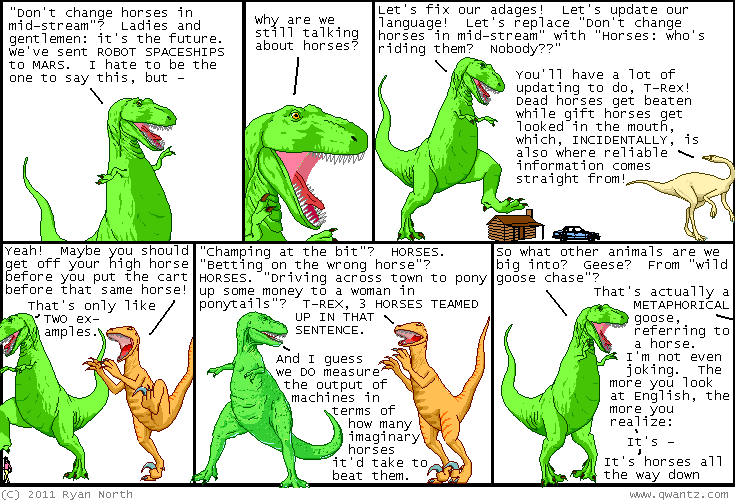
Today’s Dinosaur Comics, horsing around:

Bruce Webster pointed me to this, saying that “It’s horses all the way down” was already (early in the morning) the phrase of the day for him.

But what happened to the turtles?

twiblings

January 9, 2011

In the NYT Magazine on January 2, Melanie Thernstrom’s “My Futuristic Insta-family”, about third-party reproduction in a particularly complex form. Thernstrom, unable to produce viable eggs and liable to serious complications if she attempted to carry a donated egg, investigated surrogacy, egg donors, and carriers. She and her husband both wanted two children, so in the end they opted for finding a single donor and two carriers; the donor’s eggs were fertilized (with her husband’s sperm) at the same time, and then fertilized eggs were implanted, again at the same time, in the donors. The resulting babies, a girl and a boy, are essentially the same age.

While it’s not too hard to describe the situation, there are no brief expressions to refer to most of the roles and relationships involved. There’s only one man in the situation, but four women. And what of the children, who are genetically siblings (with the same source of genetic material on both the male and female sides), and in fact resemble twins?

(more…)

Hucking at huckfests

January 8, 2011

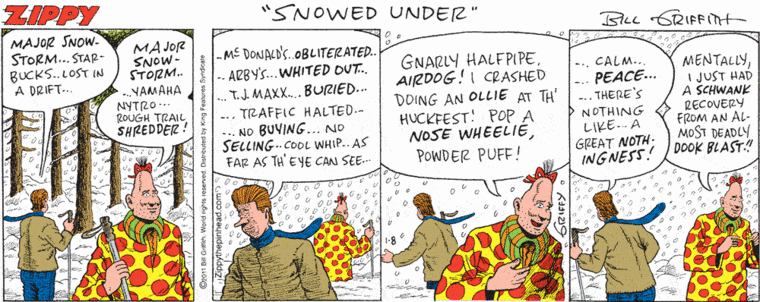
Today’s Zippy is adrift in snow and youth sports slang:

I won’t try to gloss all the slang and sport-specific terms in the last two panels, but instead focus on just one, huckfest, a term used for demonstrations (often in competitions) of daring and skill, especially in stunts and tricks involving going airborne or going over a drop-off. In the world of snow sports, it’s applied to skiing, snowboarding, and snowcatting/snowmobiling, but it’s also applied to sandboarding, skateboarding, mountain biking, kayaking, and similar events with trucks (in the sand) and remote-controlled airplanes.

There’s even the magazine Huck, “a bi-monthly lifestyle magazine rooted in surf, skate and snowboarding”, published in English, German, and French, and distributed internationally. (Note the nice “reduced coordination” in surf, skate and sandboarding, going “inside” compounds.) And a Go Huck Yourself website, which provides a gloss:

Huck (hŭk): verb. To throw, to toss; in cycling, kayaking, snowboarding, and similar sports, to ride over a drop-off. See also: sending it, try it with more speed.

(Urban Dictionary has related definitions, but with less precision.) It’s easy to find lots of occurrences of huck used as a euphemistic replacement for fuck, and the name of the blog (suggesting go fuck yourself) and the term huckfest (suggesting fuckfest) point to fuck as the origin of huck. Perhaps related to the idiom fuck around, though huckers are in fact quite serious about their play.

Hucking seems to be very heavily an activity for dudes — and except for the truck events and the remote-controlled airplane events, mostly dudes in their teens. So the racy associations of huck fit right into this social world.


Zippy and Schlitzie

January 8, 2011

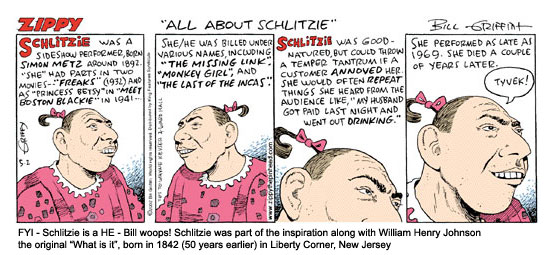
Following up on my posting about the pinhead (microcephalic) Schlitzie in the film Freaks, Tim Wilson noted on Facebook that he thought that Bill Griffith had done a cartoon based on the wedding feast scene in the movie (with the memorable lines “One of us! One of us!” and “Gobble gobble gobble” in it). I haven’t found it yet, but I did find a Zippy where Griffith makes an explicit connection to Schlitzie, and to a 19th century microcephalic Zip:

Tyvek is a brand name for flashspun polyethylene material. I’m not sure what it’s doing in this cartoon.