Archive for August, 2010

Data points: distant compounds 8/3/10

August 3, 2010

They’re all over the place. From today’s NYT, “But What Did You Do for Me Today, Developers Ask Brokers” (by Christine Haughney):

Ms. [Carrie] Chiang [of the Corcoran Group] specializes in guiding wealthy buyers through the glamorous and mundane aspects of purchasing eight-digit homes with indoor swimming pools and 1,000-bottle wine cellars.

It’s eight-digit homes ‘homes with eight-digit prices’ that caught my eye. It’s one step removed from eight-digit prices ‘prices that are eight-digit figures’ (and depends on knowing what it means for a home to have a price on it), which is still not as directly interpretable as eight-digit figure/number ‘figure/number with eight digits in it’ (though that still depends on choosing the reading ‘numeral’ for number and knowing that the figures in question are denumerated in U.S. dollars).

Eight-digit figure/number is probably to be classified as an ordinary (Type O) N+N compound, in which the semantic relationship between the second (head) N and the first (modifier) N is one from a small set of conventionalized relationships (composition, in this case), so that the compound is (relatively) easily interpreted; see the brief discussion of Goldilocks number here.

But eight-digit homes is two steps removed from this, well out into distant (Type X, X for extraordinary or exceptional) territory. Imagine trying to explain this to a child, even one who can cope with things like $34,000,000 as an expression of price.

Arnold Zwicky’s Blog X

August 2, 2010

… now open for business. This blog is open to the public, and accepts comments, but is available only to people who click through on the X-rated question, at the beginning.

The first posting is a replay of my essays here on some XXX-rated collages from 2005, but this time with the collages, all five of them:

8/2/10: Five from 2005: XXX-rated collages (link)

The collages look impossibly squinchy; but click on them once to get an enlargement, a second time to get a further enlargement, which for these images is probably the one you want.

Who or which?

August 2, 2010

From the Lousy Linguist this morning:

… I stumbled across what appears to be a legitimate, well-meaning, but perhaps somewhat misguided research project: The who/which project. From the project web page:

(more…)

Guytalk

August 2, 2010

Teenspeak and genderspeak are perennial topics here and on Language Log, especially as they are represented in cartoons — see, for example, “Dudetalk in the Arctic” (here) and “Teenspeak, genderspeak” (here). But mostly we talk about the linguistic features of generationlects and genderlects. Of course, the content, or subject matter, of speech is equally of interest, and there are genuine differences between groups in what they tend to talk about — what interests and concerns them — as well as heavy stereotypes about such things.

Which brings us to today’s Zits, where the teentalk and guytalk stereotypes about content come together in another one of those little mother-son chats:

On exhibit is the stereotypical adolescent (and adult) male interest in the extreme, especially in activities that are disgusting, humiliating, or dangerous (but challenging). And the stereotypical adolescent (and adult) female interest in relationships and clothing. There’s some basis for the stereotypes in reality, of course.

Who is this message intended for?

August 2, 2010

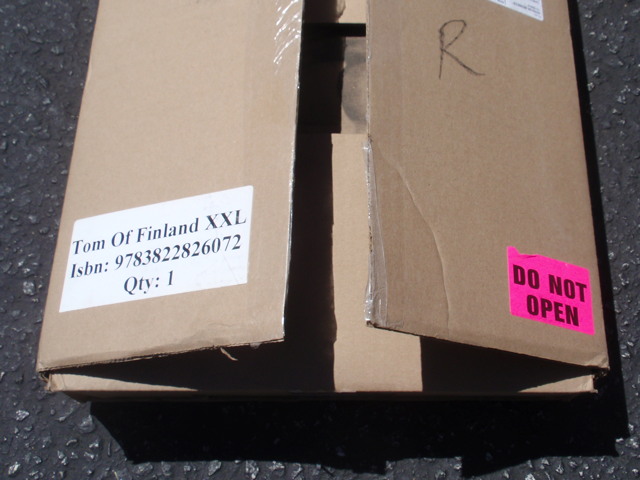
It came a few days ago, a great big heavy box, with a sticker shrieking (in hot pink, such a gay color) DO NOT OPEN:

Here’s a puzzle: how can I get my book, without opening the box?

(more…)

Data points: distant compounds 8/2/10

August 2, 2010

The story “Prime Number” on NPR’s On the Media July 30:

Numbers justify fear. 50,000 abducted children, for example, or 50,000 predators prowling for kids online. That last figure was once touted by the NBC show “Dateline.” But where did it come from? As this piece from 2006 [mp3 on the site] points out, 50,000 is something of a Goldilocks number in the media – not too big and not too small, but, for scaring the public, just right. (link)

(Hat tip to Elaine Meyer in the August 1 e-mail newsletter University South News (Palo Alto CA).)

The point I picked up on is the N + N compound Goldilocks number (which doesn’t seem to have come up here, on Language Log, or on ADS-L) — a “distant compound” (see discussion of hurricane money here in January): to understand the relationship between the second N (the head) and the first (the modifier), you just have to know the story (in this case, the fairy tale of Goldilocks and the Three Bears); otherwise, the compound is inscrutable.

(more…)

Apology in order?

August 1, 2010

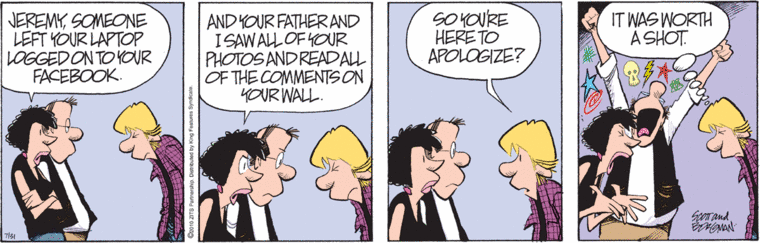
A cartoon to say goodbye to the weekend, from Zits:

This is a stock scene from the parent-child drama: parents examine (by whatever route) things the child intended to keep private from them, and they are distressed, enraged, etc.; the child is distressed, enraged, etc. at this invasion of privacy (Jeremy’s apparent contrition is unusual).

It used to be diaries, letters, face-to-face conversations, and phone calls, but now it’s electronic communications of new sorts, including social media where the expectation of privacy can be much reduced. Still, looking on someone’s computer is like looking at their diary, so Jeremy has some justification for hoping for an apology.

impertinent

August 1, 2010

It’s charming, though not conducive to speedy reading, to come across an older, semantically more transparent, use of a word that you’ve encountered only in its current idiomatic sense. So it was this morning with this passage from the NYT Week in Review, “Is It Hot in Here? Must Be Global Warming.” (by Tom Zeller Jr.):

For Eric J. Johnson, the director of the Center for Decision Sciences at Columbia Business School and a co-author of the study [on the “correlation between a participant’s stance on global warming and how he perceived the outdoor temperature” at the moment], the findings highlight the pitfalls of policymaking by poll, gived that opinions on such a complex issue appear susceptible to highly impertinent data.

That’s impertinent ‘not pertinent, not germane’.

(more…)

The obscenicons vs. the grawlixes

August 1, 2010

Comment from “Nosey” on my “Country obscenicons” posting:

August 1, 2010
While “obscenicons” is also correct, the more-widely-used term for these is “grawlixes” (which also happens to be my favorite child-friendly profanity).

Obscenicon is a portmanteau of obscenity and icon ‘symbol’, introduced by Ben Zimmer in 2006 in “Obscenicons in the workplace” (here) as an improvement on cursing character. It was invented as a technical term in linguistics — well, that tiny part of linguistics that concerns itself with devices for taboo avoidance in print.

“Nosey” notes, correctly, that uses of grawlix — a light-hearted technical term (apparently a “blurb word”, a word — like blurb — entirely invented, rather than built on existing words) in cartoonists’ jargon — exceed (by several orders of magnitude, in fact) uses of obscenicon. “Nosey” allows for obscenicon as a correct usage, but by citing the difference in frequency of use, hints that grawlix is more correct and gently suggests implicitly that it would have been better for me to use grawlix.

I’ve taken this tour before, a couple of years ago, and while I have nothing against the grawlix route, I still prefer to go the obscenicon way. (more…)

Zippylicious names

August 1, 2010

Today’s Zippy tells the tale of Dingburg gangland kingpin Jerry Artarama, his right-hand man Dougie Shlink, and four of their underlings:

Zippy has an intense taste for names (of people, places, whatever) that he finds funny, and Bill Griffith indulges his taste by finding Zippylicious real names. This time the flanking names, Jerry Artarama and Dougie Shlink, look to me like variants of names — Jerry’s Artarama, arts and crafts supplies stores in many locations, for instance Raleigh NC; and jazz musician Doug Schlink — but the other four are straightforwardly names of real people in the film industry, so there’s definitely a hidden theme here:

Dewey Starkey, assistant director in films;
Maurice Tombragel, film writer;
Bronislaw Kaper, film composer;
Irving Gertz, film composer.

(The -arama of Artarama is a variant of the “combining form” -(o)rama, connoting a display or spectacle, but here used like the combining form -(e)teria, used originally in names of self-service establishments but then extended to specialty stores of all sorts. Both combining forms have gotten attention on Language Log and this blog, and both are favorites of Zippy.)

There is, of course, the question of what makes certain names “funny” to certain people (please note: to certain people). All four of the first names of the film guys above strike some people as risible — Dewey probably because of Donald Duck’s nephews Huey, Louie, and Dewey; Irving because it’s stereotypically Jewish (to some people), Maurice because it strikes some Americans as prissy British, Bronislaw because it’s so “foreign” — and Dougie no doubt recalls the tv character Doogie Houser, M.D., and anyway men’s nicknames in -ie sound childish and/or feminine. Phonology no doubt plays a role in some of these judgments, and in the judgment that the last names of all six of these guys are funny on their own.

I am the bearer of a name that strikes many people as intrinsically funny, or stupid, or unpleasant, or just weird, with its stereotypically Jewish or German first name (and the association with the nebbishy Arnold Stang) and its hard-to-pronounce Eastern-European-sounding last name. I’ve had a guy laugh in my face when I told him my name — “Nobody’s name is Arnold Zwicky!” — and, though that was probably the liquor talking, it was pretty clearly the expression of his heartfelt feelings. Things are much better in Switzerland, of course. (The nuts come, like Charley’s aunt, from Brazil, the Zwickys come from Switzerland.)

Curse you, Bill Griffith, with your whitebread American name!