Archive for August, 2010

DWM

August 7, 2010

A Zits for the weekend, on adolescent males and the language used to talk about them:

The initialism DWM traces back to DWI, for the legal term Driving While Intoxicated (compare DUI for Driving Under the Influence), surely mediated by DWB (Driving While Black-or-Brown), which is a (somewhat bitter) play on DWI.

The Tom of Finland action figure

August 6, 2010

Although it’s called a doll on the Amazon site, the Tom of Finland Foundation thinks it’s an action figure. But that’s the extent to which the posting I’m working on, a follow-up to the one here (with a photo), involves language; now that I have my X blog, I’ll continue the posting there, and I’ll give the link when the posting is finished.

Gay flags

August 6, 2010

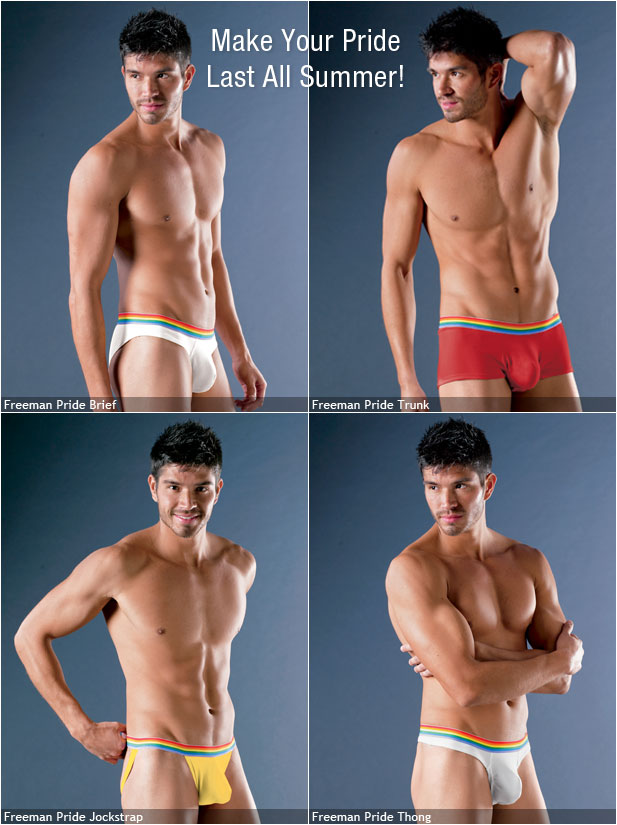
Today’s mail brought me an ad for some Gay Pride underwear, specifically the FreeMen (or Freemen or Freeman, depending on who you read) brand:

(Click on the image to embiggen.)

(more…)

Zippy taken over by Valley Girl

August 6, 2010

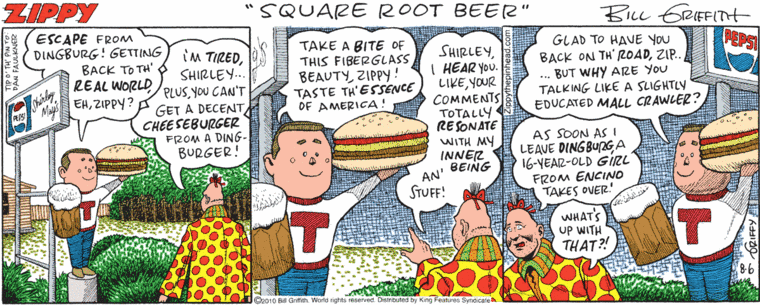
Gender, generation, class, and region stereotypes come together in the Valley Girl figure — SoCal upper-middle-class teenage girl — that we’ve written about several times on Language Log and this blog. Now she’s gotten to Zippy:

As usual, the locale of a Zippy is taken from real life: Shirley May’s Restaurant-Big Boy in Albany (or, if you want to get really local, Crabtree) OR (photo here). Shirley’s breakfasts get good reviews.

I like the conceit of having Zippy address Big Boy as Shirley.

And then there’s the strip’s title, “Square Root Beer”, a phrasal overlap portmanteau.

Zippy physics

August 5, 2010

I’m not sure how much of this is about language, in particular names, but …

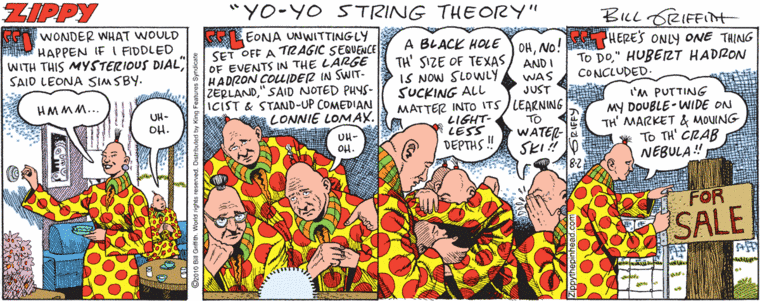
Here’s a recent Zippy with three Dingburgers sort of talking about theoretical physics: Leona Simsby, Lonnie Lomax, and Hubert Hadron.

Knowing Bill Griffith’s penchant for finding real people with names from some common domain (see here), especially names that Zippy would savor, I did some searching on those three, but found no common thread, and then (given the physics connections of the family name Hadron) tried to find physics connections for Simsby and Lomax, but without much success.

Lonnie Lomax is alliterative, like Hubert Hadron, but Leona Simsby isn’t. Leona Simsby suggests Leona Helmsley, but I see no parallel associations for the other two names (Lonnie Something-That-Sounds-Like-Lomax? Hubert-Something-That-Sounds-Like-Hadron?).

I am open for elucidation.

There might, of course, be no larger pattern. Nothing would keep Griffith from just pulling names out of the air, as it were.

And the winner…

August 4, 2010

(the winner of the Gasoline Prize, that is) is… Sam, for two entries that are not quite what I asked for: they’re not exactly As/tor Bars, but they’re close, and interesting in themselves. Both phenomena, like As/tor Bars and Susie Couplets (“go to / Hello operator”) break during a line and frustrate the hearers’ expectations.

In an As/tor Bar, the hearers are led to believe that a word within a line has been completed (the result being naughty or anomalous in context ), but the line continues with the remainder of a larger word. In a Susie Couplet, instead of an expected naughty word, the first line of the couplet breaks without completion and the second line begins with a word that’s phonologically related to the expected word.

Sam #1 has an internal line break, at a point where the hearer anticipates a rhyming word — which, however, doesn’t quite fit into the meaning of the verse — that is then replaced by a surprise that doesn’t rhyme at all:

… from another Foremen song Everyman (for himself):

When you’re a Black, Chicano, Native-American, Jewish lesbian folk singer
And this morning when you woke up you hit your head on the steering wheel
You’re shoulder deep in shit
And you just wanna quit
I know how you [pause, then spoken quickly] can get a handgun without the usual background check

Where the comedic tension comes because the rhyme that’s set up is wheel/feel, which would lead to “I know how you feel”, which is impossible for this song’s voice.

Sam #2 has a line breaking off while a word is in progress, at a point where a naughty continuation that would fit both rhyme and sense is expected, but instead the line ends with innocuous, and non-rhyming, material:

Another one from a children’s song (Mary Had a Little Lamb / The Battle Cry of Freedom )

Mary had a little lamb / she also had a duck / she put them on the window / to see if they would f….all off

Not on a syllable boundary.

In all four cases, we have intentionally frustrated  expectations of something naughty at a break within a line.

So Sam gets the loot, such as it is. And I know how to get to Sam electronically and can ask him for a physical address (how do you say this?).

Marriage equality

August 4, 2010

[Not about language.]

I was about to post on AZBlogX (Arnold Zwicky’s Blog X) about a topic in the area of Gender and Sexuality, namely the frequent configuring of same-sex couples on the basis of opposite-sex couples: straight people ask, “Which one of you is the man and which one is the woman?” (a question I have always found deeply insulting); and even some same-sex couples, now that they are offered the possibility of civil marriage in some jurisdictions, go on to adopt the labels husband and wife and the wedding rituals that go along with them. (I was going to quote from a NYT story a little while ago about arrangements for same-sex weddings, and I probably will, eventually.)

But then the news came from San Francisco: from SFGate (the San Francisco Chronicle website), an hour or so ago:

Chief US District Court Judge Vaughn R. Walker has ruled — California’s Proposition 8 which banned gay marriage [this nonrestrictive relative cries out for flanking commas, but I guess the columnist, Yobie Benjamin, was in too much of a hurry] is unconstitutional. It is the first federal judgment against Prop 8’s legality.

I heard it first through the local mailing list for QUEST (Queer Employees of Stanford), with exciting local details, like the Santa Clara County clerk of records’ office announcing that it would be offering marriage licenses for same-sex couples — though it’s probably already been legally blocked from carrying out this plan (but still it’s a nice thought from my county offices). In a little while, minutes in fact, I’ll be off to a monthly gathering of QUEST-folk, at a restaurant a few blocks from my house. Wearing my best fag-lavender polo shirt, with my wedding-equivalent ring on a silver chain around my neck.

As my grand-daughter put it recently, Jacques and I weren’t allowed to get married — so we racked up a series of domestic partnerships, the last of which (contracted while his mind was still up to it) granted by the city of Palo Alto. On February 14, 1996. Valentine’s Day, and a beautiful day it was (not always a sure thing in these parts in the middle of February). There was a ceremony inside City Hall, then a party, put on by the city, on the plaza outside.

Elizabeth, bearing small wedding-equivalent gifts, came to see her fathers get domestically partnered. A surprising number of the couples were there with their children, so it was very much a family occasion, and most of them had been certified as domestic partners — an almost entirely symbolic status, but a powerful symbol for us nonetheless — several times before, though not in such style.

Later, our friend Robert Emery Smith (aka ModBob), who’s a professional photographer (among other things) came by to take pictures of Jacques and me. His wedding-equivalent present to us. There was some discussion about where J and I would pose (answer: on our front patio, among the cymbidium orchids that were my annual birthday presents to him) and how we would be arranged.

The classic wedding photo has the couple standing or (very often) the bride sitting and the groom standing — in either case, ensuring that the man will be shown standing above the woman. Also, quite often with the groom behind the bride, looking proprietary while she is shown off to the world, sometimes with his hand on her shoulder (to emphasize the gender inequality even further). In any case, the couple are facing the camera, and the world, presenting themselves to an audience.

All three of us just hated the whole business and the gender-relationships baggage that comes with it (we’d read our Goffman, after all).

In the end we took a couple of chairs out there, and sat facing each other. We’re symbolically equals, and we’re in this for each other, not an audience (though J’s kids, and the rest of his family, were just as pleased by the occasion as my daughter was). (We also decided not to go for formal wear.)

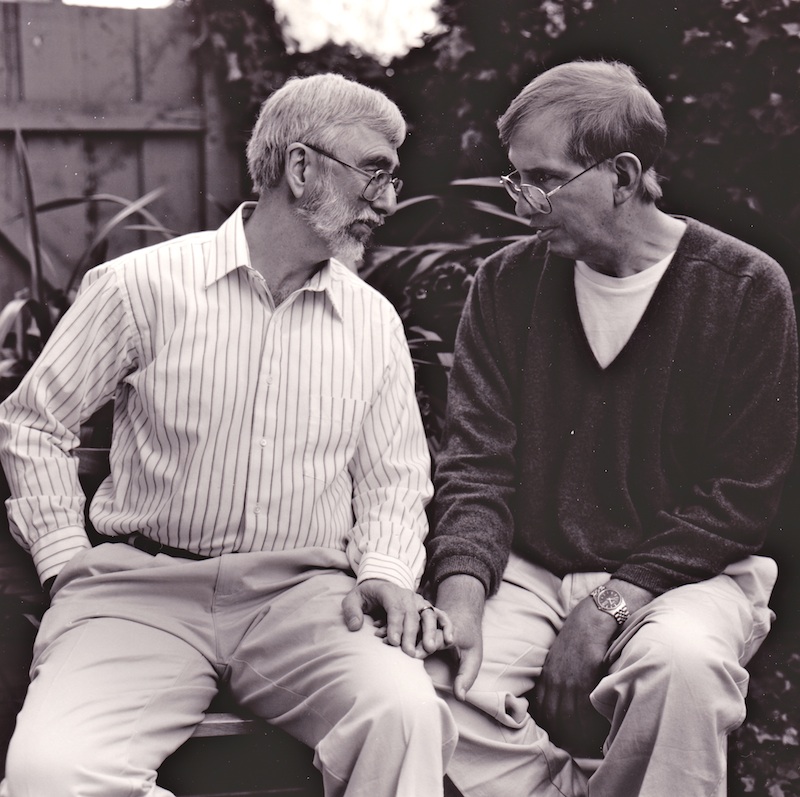
Here’s the one we picked from among the finalists ModBob offered us:

(In the photo you can see my wedding-equivalent band — black hematite — but not his.)

A determined reader of gender/power can still find differentiae: my hand is on top of his; even though we’re sitting, he’s still recognizably taller than I am; my hair has gone white, while his is still dark, so perhaps I register as the older (and so I am, by all of 16 months); his hands are clearly bigger than mine, and we all know what that signifies (in this case, accurately); I’m on the left as you look at the photo, and maybe that gives me an edge; and you might imaginably see something in the light vs. dark contrast of our clothing. But  overall, in the photo we’re equals — very different people, but equals.

In the real world, I was already into my role as his caregiver, as the last seven years of his life unfolded — an emotionally wrenching assignment of roles that we both resented passionately. You can’t tell what’s behind the picture.

But we were intensely happy that day.

Snarled-up ESOC on the op-ed page

August 3, 2010

Alana Newhouse, “The Diaspora Need Not Apply” [on who is a Jew], op-ed piece in NYT, 7/16/10:

It will do little good, too, to point out that [“the stringent approach to Jewish law that the Israeli rabbinate promotes”] is well outside the consensus established by Hillel — arguably the greatest rabbi in all of rabbinic Judaism and whom, as Joseph Telushkin argues in a forthcoming book, was willing to convert a pagan on the spot, simply because he’d asked [Hillel to].

That whom remains in the on-line version as of August 3. It looks like a case of ESOC (“extracted subject of an object clause”), a type of usage — one of several — in which accusative whom appears in subject function. ESOC (along with its cousin ISOC) is discussed in a long piece of mine about who vs. whom on Language Log a few years ago. (If you have questions or comments about the technical details, variability in the data, the status of ISOC and ESOC as mistakes or non-standard variants, and the like, I’d suggest that you look at that piece and its follow-up, here, before posting a comment here.)

But in this example several constructions are snarled up together, in such a way that it’s hard to see what might be going on (though, mercifully, Newhouse’s intended meaning seems clear enough, so that no one detected a problem with the sentence).

(more…)

Grownup performances for children

August 3, 2010

[Not about language. But not about gay life or Gayland, either.]

Following up on the splendid response my grand-daughter Opal had to a performance of the Mikado (see here), her mother and I have been surveying other possibilities in the line of grownup performances (including movies) that might appeal to her.

(more…)

Data points: portmanteaus 8/3/10

August 3, 2010

I realize I’m probably way late for these particular trains, but here are three portmanteaus from yesterday’s NYT Magazine that caught my eye.

(more…)