Bizarro‘s latest pun, which is a phonologically perfect one if you have an /a/ in the first syllable of pampas:

Bizarro‘s latest pun, which is a phonologically perfect one if you have an /a/ in the first syllable of pampas:
A correspondent has written me (presumably in my role as Zero-Plural Man, possibly because of my recent note on nouning and zero plurals in the case of the noun background ‘movie extras’) a message with the header
A rather famous zero plural
and the one-word body
Entheta
That rang only the most distant of bells for me, but of course I have on-line resources, from which I concluded that entheta is a Hubbardism (as in L. Ron Hubbard), a bit of Scientology-speak. And that it’s not a zero plural of a count noun, but instead a (singular) mass noun.
Well, strictly speaking, it was sarcasm in the form of a suggestion:
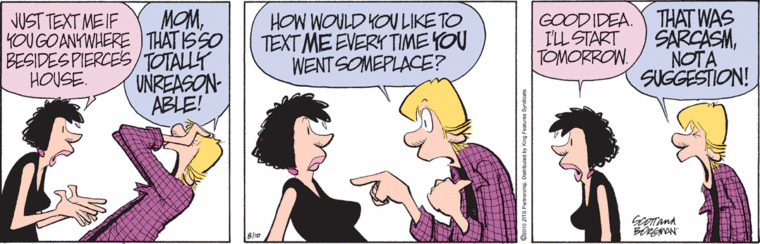
There’s a collection of why- and how-interrogative forms that, in addition to their literal question-asking meanings, can be conventionally used to make suggestions, and suggestions can be uttered sarcastically to reverse their polarity, as in the following set:
Why don’t you like me? [literal information question]
Why don’t you have dinner with me? [suggestion, for joint dining]
Why don’t you just jump off the fuckin’ roof, you moron?! [sarcasm, conveying that it would be stupid of you to jump off the roof (or to do something relevantly like jumping off the roof), hence suggesting (strongly) that you shouldn’t do that]
I’ve overloaded the last example with features (including the orthographic device ?! to indicate the very high rising-falling final intonation of an emphatic interrogative that might be intended to convey sarcasm) that point to sarcasm, but in actual life things are very often not so dramatically underlined by linguistic features.
Faced with utterances that could be unclear as to the speaker’s intent, the hearer might just fail to get the sarcasm and interpret an utterance like Jeremy’s as a suggestion. Or, more deviously, the hearer can reject the intent behind the speaker’s sarcasm and affect not to get the sarcasm, by treating the utterance as a simple suggestion. We can’t be sure which route Jeremy’s mother has taken, so the strip might be “about” the cluelessness of parents or “about” their resistance to their kids’ (unreasonable) opinions in opposition to their (of course, entirely reasonable) requirements. Or both.
It was bound to happen. Barbie came out in 1959, and Mad Men is set in the 1960s:

From Gail Collins’s NYT op-ed piece “The Kids Are All Right”, 7/29/10:
Maybe the North Koreans threatened to nuke the American-South Korean war games because they thought our country would be easy to bulldoze while the secretary of state was laboring under the stress of wedding planning [for her daughter’s wedding].
American-South Korean is a “copulative compound”, a compound in which the two elements are interpreted semantically as coordinate; American-South Korean war games are war games involving both American and South Korean troops.
Copulative compounds come in a number of flavors, though they generally have paraphrases in which the coordination is syntactically explicit.
There are things like the N+N compound singer-songwriter ‘both singer and songwriter’ (as in singer-songwriter Judy Collins) and the Adj+Adj compound French-American in a French-American obsession ‘an obsession of both the French and American peoples’. Compare: singer and songwriter Judy Collins, a French and American obsession.
This is in a way the simplest type; the other types have semantics that goes beyond just coordination. In particular, there are several types in which a relation between the two elements is part of the meaning, or at least an implicature. The relation can be, for instance, reciprocal, oppositional (a French-American conflict ‘a conflict between France and America, of France and America against each other’) or joint, cooperative (a French-American initiative ‘an initiative of the French and the Americans together’). Compare: a French and American conflict, a French and American initiative; in general, the multiplicity of understandings for coordinations carries over to the corresponding composites. (Multiplicity of understandings is everywhere in language.)
In principle, a copulative compound like American-South Korean can be understood in any one of the three ways I’ve illustrated. It all depends on the context, our background knowledge, and our expectations. Things go one way in American-Korean assumptions, another in American-North Korean animosity, still another in American-South Korean war games.
Perhaps what we want to say about copulative compounds, like other compounds, is that (a) there’s only one — very non-specific — semantic interpretation for the compounds, but (b) there are a number of common, perhaps conventionalized, patterns for filling in more specific details.
From Peter Savodnik’s Talk of the Town piece “The Pictures: Blow-up” (New Yorker, 7/26/10), about Gail Boykewich, who makes life-like inflatable dolls (inflatables — note nouning of adjective, either directly or by truncation) for the movies:
Sitting in her studio in the woods [in Oakland, New Jersey], surrounded by paints, pliers, a staple gun, and books on human anatomy, she talked about how annoying it is when “background”–movie-speak for extras–tamper with her art work.
Here we have the count noun background ‘background actor/player’ derived by truncation and then given a zero plural — the verb agreement in “when “background” … tamper with her art work” shows that background in this clause is plural — rather than the regular -s plural (“when “backgrounds” … tamper with her art work”).
From Tad Friend’s “California Postcard: Pot 101” piece in the New Yorker‘s Talk of the Town section, 8/9/10:
The university’s [Oaksterdam University in Oakland CA, which “aims to reposition pot-smoking as both a civil right and as the stuff of empire”] founder, president, and horticulture professor is Richard Lee, who also owns seven local enterprises that have helped revitalize the once derelict neighborhood, five of them so-called “canna-businesses.” (p. 22)
This is an overlap portmanteau, in fact a telescoping: cannabis business > canna-business, with the -bis of cannabis truncated by the overlap with business.
Respectable number of ghits, with all three spellings (solid cannabusiness, hyphenated canna-business, separated canna business) represented in the mix. Here, for example, you can find Stoner Magazine (U.K.) — “Your Cannabis Culture Magazine” — with its Canna Business Directory (listing head/hydroponic shops in England and Scotland, but not Wales or Northern Ireland, plus the Netherlands and Switzerland).
[Though you might not see this right away, head shop is an ordinary (type O) N+N compound, when understood as ‘shop for heads’, with modifying N head ‘pothead, person who enjoys marijuana’. Hydroponic shop, however, is a type X Adj+N composite, since the Adj hydroponic in it is non-predicating, but is instead interpreted via the plural N hydroponics ‘equipment for growing plants hydroponically’).]
This morning at the local farmers’ market, I picked up a couple of nectaplums, which started to become available last week. Nectaplum is a portmanteau of nectarine and plum, and the nectaplum is a hybrid of a variety of nectarine and a variety of plum.
There were also pluots (pluot = plum + apricot) on sale.
And so I was plunged into the mysteries of the genus Prunus (peaches, plums, apricots, cherries, and almonds) and the names for its bewildering collection of varieties and hybrids.
A set of 15 comic homoerotic XXX-rated collages on this theme, along with some commentary on each of them, is now available on my Blog X (here).
And now a Zippy for the weekend:
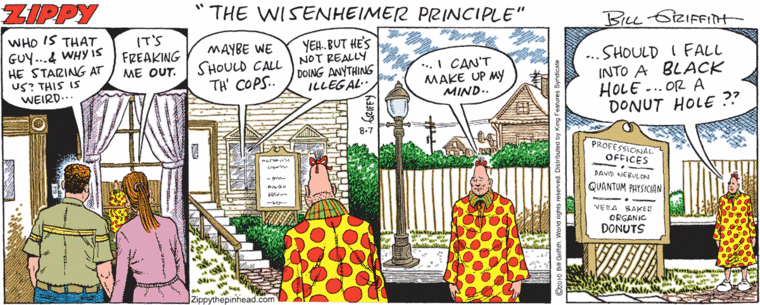
It’s a Zippy name thing again:
David Nebulon, Quantum Physician
Vera Baker, Organic Donuts
This time it seems pretty clear that the names are made up, to create that special relationship between some people’s family names and their occupations. (But it would be delicious if Bill Griffith had actually found the sign in real life.)
But of course there’s more. Is quantum physician a subsective compound, in which case a quantum physician is a physician? (And if so, what’s the semantic relationship between physician and quantum?) Or is it to be understood as parallel to quantum physicist, so that quantum physics is involved in its interpretation? Or, somehow, both?
Then there’s organic donuts, with organic having drifted from applying to the grain to applying to the donuts it’s made into (on the road to hypallage, discussed most recently on this blog here).
Finally, there are conventions about how occupations are listed (on signs, in directories, etc.), with the Zippy sign illustrating two of the most common schemes: job title (quantum physician) and service rendered or product offered (organic donuts).