Archive for August, 2010

Data points: referent finding 8/20/10

August 20, 2010

From the NYT Science Times of August 17 (John Markoff, “Step 1: Post Elusive Proof. Step 2: Watch Fireworks.”):

“The difference between the alchemists and the chemists was that the printing press was used to coordinate peer review,” [NYU professor Clay Shirky] said. “The printing press didn’t cause the scientific revolution, but it wouldn’t have been possible without it.”

Among the reader’s tasks is to find the referents for the two it‘s in

(1) … it wouldn’t have been possible without it

There are two candidates in the text for each it: the printing press and the scientific revolution.

(more…)

The Library Train to Sauk Centre

August 19, 2010

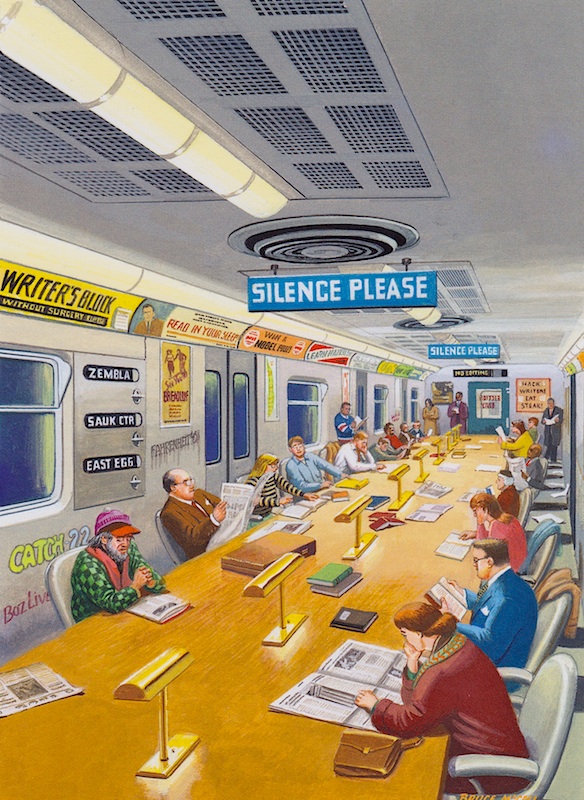
Bruce McCall’s fantasy train:

This bears a family resemblance to the Reading Room of the New York Public Library, but with different lamps and with various amendments. And without the computer connections.

The illustration is entitled:

Silence (Screech, Ka-Bang, Yudda-Yudda-Yudda), Please

[Added 8/23/10: Note that Sauk Centre is the name of the real Minnesota town that corresponds to the fictional Gopher Prairie of Sinclair Lewis’s Main Street. It’s left as an exercise to the reader to identify the other two destinations.]

Data points: verbing 8/18/10

August 18, 2010

Jon Lighter just wrote to ADS-L:

Reading this reminded me of the many times I read it in freshman themes in the 1980s and probably ’70s:

2010 WikiAnswers (link):
Who quoted The more you sweat in peace the less you bleed in war?
* *sun tzu*.*

Here we have the noun quote, a clipping of the noun quotation or a nouning of the verb quote, verbed to yield quote ‘originate  (a notable quote/quotation)’. Both more compact and more direct than “first said” or “originated the quote”.

Though it does introduce a possibly troublesome (in these days of plagiarism anxieties) ambiguity between originating and relaying a quote.

Short shot #52: ten-stone cowboy

August 18, 2010

As my dieting closes in on 11 stone (1 (British) stone = 14 lbs.), I am reminded that my goal, the return to 140 lbs. after nearly a decade away, figured in a cute pun made by Ann Daingerfield Zwicky many years ago, when she quipped that I’d become

a ten-stone cowboy

(playing on the title of the country-pop song “Rhinestone Cowboy”, written by Larry Weiss and famously performed by Glen Campbell).

It’s a distant pun, /tɛn/ for /rajn/, but it works, if you know about the song; otherwise, it’s just mysterious.

(Small phonological note: ten-stone and rhinestone differ prosodically, though both have primary accent on their first syllable and some accent on their second: the second syllable of ten-stone has a heavier accent than the second syllable of rhinestone. There are two schemes for transcribing this difference: either by distinguishing a secondary and a tertiary accent (both distinct from unaccented), 1 2 vs. 1 3; or by transcribing the words as 1 1 vs. 1 2 (positing only one non-primary accent), with the understanding that in 1 1 compound words, the first syllable has a phonetically heavier accent than the second.)

Data points: subj-verb agreement 8/17/10

August 17, 2010

Headline on the front page of the New York Times today:

Exclusive Golf Course Is Also Organic, So a Weed or Two Get In

My first reaction — really, why I noticed the head in the first place — was that I would have written gets (sg.) rather than get (pl.), and I’m still inclined that way, though I’m not willing to say that get is unacceptable or non-standard. I do have a hypothesis about where the plural might have come from.

(more…)

On AZBlogX

August 17, 2010

These are mostly not about language, though linguistic matters sneak in there fairly often anyway, and there are links back to postings on this blog:

8/14/10: Pits ’n’ Tits: five underwear models (link) [on sexualized presentation of the male body in the mass media and in male photography]

8/14/10: Pits ’n’ Tits: the captioned series (link) [XXX-rated images with comic captions accompanying them]

8/15/10: From 10percent 8/15/10 (link) [on a recent e-mail ad from this company]

8/16/10: Hi-def (link) [on men’s underwear in sheer, revealing fabrics]

8/16/10: The triad: jockstrap, locker room, shower room (link) [mostly about jockstraps]

Today’s pun crop

August 15, 2010

Another Bizarro with three puns:

The thing about imperfect puns — those where the punning expression and the one punned on are not phonologically identical, as in all three of these examples — is that the punner can get away with considerable disparity between pun and model if the context (in a formulaic expression of some kind, with visual reinforcement, etc.) is rich enough.

Trolls for scrolls is moderately distant, /t/ for /sk/ — but it’s a rhyme, and rhymes make the pun relationship easy to perceive; the onsets of the accented syllables in the rhyming relation can be pretty much anything.

Wrestler’s for Whistler’s is more distant: /r/ for /(h)w/ in the onset plus /ɛ/ for /ɪ/ as the accented vowel. But there’s support from the formula and the picture.

Goth for Gogh is a snap orthographically, but quite distant phonologically, if you use the most common English pronunciation for Gogh: /aɵ/ for /o/. Or moderately distant if you use a reasonably faithful approximation to Dutch: /gaɵ/ for /xax/, where /x/ is a voiceless velar fricative not ordinarily appearing as a phoneme of English. Only if you use the mixed pronunciation /gax/ for the painter’s name (an alternative given by AHD4 in addition to the other two) does the pun resolve to something really easy, /g/ for /x/ in the offset.

Probably Piraro was thinking about the relationship orthographically, with T for G.

And that’s the Sunday puns.
The House of X formula

August 12, 2010

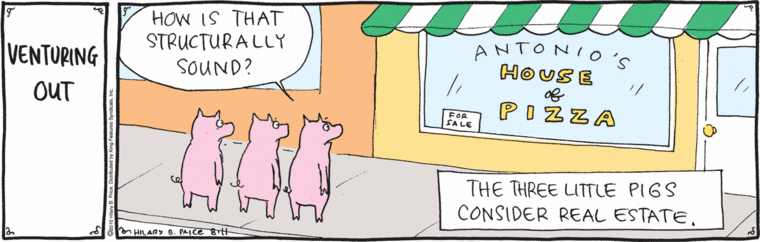
The central exhibit in yesterday’s posting on ambiguity in N of N nominals was

House of Pizza

as the name of a store (which the Three Little Pigs of course misinterpreted).

In a comment, Chris Hansen wrote:

Bob and Ray’s House of Toast comes to mind…

Indeed. Bob and Ray’s invention was a take-off on House of X shop names, a kind of snowclonelet alternative to common nouns of the form

X + -eteria, -ateria, -teria, -eria

(pizzateria, toasteteria, etc.), with the libfix -((V)t)eria that has come up on Language Log and this blog several times. Antonio’s House of Pizza or Antonio’s Pizzateria, take your pick. And to N+N shop names of the form X Shop/Store/Place/Nook/Hut/City/Town/Center… (The Toast Shop, Toast City, etc.)

(more…)

On Blog X

August 11, 2010

Some recent XXX-rated things of linguistic interest or with links to this blog (or just for fun):

8/8/10: Red Ken (link) [dolls and action figures]

8/9/10: Action figures getting some action (link) [dolls and action figures]

8/9/10: Error collage (link) [typos and spelling mistakes]

8/9/10: The bear-eating figure (link) [“eating the bear”]

8/10/10: Tadzio (link) [Death in Venice]

8/11/10: Collages on linguistic subjects (link) [seven of them]

The ambiguity watch: N of N

August 11, 2010

I’ve written a lot about ambiguity in N+N compounds, and will write more, but today’s lesson is on a related set of ambiguities in N of N expressions, illustrated here in a Rhymes With Orange:

It took me a moment to get this one:

House of Pizza, intended like House of Foam (two blocks from my house) and other shop names (with an extended sense of house and with of marking function or source: ‘place where one can get/buy …’); versus

house of bricks, house of sticks, house of straw (as in The Three Little Pigs story), house of cards, etc., conveying ‘house made of …’

There are lots of other possibilities, of course, in House of Rothschild, House of Lords, and more. The House of Lords could, after all, be a place where you could pick up a Lord (for whatever purpose you have in mind), or the proper name of a particular type of house made of Lords (say, by stacking them one on another). Potential ambiguity is everywhere.