Archive for March, 2010

A fashion for portmanteaus

March 14, 2010

Playful portmanteauing is everywhere [so is verbing]. Here, for example, from Daniel Clowes’s “Wilson in Day 16,412” comic strip in the March 15 New Yorker: sitting at a cafe table on the street, Wilson is approached by a young man seeking signatures and donations for a “save the planet” cause. Afterwards, Wilson remarks to a guy at next table:

You know what my ex used to call those guys?  “Clippies.”  Get it?  Clipboard plus hippie.

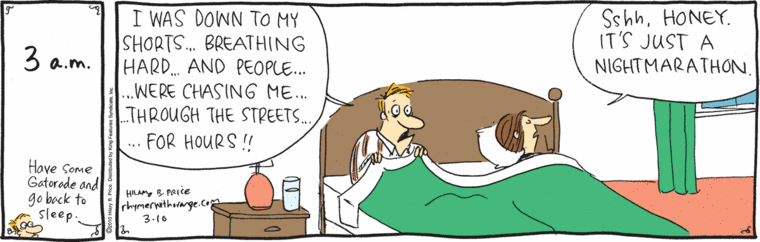
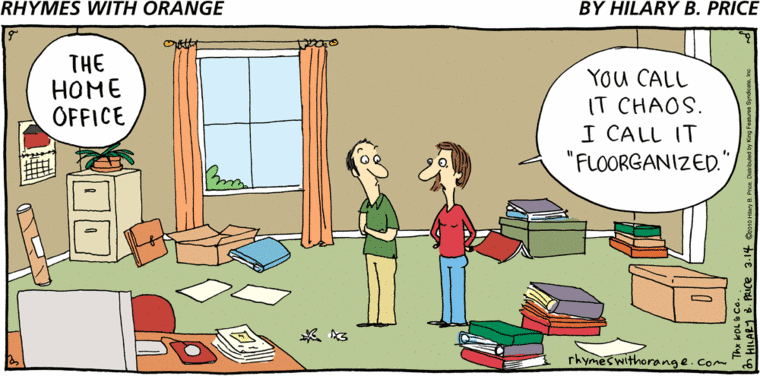
And then there’s Hilary Price in Rhymes With Orange. A few days ago came nightmarathon. And now today:

MS and Apple in Eden

March 13, 2010

A Bizarro cartoon to inaugurate the weekend (and mark the beginning of Daylight Time in the U.S.):

A play on buggy with reference to apples and with reference to operating systems.

Yet another portmanteau

March 10, 2010

From Hilary Price’s Rhymes With Orange:

The portmanteau works especially well for people who have a tensed, raised variant of /æ/ in marathon, a vowel approximating or merging with the vowel these people have in mare. (This doesn’t work for me, but it does for a fair number of speakers.)

Searches on “nightmarathon” bring up mostly references to “night marathons”, that is, marathons held at night. But there are a few more portmanteau examples in there.

Welcome to Dingburg

March 10, 2010

Back in February I posted here on Zippy’s fascination with certain words, among them the name of Grundy Gulch MT; Bill Griffith supplied a drawing of the mythical town (there’s a gulch, but not actually a town). Now it turns out that this Grundy Gulch bears a rough family resemblance (but only a rough one) to the mythical town of Dingburg –another silly name — MD, whose Main Street is depicted in this drawing from the cover of Griffith’s Welcome to Dingburg (Zippy Annual #9, 2008):

Note especially the vehicles in the two drawings.

Totally non-committal

March 8, 2010

In today’s Zits, Jeremy diffidently considers going to college in the east:

Nonce truncations

March 7, 2010

A few months ago, I looked at some truncations in syntax, focusing on a series of developments in no matter constructions, in particular:

it’s no matter what NP is/are > no matter what NP is/are > no matter what NP > no matter NP

(getting us from “It’s no matter what your objections are” to “No matter your objections”), but looking also at truncations of fixed expressions, especially truncations that are deployed by individual speakers/writers “for the nonce”, for the sake of brevity, in contexts where the omitted material can be supplied by hearers/readers — notably in fixed expressions.

(Of course, these individual innovations can then spread to a larger community of speakers, perhaps becoming an in-group usage, so that people in that group can use the expressions without necessarily appreciating their historical origins. And then they can spread to more general use, as widely used — even, in some cases, standard — conventionalized expressions on their own.)

The examples I gave of such nonce truncations were above and beyond (with the call of duty suppressed) and the whole nine (with yards suppressed). Since then I’ve collected a couple more: a hundred percent (with sure/certain suppressed) and have a snowball’s chance (with in hell suppressed):

[in a Law and Order episode, one cop to a second, who is contemplating moving ahead on some investigation, something along the lines of] Make sure you’re a hundred percent.

[in a Cold Case episode] You think he had a snowball’s chance?

No doubt there are examples to be found of (not) give a flying (with a following noun, fuck or some substitute, suppressed). No doubt, indeed, there are plenty more nonce truncations to be found, and I invite readers to supply their finds in comments; these things can be hard to search for.

The snowball’s chance and give a flying cases suggest another motive, beyond simple brevity, for truncating some fixed expressions: modesty, politeness, avoidance of possibly unsettling content. This motive can be seen in a police usage reported in the NYT on March 5 (Al Baker, “Packaged and Likely: A Brief Lexicon Of the Police” — well, at least the NYC-area police officers, firefighters, and paramedics who catch radio bulletins on the local Breaking News Network):

Likely: Likely to die.

(as when someone is reported to be “likely”).
I saw th’ best minds of my generation

March 7, 2010

Zippy and the older Dingburgers do not rapidly embrace innovations in communications technology; see here and here, but note that Zippy isn’t drawn into adolescent rebellion in these matters:

And now comes the Allen Ginsberg of Dingburg (Allen Dingsberg?):

More on the -ottles

March 6, 2010

Following up on his first posting on World Wide Words on -ottle words (TOTTLE and NOTTLE, based on BOTTLE) — reported on in this blog here — Michael Quinion added a posting today about further investigations. Three things:

– he added the portmanteau HOTTLE, which I’d noted in my posting;

– he added the portmanteau FOTTLE (folding + bottle), supplied by another reader;

– and he retracted NOTTLE, which appears to be a ghost word, the result of a misprint.

The full entertaining story (“Notta Lotta Notta”), with illustrations, is on his blog, here.

I beg (of) you

March 5, 2010

First came one character (a well-spoken FBI agent) on the television show Criminal Minds saying to another:

I’m begging of you. [to do something or other, which was supplied from the context]

Me, I would have used the transitive variant:

I’m begging you. [to do this]

(In the simple present and with an overt complement, the intransitive and transitive variants both suit me, though they strike me as subtly different semantically, and perhaps stylistically as well: “I beg (of) you to leave immediately.”)

OED2 has the intransitive pattern BEG OF SOMEONE TO DO SOMETHING from 1604 and the transitive pattern BEG SOMEONE TO DO SOMETHING from 1675 (plus BEG SOMETHING OF SOMEONE — “beg a favor / two favors / it of someone” — from 1711), and both continue in use today, with (apparently) some variability as to who uses which patterns and in what contexts.

That was this morning. Then this afternoon, I was reading Terry Castle’s The Professor: And Other Writings, and in the title chapter (pp. 213-4) there was a reference to Dolly Parton’s song “Jolene”. Castle quoted some of the lyrics, but didn’t quote the beginning:

Jolene, Jolene, Jolene, Jolene
I’m begging of you please don’t take my man

(which I came across in a Criminal Minds-inspired search on {“I’m begging of you”}.)

“Jolene” has been recorded many times by many different singers, and “I’m begging of you” occurs in various other songs as well — and in plenty of writing on the net. So though it’s not something I think I would say myself, it’s out there in significant numbers.

Ain’t variation grand?

Fun X 3

March 5, 2010

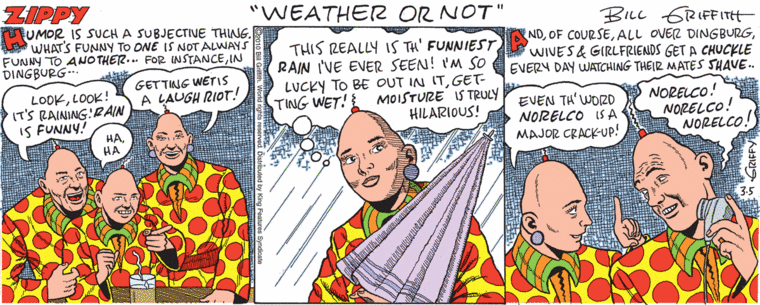
Dingburgers, Zippy among them, are easily amused — and Zippy, as we know, is entertained by any number of words and other expressions, and, onomatomaniacally,  likes to repeat them three times:

What Zippy tells you three times must be funny.