Archive for 2009

Jokes and snowclones

July 25, 2009

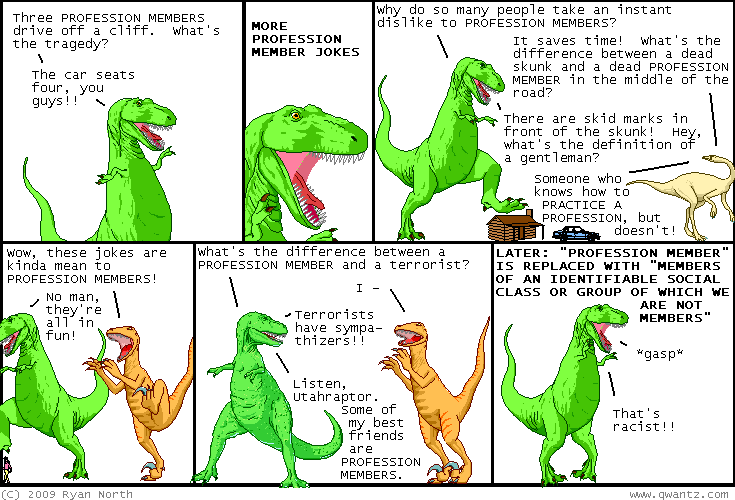
Dinosaur Comics takes on a class of jokes insulting particular groups, and supplies some joke templates for them:

(Hat tip to Bruce Webster.)

Some readers will identify these most strongly with the rich vein of “lawyer jokes” that put lawyers down (“What’s the difference between a lawyer and an X?” and the like).

Note that when PROFESSION MEMBER is expanded to take in members of social groups, then T-Rex finds the jokes no longer “all in fun” (“just jokes”, as some people say), but instead sees them as X-ist, in particular racist.

Erin O’Connor has picked up this cartoon on the Snowclone Database, in an entry for 7/20/09, where she connects the joke templates to snowclones. Granted, they are both types of formulaic language (as are riddle templates, poetic forms, and much else), but I see them as significantly different. Templatic jokes and riddles (and so on) are routines embedded within larger texts — they are, in a sense, digressions — while snowclones, like idioms and clichés, are expressions fully integrated into their texts.

However, the lines are by no means clear, and there are many problematic cases (not all jokes are templatic, and there are short non-templatic digressions, like proverbs). There’s isn’t necessarily a bright line separating interruptive from fully integrated material.

Summer intern

July 21, 2009

I’ve had a number of summer interns in linguistics over the years — I have one now — but I hope I’ve given them work more useful than what’s depicted in this Rhymes With Orange cartoon:

Carrot, stick

July 20, 2009

Bizarro takes on English idioms involving a carrot and a stick:

There’s been a lot of passionate argument about whether “carrot and stick” or “carrot on a stick” is the original and/or “correct” variant of the expression. The arguments are mostly about the inherent plausibility of one or the other of the images; the textual evidence doesn’t come down clearly on one side or the other. For some recent surveys, look at Paul Brians here. Michael Quinion here, and Jan Freeman here.

Jan Freeman suggests an amicable resolution: the possibility that the two expressions arose independently, both building on the idea of a carrot as an inducement.

The patio footnote

July 19, 2009

Elizabeth Daingerfield Zwicky reported a few days ago that she had found an odd footnote in L. Frank Baum’s The Magic of Oz (1919), p. 73. The text goes:

The Sorceress smiled and answered:

“Come into my patio* and I will show you.”

So they entered a place that was surrounded by the wings of the great castle but had no roof …

This is in effect a definition of patio, giving the OED’s (draft revision of June 2009) older sense, ‘In a Spanish or Mexican house, a roofless inner courtyard open to the sky’, attested from 1764 (but obviously not always restricted to Spanish or Mexican houses); the external version (‘A paved roofless area adjoining and belonging to a house’) is attested from 1931 (from P.G. Wodehouse!) on.

So far so good. The footnote gives a pronunciation:

* Pronounced pa′-shi-o.

That’s the odd part: the assibilated middle syllable [ʃi], instead of [ti]. A variety of pronunciations have been reported for patio, but I haven’t seen this one before.

In any case, you can view the original by going to page 73 here.

(more…)

X number

July 18, 2009

I posted yesterday on Language Log about Erdős numbers, and then paused to note that composites of the form X number come in at least two varieties, exemplified by Erdős number vs. Fibonacci number (both with nouns as their first element) and by lucky number vs. triangular number (both with adjectives as their first element). I’ll focus here on the slightly less complex N + number case.

Both Erdős number and Fibonacci number have the semantics ‘number associated in some way with N’, but  Erdős number has an additional component of meaning lacking in Fibonacci number, evoking another referent besides Paul Erdős — someone who has this number. That is, Erdős number is “inalienably possessed”, and in normal usage requires that an explicit possessor be expressed (“My Erdős number is 4”). For Fibonacci number, in contrast, there’s no such requirement (I do not have a Fibonacci number associated with me). Similarly, lucky number vs. triangular number.

Inalienable possession is a huge and much-studied topic in semantics, syntax, and morphology. In some languages, there are explicit morphosyntactic indications of inalienable possession, but English is not such a language. Languages also differ in which nouns are inalienably possessed; body-part terms (like hand) and kin terms (like sister) are especially likely to be inalienably possessed (as they normally are in English).

Searching on {“your * number”} pulls up some entertaining inalienable N + number compounds: your birth number (known under various other names), a one-digit number calculated from birth year, month, and day and used to predict personality characteristics and the like (think of it as a zodiac with only nine signs); your sex number (the number of sexual partners you’ve had); and your fuck number (for men, the number of strokes it takes until you reach orgasm), for instance.

Bewitched, Bothered, and Bemildred

July 18, 2009

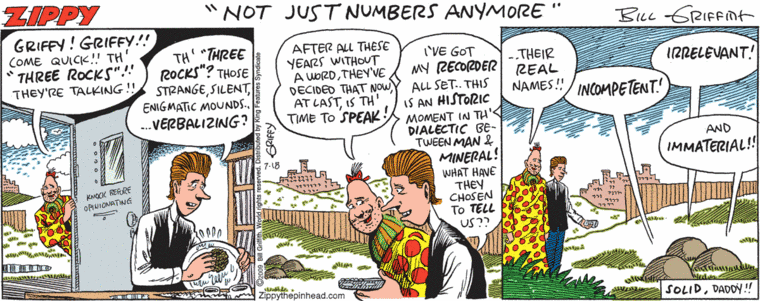
When rocks speak! A bit of Zippy silliness to start off the weekend:

Bewitched, Bothered, and Bemildred (or Bewildered) are three bat brothers from the Pogo cartoons. Three-part expressions (with primary accent on the third element) are all over the place: Signed, Sealed, and Delivered; liberty, equality, fraternity; Meshach, Shadrach, and Abednego; Abraham, Martin, and John; ready, start, go; and endless others. (No, I’m not collecting these, just giving some diverse examples.)

Include All Necessary postings

July 17, 2009

Another little inventory (assembled by Tim Moon), this time a very little inventory, on Include All Necessary Words advice discussed on Language Log and this blog. I’ll post soon on the why this inventory is so short, despite the fact that advice along these lines is very common in the manuals.

Arnold Zwicky’s Blog

“Zombie rules I: blame, love, graduate” – January 15, 2009 – Arnold Zwicky

Zombie rules I: blame, love, graduate


Discusses the phrase “graduate from”, as in “Many students graduated from Princeton in June.” A frequent complaint against “graduate from” is that it is missing a “necessary” form of be, and that the correct phrase is “Many students were graduated from Princeton in June.”

New Language Log

“V + P~Ø” – February 13, 2009 – Arnold Zwicky

V + P~Ø


Talks about verbs that can occur (with similar meanings) either with direct objects (the Ø option) or oblique objects (the P option). Says that when usage critics prefer the P option, they usually appeal to explicitness (IANW), disregarding possible meaning differences – such critics would prefer the phrase “I played on the piano for hours” (oblique) over “I played the piano for hours” (direct).

Language Log Classic

“What’s It All About?” – September 11, 2007 – Arnold Zwicky
http://itre.cis.upenn.edu/~myl/languagelog/archives/004901.html
Discusses the OI! Project. Zwicky notes that appeals to ONW and IANW can be classified as secondary (a usage is deprecated for social reasons, and people bolster these objections with a secondary appeal to ONW or IANW) and primary (appeals to ONW and IANW that lack any evident social basis) and states his hypothesis that secondary appeals to ONW and (especially) IANW outnumber primary appeals.

“(An)arthrous Abbreviations” – September 17, 2007 – Arnold Zwicky
http://itre.cis.upenn.edu/~myl/languagelog/archives/004923.html
Discusses how how in general, initialisms are arthrous if their full forms are, and anarthrous otherwise (The Initialism Principle) while acronyms are anarthrous, even when the full names they abbreviate are arthrous (The Acronym Principle). Also brings up a general exception to the Initialism Principle in the naming of educational institutions, whose initialisms are generally anarthrous. Zwicky points to these variations as another example of the competition between economy and clarity.

“Whether Either” – December 20, 2007 – Arnold Zwicky
http://itre.cis.upenn.edu/~myl/languagelog/archives/005242.html
Brings up IANW in a discussion of various puzzles involving whether and either (concessive either, correlative either…either, correlative whether…whether, correlative subjects, bonus WTF coordination). Zwicky gives two example situations where people might omit words because they are needless in the context but “guardians of the standard” insist that you must Include All Necessary Words (non-standard truncated concessive (without or not) – “Whether you like it, you are ‘public figures.’” – and truncated as far as – “As far as your ideas on this subject, I think they’re nonsense.”). Zwicky says that “the guardians’ judgment is in fact based on social critera – who uses the variant, an antipathy to what’s perceived as innovation.”
Postings about or

July 16, 2009

An inventory of Language Log postings about the semantics of or:

GP, 4/14/08: And/or: “and AND or”, or “and OR or”?: http://languagelog.ldc.upenn.edu/nll/?p=35

GP, 4/16/08: Exclusive OR: free dinner and stay out of jail:

Exclusive OR: free dinner and stay out of jail

AZ, 4/19/08: And/or or both:

And/or or both

AZ, 4/20/08: Conjunctions and logical connectives:

Conjunctions and logical connectives

AZ, 4/21/08: Disjunction mailbox:

Disjunction mailbox

Plus links to other sources.

So fun

July 16, 2009

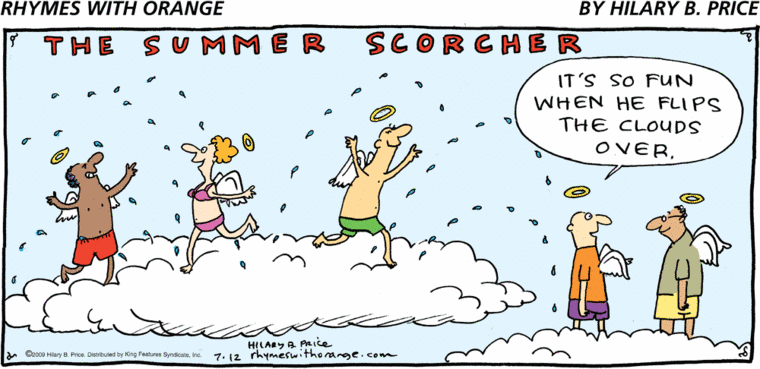
Over on ADS-L we’ve returned to an evergreen topic, uses of fun as an adjective, as in so fun in this Rhymes With Orange cartoon:

A reminder: fun hasn’t lost its noun uses (as in “We had a lot of fun”), but for many people an adjective fun has developed alongside it.

ADS-L discussions over the years have tended to focus primarily on the very noticeable inflected forms funner and funnest (which have been attested at least since the early ’80s), but there are other clearly adjective uses — so fun as above (very common), very fun, the periphrastic superlative most fun (as in “That was the most fun party I’ve ever been to”), and others.

There are two routes (not incompatible with one another) to the development of an adjective fun: by reinterpretation of the first element fun in noun-noun compounds like fun party as a prenominal adjective; and  by reinterpretation of the predicative noun fun (as in “The party was fun”) as a predicate adjective. (The intended interpretation of many instances of fun will of course be unclear, which makes the historical record hard to interpret.)

Postings on internal/external inflection

July 14, 2009

Here are some postings, on Language Log and on this blog, on internal and external inflection. This inventory is probably incomplete.

(Note: the case of noun-noun compounds with a plural as first element — activities center, Mets fan, etc. — is a separate topic from this one and is not covered in this posting.)

EB, 5/28/06: And the plural of MacBook Pro is …:
http://itre.cis.upenn.edu/~myl/languagelog/archives/003195.html

GP, 8/10/06: The dying adjective laureate:
http://itre.cis.upenn.edu/~myl/languagelog/archives/003438.html
poet laureate (vs. Nobel laureate)

ML, 8/21/06: Term for shifting plural s to the end of initialisms and acronyms?:
http://itre.cis.upenn.edu/~myl/languagelog/archives/003484.html
WMD etc.

GP, 8/21/06: No plural shifting term:
http://itre.cis.upenn.edu/~myl/languagelog/archives/003486.html
follow-up to 3484

ML, 4/22/07: Cavett’s comforting cavils:
http://itre.cis.upenn.edu/~myl/languagelog/archives/004433.html
attorney general, film noir, and more

External, internal, and double inflection


ticking off

More internal inflection


shout-out; in comments: Whopper Junior, fuck-up, Chicken-In-A-Biskit