Archive for November, 2009

Ask AZBlog: metanalysis

November 19, 2009

Tom Limoncelli has passed on to me a query from a friend of his:

I have found myself running syllables together in unexpected ways:

instead of “hobo beans” I might say “hobob eans”

or instead of “Jon Bon Jovi” “Jon Bonge Ovi”

or instead of “soup and sandwich” “soups and which” (which is another set of problems, perhaps)

Do you or any linguists of your acquaintance know of this phenomenon?

It happens only orally, and not in writing.

The short answer is: metanalysis, a.k.a. recutting, though the third example seems to involve omission of and followed by recutting. But there’s more to be said here.

(more…)

Center-embedded discourse

November 19, 2009

From Joe Clark, an insanely complex comedy routine, involving (among other things) center-embedded discourse:

stand-up comic

(This is from the National Lampoon album Gold Turkey.)

Cultural references

November 18, 2009

Ann Burlingham has written me about the headline

Mau Mauing the Flesh Eaters

on Jennifer Schuessler’s review of Jonathan Safran Froer’s Eating Animals (in the November 15 New York Times Book Review). She just didn’t get it. But Wikipedia’s article on the Mau Mau uprising of the 1950s had the crucial clue, all the way at the bottom: a reference to Tom Wolfe’s 1970 article “Mau-Mauing the Flak Catchers” (combined with another Wolfe article to make the 1971 book Radical Chic and Mau-Mauing the Flak Catchers).

Cultural references are the very devil.

(more…)

Short shot #22: Fitzgerald and Strunk

November 17, 2009

What do F. Scott Fitzgerald (the American writer) and William Strunk Sr. (the father of the Cornell English professor who was the author of  the original The Elements of Style) have in common?

Meticulous record-keeping.

Here’s Arthur Krystal, in the November 16 New Yorker (p. 38):

Fitzgerald always had a plan. He liked to draw up schedules; he kept meticulous records; he made numerous lists; and he recorded every penny earned, borrowed, and paid back. For a man who led one of the messiest lives in literary history, on paper he was as organized as Felix Unger’s sock drawer.

As for Strunk Sr., from Mark Garvey’s recent Stylized: A Slightly Obsessive History of Strunk & White’s The Elements of Style (p. 1):

An energetic record keeper all his adult life, William Strunk Sr., in a flowing, nearly calligraphic script, filled ledger after ledger with the details of Strunk family life–expenditures of every kind, from the cost of his own wedding to the annual expenses of child rearing [including those for Will Strunk Jr.] …

Garvey fills more than a page with further details. He doesn’t offer similar details about Will Strunk Jr., though he does touch several times on Strunk’s passion for order.

Maybe it was the spirit of the times.

Short shot #21: portmanteau crop

November 17, 2009

I don’t collect all the  examples of portmanteau words that come past me, but I do try to note ones that strike me as having special interest (general discussion, with some examples, here and here).

The November 16 New Yorker has a couple: the Frillies for the Phillies, and the German Ostalgie.

Frillies is a combination of frilly and Phillies (the Philadelphia Phillies, the city’s major-league baseball team). The portmanteau comes to us from the New York Post, chortling over the New York Yankees’ win over the Phillies in this year’s World Series and mocking the Phillies with the feminine frilly, using a classic tactic in male-on-male insult, feminizing the object of the insult. (Ian Parker, “Perfect Paper”, p. 23)

Ostalgie, combining Ost ‘East” and Nostalgie ‘nostalgia’, is a neologism referring to “the pining of some East Germans for their simpler, cozier former lives under state socialism” (George Packer, “November 9th”, p. 22).

Now one that works in both French and English: fauxteur. According to Michael Quinion in World Wide Words #661, 10/17/09:

The Urban Dictionary defines it as “A filmmaker, usually a director, who makes cheesy, derivative, or unoriginal movies.” So it’s clearly a combination of “faux” and “auteur”. It has been around at least since 2005. The New York Times suggested in 2006 that it was a coinage of the Web site defamer.com.

Finally, one I heard on NPR a few days ago, though it seems it’s been around for a while: cyberchondria (cyber- + hypochondria). Lots of ghits for this one. Here’s a brief discussion from a NYT piece by John Markoff, “Microsoft Examines Causes of Cyberchondria” (11/24/08):

On Monday, Microsoft researchers published the results of a study of health-related Web searches on popular search engines as well as a survey of the company’s employees.

The study suggests that self-diagnosis by search engine frequently leads Web searchers to conclude the worst about what ails them.

Well, not finally. Cyberchrondria suggested to me that cyberteria might be out there as well, and indeed it is, in several senses. It can refer to an internet café, to a commercial site offering a range of audio/visual or other electronic equipment, to the panoply of material available on the web, and no doubt many other things. A versatile neologism.

NYT Week in Review omnibus

November 16, 2009

The November 15 NYT Week in Review offers a diverse collection of language-related items. The most distantly related is Nicholas Wade’s “The Evolution of the God Gene”, which Mark Liberman has posted about on Language Log, mostly because it comes only a few days after Wade’s latest piece on FOXP2, the “Speech Gene”.

Then there’s an odd piece excerpted from Harper’s: “When Sartre Talked to Crabs (It Was Mescaline)”. Yes, Jean-Paul Sartre. Back in 1929. The mescaline-induced crabs stayed with him for some time; he says he knew they were imaginary, but he still saw them and talked to them. In the excerpt he doesn’t say whether the crabs answered. But we can wonder about the Language of Crabs.

(I’m sorry, I can’t resist it. With apologies to Paint Your Wagon: “I talk to the crabs / But they don’t listen to me”.)

The most obviously language-related item is the editorial cartoon I posted about on this blog earlier today.

But wait, there’s more. There’s an opinion piece by Earl Blumenauer (Democratic representative from Oregon), “My Near Death Panel Experience”, about the disinformation campaign surrounding a provision, in the health-care bill he helped write, for Medicare-supported voluntary counseling on end-of-life planning.

There followed a series of outrageous distortions of the provision — seniors being put “in a position of being put to death by their government” and the like — culminating in Sarah Palin’s framing the matter as Obama’s proposing to create “death panels”. The term death panel pretty much took over public discussion of health care bills, as well as media reporting on it. Blumenauer:

The “death panel” episode shows how the news media, after aiding and abetting falsehood, were unable to perform their traditional role of reporting the facts. By lavishing uncritical attention on the most exaggerated claims and extreme behavior, they unleashed something that the truth could not dispel.

Then, a fluffy piece by David Segal on “Naming the ’00s” (as 2009 nears its end). Attempts to find names for things by asking for proposals are entertaining, but virtually never result in a consensus answer. Instead, a name spreads (if it does) when people actually use it in their writing and conversation and it resonates with others, who use it themselves. It’s not something that you can legislate, or vote on.

Finally, there’s Catherine Rampell’s “How Old Is Old Enough?”, about the social categories of life stages in the U.S., in particular the distinction between childhood and adulthood. In fact, the piece is about how this distinction is made for legal and administrative purposes, where “bright lines” are needed. (The issue that gave rise to Rampell’s article, because it’s been under consideration by the U.S. Supreme Court, is the cut-off age for sentencing to life imprisonment without parole.)

But, as Rampell points out,

For drinking, driving, fighting in the military, compulsory schooling, watching an R-rated movie, consenting to sex, getting married, having an abortion or even being responsible for your own finances, the dawn of adulthood in America is all over the place.

Folk categories of life stages don’t usually involve such bright lines; there can be more than two folk categories in this part of the semantic domain; different people have somewhat different schemes of categorization; the folk categories are different in different places and times; and so on. Scientific categorizations are still another matter; as Rampell says, “scientific research has in many ways … blurred, rather than clarified, the distinction between childhood and adulthood.”

So there are three types of categorizations, for different purposes, and more than one scheme of categorization within each type. But discussion of these matters relies — over-relies, I would say — on a binary distinction in English vocabulary, between child(hood) and adult(hood). It’s hard to sort out these matters when only this one distinction is easily available.
Playing with anaphora

November 16, 2009

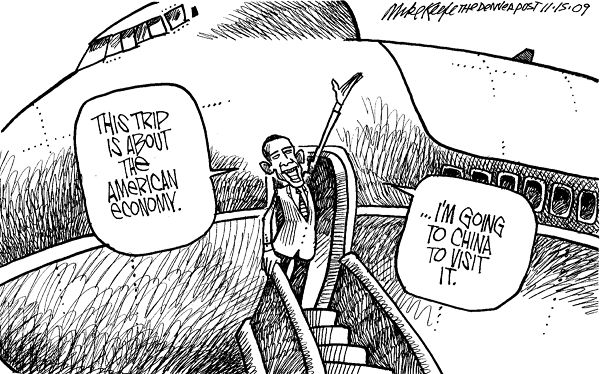
Mike Keefe’s Denver Post editorial cartoon of November 15:

Out of context, “I’m going to China to visit it” is puzzling, since the referent for the pronoun it would appear to be China, so that Obama would seem to be saying that he’s going to China to visit China, which is sensical but fatuous. But the preceding sentence supplies a better referent for the pronoun it, namely the American economy.

This little text still requires some interpretive work, since you have to extend the meaning of visit some to understand how someone could visit the American economy. That’s not very hard to do, and then you see that the text conveys that the American economy is in China. Clever.

Inventory of who/whom postings

November 15, 2009

Another inventory, this time of Language Log postings about who vs. whom. The inventory isn’t annotated, and it might not be complete.

GP, 4/17/04: I really don’t care whom (link)

ML, 4/18/04: Whom humor (link)

GP, 9/10/04: The coming death of whom: photo evidence (link)

ML, 11/9/04: Talking about whom you are and who you’re seeking (link)

ML, 10/22/05: Whomever controls language controls politics (link)

ML, 12/2/06: Class consciousness (link)

HH, 12/21/06: Dog whistles for linguists (link)

AZ, 1/5/07: Whom? (link)

AZ, 1/8/07, Marxist quotation (link)

AZ, 1/23/07: Whom shall I say [ ___ is calling ]? (link)

AZ, 1/28/07: Relevance of a different kind (link)

ML, 5/3/07: A note of dignity or austerity (link)

AZ, 6/18/07: ISOC, ESOC (link)

ML, 8/29/08: It’s whom (link)

AZ, 9/8/07: Whom was that masked man? (link)

BZ, 10/24/07: It’s a made-up word used to trick students (link)

ML, 10/26/07: Cold comfort for whomever (link)

AZ, 4/11/08: Wikipedia gets it half right (link)

AZ, 7/30/08: Not exactly a smackdown (link)

Chuckles Bites the Dust

November 15, 2009

In the “not about language” file, something personal (You Have Been Warned):

The NYT of November 13 carried an obit (by Bruce Weber) for David Lloyd, who wrote “scores of scripts for some of the most popular television sitcoms of the 1970s, ’80s and ’90s”. Headed:

David Lloyd, 75, Dies
Wrote ‘Chuckles’ Episode

The reference was to a 1975 episode (“Chuckles Bites the Dust”) of the Mary Tyler Moore Show (with MTM as an earnest news producer for a Minneapolis television station), in which

[news anchor Ted Baxter] is invited to be the grand marshal of a circus parade, but [station manager Lou Grant] forbids it as undignified. Ted’s replacement is Chuckles the Clown, the host of a children’s show on the same television station. But on the day of the parade, Lou rushes into the newsroom, stunned, and explains that Chuckles, who attended the parade dressed as one of his characters, Peter Peanut, had been crushed to death. As Lou explains it, “a rogue elephant tried to shell him.”

This is funny enough, but then, at the funeral the priest lists Chuckles’s characters (Mr. Fe Fi Fo) and catchphrases (“A little song, a little dance, a little seltzer down your pants”), and Mary involuntarily dissolves in laughter, then (when the priest encourages her to let it all out) bursts into tears.

It’s a comic gem, all the more so for being compressed into a small space. (Kudos to the director and the ensemble cast as well.)

Lloyd wrote many wonderful scripts, but it pleases me that on his death he’s recognized so publicly for one of them. As an old man, I would like to think that when I die people will celebrate at least one of the things I’ve written (or one of the lectures I’ve given).

The hiney virus

November 14, 2009

A few days ago, a friend mentioned the /hájni/ virus, referring to the H1N1 flu virus, but treating “H1N1” as if it were a piece of leetspeak, with the numeral 1 standing for the letter I, the whole thing pronounced like the North American slang word for ‘buttocks’ (a shortened variant of behind, in combination with the suffix -y). There’s even a t-shirt (and a sweatshirt), on sale here:

The t-shirt uses one of the variant spellings of the buttocks word. The OED entry (draft of December 2006) for the word (which notes that it’s frequently a euphemistic substitute for ass and has cites from 1922 on) gives four spellings: heinie, heiny, hiney, and hinie. Though the OED treats heinie as the main spelling, when the buttocks word appears in combination with virus and flu, the hiney spelling (as on the t-shirt) is by far the most frequent in Google hits. The ordering of the OED‘s spelling variants is the  same for X virus and X flu: hiney first, then (well behind it) heinie, then hinie, then heiny. In addition, there are some occurrences of the spellings heiney and hiny.