Coming up on my Pinterest mail several times recently, this powerful sculpture (with no identification beyond its mislabeling as a piece of classical sculpture), clearly of Saint Sebastian (in some public place; I’ve deleted a trash can in the background), tied to a figurative tree, mortally wounded by arrows, his body contorted in unbearable pain, writhing in the deepest agony, with no trace of homoerotic ecstasy:
(#1) Not a piece of classical sculpture, since clearly not from ancient Greek or Roman times; not a sculpture on a classical theme, since Christian martyrdom is not a theme of ancient statuary; not even a sculpture in a classical style, given its sinewy modernist roughness; classical in spirit only in its capturing the virtually nude male body in bronze
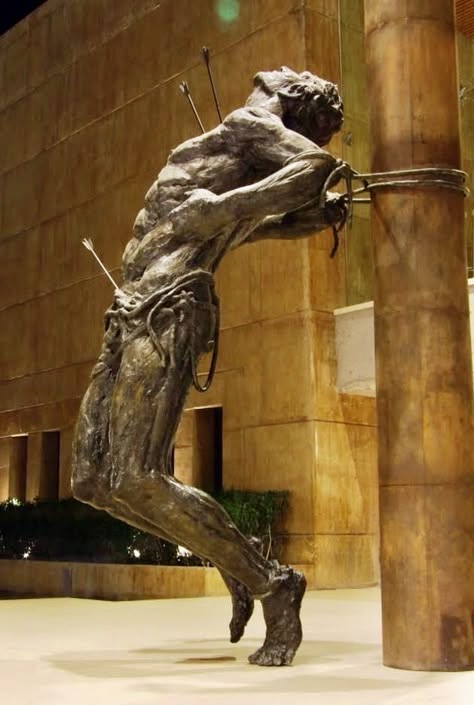
Google Images told me instantly that this remarkable figure is Saint Sebastian, a large bronze sculpture (from 2008) by Ricardo Motilla (born 1951 in San Luís Potosí, Mexico), located at the entrance to the Museo de Arte e Historia de Guanajuato (the Art and History Museum of Guanajuato), in the city of León in the central Mexican state of Guanajuato.
Now, some brief remarks about the city of León (a place I suspect few of my readers have ever heard of, so you’re probably wondering how it could have a serious art and history museum). Then I’ll counterpose the terrible agony of Motilla’s StS to the general run of depictions of the saint, which are heavily weighted towards the ecstatic-homoerotic; in particular, the Motilla is at the opposite end of the StS brutality scale from the many depictions by Pierre et Gilles, all of them agony-free.