The dorky, the raunchy, and the portmanteaued

November 22, 2023

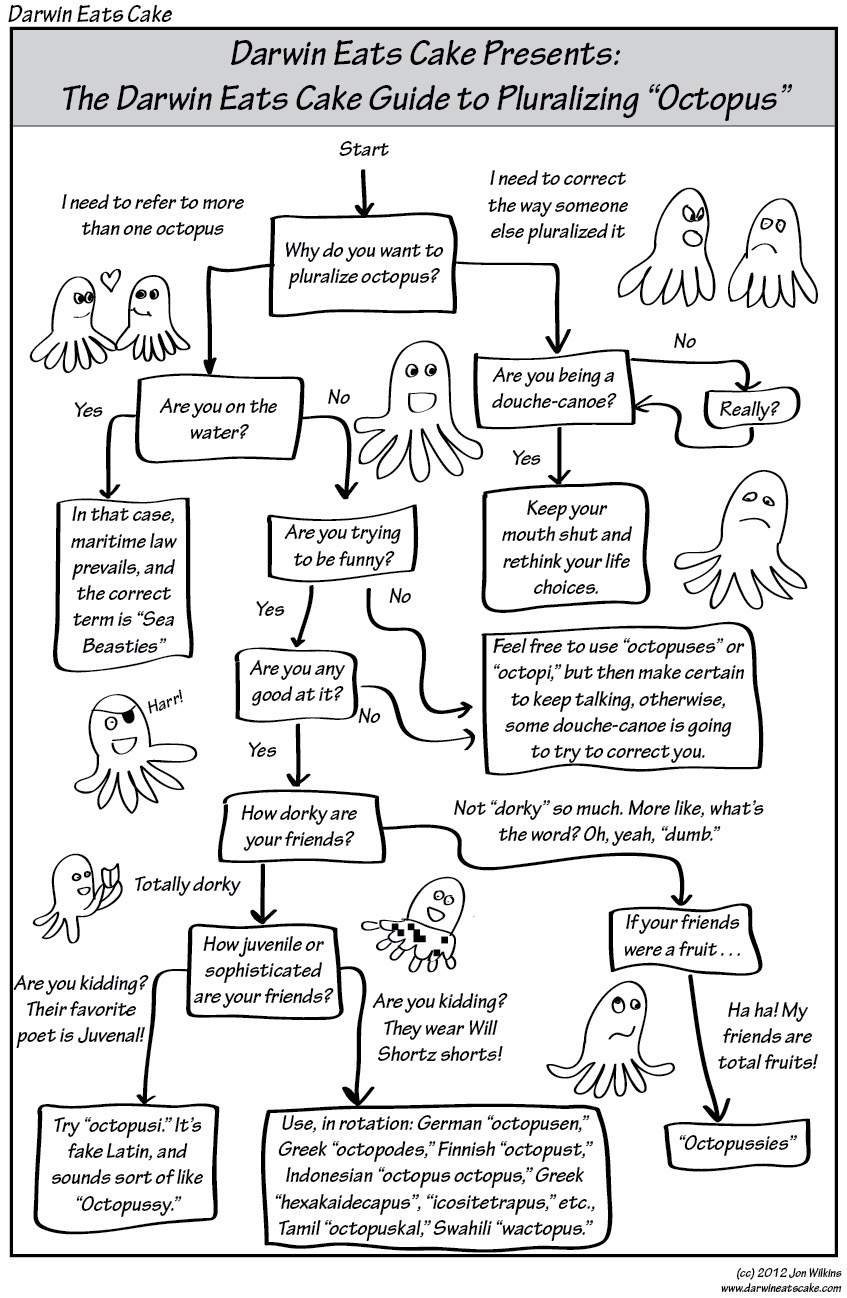
The pursuit of plurals for the English noun octopus — most recently, in yesterday’s posting “Obscure plurals of octopus (and rhinoceros)” — has now lurched into the zone of the dorky, the raunchy, and the portmanteaued with Kyle Wohlmut’s posting today on Facebook of Jon Wilkins’s webcomic Darwin Eats Cake‘s smartass Guide to Pluralizing “Octopus”:

(#1)

The cartoon seems determined to take us to the raunchy portmanteau octopussy (= octopus + pussy) and to Octopussy, the 1983 James Bond spy film, titled from its principal female character, the wicked seductress Octopussy. I’ll be following it there.

Read the rest of this entry »

The 2024 Arnold Zwicky Award

November 22, 2023

From the Linguistic Society of America’s Secretariat this morning:

Arnold Zwicky Award: This award, given for the first time in 2021 [as the 2022 AZ Award], is intended to recognize the contributions of LGBTQ+ scholars in Linguistics and is named for Arnold Zwicky, the first [openly] LGBTQ+ President of the LSA. The Committee on LGBTQ+ [Z] Issues in Linguistics (COZIL) is pleased to announce that Professor Lal Zimman is the LSA’s 2024 Arnold Zwicky Award recipient [AZ: to be formally awarded at the 2024 LSA meeting in early January in New York City].

Lal Zimman, an Associate Professor of Linguistics at UC Santa Barbara, is recognized as a global leader in the area of trans linguistics. His research on trans language has had a significant impact on sociocultural linguistics, sociophonetics, inclusive pedagogy, and social justice- and community-based linguistics. Zimman has also been active in advocating for trans inclusion in the discipline and the academy, and he has been a mentor to many trans students. He now directs the Trans Research in Linguistics Lab (TRILL) at UCSB, which is dedicated not only to studying trans linguistics but also holistically supporting trans students and scholars.

Yes — a Z to a Z!

Read the rest of this entry »

Obscure plurals of octopus (and rhinoceros)

November 21, 2023

A brief, somewhat goofy spin-off from my 11/18 posting “The visiopun”, about plurals of the English noun octopus, which entertained mostly octopi (borrowing the Latin plural, but giving it an English spelling-pronunciation /áktǝpàj/) and octopuses (with the default plural suffix for English nouns), but also entertaining octopodes (borrowed from Classical Greek, so learnèd and obscure). The posting inspired a Facebook exchange today, starting with:

— Gadi Niram: I love the [four-syllable] plural octopodes, but it’s really not suited to most communication.

To which I replied:

— AZ >  GN (amplifying on GN’s reservations): It has the primary accent on the second syllable: òctópodes, like àntípodes. … At first I was hoping for óctopòdes or òctopódes, cleaving more closely to the accent pattern of óctopùs. But reality is weirder than that.

Read the rest of this entry »

Two stock similes

November 20, 2023

Briefly noted, this Leigh Rubin cartoon passed on to me by Susan Fischer on Facebook today:


To understand this, you need to recognize a bull and a young goat

Two stock expressions, both of them similes, lie behind the two images of creatures entering retail establishments: like a bull in a china shop, like a kid in a candy store. The two ideas can appear as an explicit comparison, in a simile with like; or in a metaphor, with the comparison implicit: you are a (veritable) bull in a china shop; they were (proverbial) kids in a candy store.

Read the rest of this entry »

Der Vogelfänger bin ich ja

November 20, 2023

Or, in rhyming colloquial English:

I’m Papageno, that’s my name,
And catching birds, well, that’s my game!


Nathan Gunn as Papageno, clutching his magic bells

And he more or less literally animates the Mozart / Schikaneder (think: Sullivan / Gilbert, Rodgers / Hammerstein, McCartney / Lennon) opera Die Zauberflöte (The Magic Flute) — since he’s on the scene and in the action during most of the opera’s duration; and since he brings common, earthy, fallible, playful, humane depth to the work. The other characters are mostly otherworldly beings of one sort or another, or the presumed central human characters Tamino and Pamina (“a prince on a quest” and “a princess in distress”, according to the screen characterizations in the 2006 abridged video version of the fabulous 2004 Julie Taymor production at the Metropolitan Opera Company), who are earnest but rather cardboard idealizations of humanity (though they are humanized as much as possible in the Taymor production’s performances).

Zauberflöte is a fairy-tale opera with a familiar schematic story line, in which someone achieves a much-sought goal (love; entrance into the adult world; admission to some desirable association, band, or circle; whatever) by enduring probative tests, trials, or ordeals. T&P do that, but kids nevertheless seem to think — as I do — that the opera is about Papageno, who brought T&P together in the first place and then gets dragged along with them, serving as an unwilling hero in their ordeals but in the end failing to undergo the trials of fire and water (instead he gets his mate, Papagena). I doubt that any child seeing the video identifies with either T or P; but Papageno is a great kid, one of them: silly, error-prone, adorable, sometimes scared shitless, a sturdy friend, and a hell of a lot of fun.

It also has two prominent subtexts, which work together to support the theme of brotherhood that runs through the opera: Freemasonry and the Enlightenment ideal of the brotherhood of all humanity.   Many people will experience a performance of the opera without appreciating either element of its late-18th-century European intellectual and political context, and children will surely not get any of this (they will instead have their own understanding of what’s going on, and that’s fine; after all, there can be 17 ways of looking at a blackbird), but it’s especially relevant to the Taymor production because that production is richly overloaded with symbolism for both subtexts — which children will experience as the ways and forms of a strange but delightful imaginary world (imaginary worlds being a central element of childhood experience).

I write this after having watched the video again, twice, and of course seeing lots of things I hadn’t seen before, thereby complicating my intentions of reporting a lamentable memory lapse on my part. But I’ll press on.

Read the rest of this entry »

On the plot of Die Zauberflöte

November 19, 2023

(Side material for a posting in preparation about Julie Taymor’s Metropolitan Opera production of Mozart’s Die Zauberflöte)

Opera plots are notoriously packed with preposterous and incomprehensible details, but at least at first glance, The Magic Flute would win some sort of grand prize in the problematic plot department. But some of it makes sense when you understand it as a fairy-tale (so accommodating many of the fantastical elements) in which someone (the prince Tamino, with whom the opera opens) undertakes a quest and undergoes an ordeal to achieve some prize (admission into the wizard Sarastro’s (S’s) Brotherhood of the Sun); it’s also a love story, with Tamino (T) falling in love with the princess Pamina (P) — daughter of the otherworldly Queen of the Night (Q) — through seeing a portrait of her brought to him by his quest-companion (acquired in the early scenes of the opera), the bird-catcher Papageno (Pg); T&P become a couple, undergo the trials together, and so join S’s band.

Summing up this much, there are five central characters:

three ordinary mortals (in the order of their appearance): T, Pg, P (T&P become a couple; Pg picks up a mate along the way, instead of undergoing the trials)

two otherworldly mortals, S and Q

More of the details become comprehensible if you know that the opera is full of allusions to and symbols of Freemasonry; Mozart and his librettist Schikaneder were both active Masons, and they seem to have viewed Die Zauberflöte as their “Masonic opera”. The Taymor production is way overloaded with Masonic symbolism. But unless you’re a Mason or read analyses of the opera, you’ll miss all this.

But we’re still left with two sources of audience bewilderment: the nature of S and of Q, which appears to shift dramatically between the two acts of the opera; and a sixth character, Monostatos (M), a third otherworldly mortal character, who keeps cropping up in a creepy subplot that stretches through a considerable span within the opera. A Moor in the original, in the Taymor production M is white but bizarre, hawk-beaked and grotesquely fleshy (with a troupe of Turkish followers). But the question is what M’s intrusions are doing in the opera at all; they might just be Mozartean effusions of dark and dangerous Turkishness, with M replaying the character Osmin from Mozart’s earlier German Singspiel opera Die Entführung aus dem Serail (The Abduction from the Seraglio). A bit more below.

Read the rest of this entry »

The visiopun

November 18, 2023

… visiopun being my coinage referring to a punning word presented visually — not actually said or printed, but alluded to by some striking image, usually with some lead-on hinting at the pun. An extremely simple, utterly flat-footed example of my own devising:

What do you call a US infantryman from World War I?

(#1)

The image is of a small male figure made of dough, so the punning word is doughboy. (Yes, the Pillsbury Doughboy. I simplified things by using an existing image.)

Now to a complex visiopun passed on to me on Facebook today by Emily Menon Bender (the source is cited in the image):

(#2)

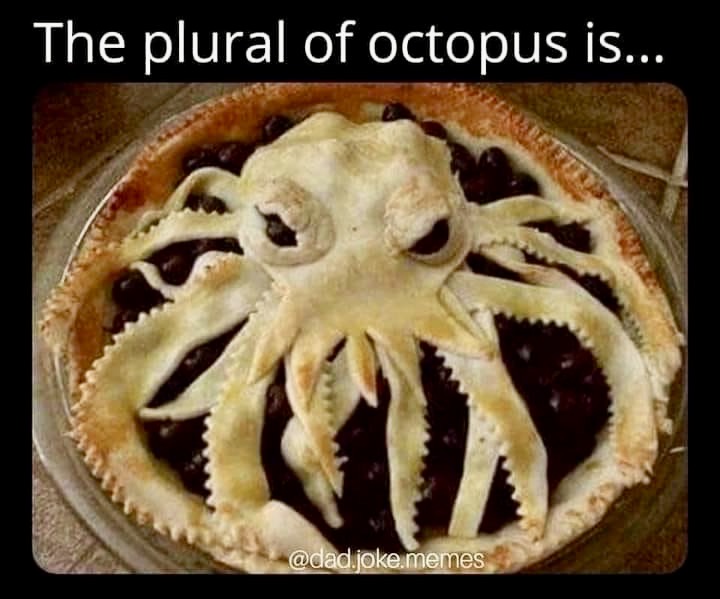
The image is of a pie in the shape of an octopus, so the punning word is octopie (/áktǝpàj/ in my AmE variety), a play on octopi, one of the plural forms of octopus. Cute.

Read the rest of this entry »

My in-law news from a month ago

November 17, 2023

Taking off from Virginia Transue’s message on 10/12, about her having unearthed this photograph from about 50 years ago:


(#1) From left to right: Jacques Transue (my husband-equivalent); his mother Monique Serpette Transue; and VT’s husband, J’s older brother Bill (William R.R. Transue, to distinguish him from his father Bill, William R. Transue)

VT wrote:

Maine, but which summer??? No date on the back. Mid-seventies, certainly —- those good-looking fellas!

(Oh yes, good-looking, two hot guys, but in two different ways in the photo — Jacques looking open but intense, Bill looking amiable.) By “Maine”, VT refers to Machiasport ME, way way Down East, where the family long has had a summer compound, at which they sail, play tennis on their tennis court, bring friends, and enjoy each other’s company. That’s the Maine woods in the background in #1; the three Transues in the photo are facing Machias Bay, the Atlantic Ocean, and Canada.

Read the rest of this entry »

Ditto ditto my song

November 17, 2023

A serenade on my Apple Music in the dark night of 10/13, Danny Kaye singing Gilbert & Sullivan patter songs, with warmth rather than the sharp edges of the D’Oyly Carte patter specialists; at my 2 am whizz break, he had arrived at the Lord Chancellor’s “Nightmare Song”, from G&S’s Iolanthe, with its concluding:

the night has been long —
ditto ditto my song —
and thank goodness
they’re both of them over!

Being (more or less relentlessly) a linguist, I asked myself, not for the first time: What kind of word is ditto? It looks a lot like some kind of adverb here, with the crucial line paraphrasable as (awkward) thus thus my song, or (better) also also my song, or (even better) so too my song. (Although you might argue that ditto‘s a special kind of noun, since it’s paraphrasable as the same.) And, while we’re on the subject: Where on earth does it come from? I entertained speculations about some connection to double, maybe Greek di– ‘two’, or possibly to dot, given ditto marks.

My etymological speculations are provably off-base; the closest English words are diction and dictate, from the Latin stem dict– ‘say’. Meanwhile, my off-the-cuff part-of-speech assignment is flatly contradicted by the authority I look at first, NOAD (a lexicographically respectable dictionary of manageable size, and — unlike AHD or the M-W dictionaries — one accessible directly from my browser). NOAD is based on the resources of the OED, and the OED (which I can access on-line) on ditto classifies the word as a noun — but in an entry from well over a century ago, so we need to look critically at its evidence for this classification. Which shows that in the 18th century the word was incontestably a noun (with a plural dittoes). That usage, however, is long dead. The question is what to say about modern usage, and there my adverb idea has a lot going for it (and is also the classification given in Merriam-Webster’s word history for modern ditto).

So we’re in for a bumpy ride, much like the Lord Chancellor’s, with possibly more questions than answers. Hang on.

Read the rest of this entry »

The Yiddish word for shpilkes

November 17, 2023

Melinda Shore on Facebook yesterday, the wry comment “How to spot the NY newspaper”, about this passage that Ann Burlingham had posted on FB:

At Lot 77062, he started to get antsy. “I’m getting shpilkes,” he said, using the Yiddish word for shpilkes. [The paragraph continues: His hope — not unreasonable, he thought — was somewhere in the high six figures.]

To supply the context (thanks to Season Devereux for pointing me to this): it’s a New York Times article by John Leland: on-line on 11/15/23 with the headline “He Thought His Chuck Close Painting Was Worth $10 Million. Not Quite: A bittersweet ending for Mark Herman, the dog walker who was given the painting: It finally sold, but for far less than he had envisioned”: in print with the headline “Gavel Comes Down on a Chuck Close Nude and a Fantasy”.

New Yorker Mark Herman was the speaker of using the Yiddish word for shpilkes; why he didn’t say using the Yiddish word for pins and needles is something of a mystery to me — but if you can’t easily pull up the English idiom pins and needles ‘anxiety’, then Yiddish shpilkes might be all you’ve got.

Read the rest of this entry »