A playful poetic footnote

April 26, 2015

In my “More detection” posting, we came across writer E. C. Bentley, with fame in two areas. From Wikipedia:

E. C. Bentley (full name Edmund Clerihew Bentley; 10 July 1875 – 30 March 1956) was a popular English novelist and humorist of the early twentieth century, and the inventor of the clerihew, an irregular form of humorous verse on biographical topics.

… His detective novel, Trent’s Last Case (1913), was much praised, numbering Dorothy L. Sayers among its admirers, and with its labyrinthine and mystifying plotting can be seen as the first truly modern mystery. It was adapted as a film in 1920, 1929, and 1952. The success of the work inspired him, after 23 years, to write a sequel, Trent’s Own Case (1936). There was also a book of Trent short stories, Trent Intervenes.

… From 1936 until 1949 Bentley was president of the Detection Club.

Read the rest of this entry »

More detection

April 26, 2015

Follow-ups to my posting on Ronald Knox and his ten “rules” for detective fiction (enjoining writers to play fair with their readers): the origin of the rules; floutings of the rules; and attacks on detective fiction as a genre.

Read the rest of this entry »

Morning: Great American Dream Machine

April 26, 2015

This morning’s name: the television show The Great American Dream Machine. Bonus: grades of olives and their names.

Read the rest of this entry »

Apologetic candy

April 26, 2015

On the tv this morning, a (very short) commercial that turned on the apology “Sorry I was eating a Milky Way”. It’s on this site, with an explanation of its content:

A hairstylist, a rodeo clown and a cruise ship captain all completely forget what [they’re] supposed to be doing while eating a delicious Milky Way chocolate and caramel candy bar. Hilarity ensues, but their Milky Ways are just too good for these people to care.

On another site, a set of other “Distracted Chocolate-Eating Ads”:

Although being distracted by a chocolate bar might not be the best excuse for certain scenarios, the Milky Way Caramel campaign shows that this snack may be particularly irresistible. With its gooey caramel center, how could a bride possibly make it to her wedding on time? Or a mother not burn her son’s boy scout uniform with an unattended iron? These situations and more should be excused, at least according to the Milky Way Caramel campaign.

Read the rest of this entry »

Morning: Conrad Ecklie

April 25, 2015

This morning’s name was Conrad Ecklie. From Wikipedia:

Conrad Ecklie is a fictional character on the television series CSI played by Marc Vann. He was employed as Assistant Director of the crime lab of Clark County, Nevada until he was promoted first to Undersheriff in Season 10, then to Sheriff of Clark County in Season 13. In earlier seasons, he is a typical antagonist. As the series progresses, he gradually starts to become a good friend to the CSI team.

(#1)

Read the rest of this entry »

Underground Mastodon

April 25, 2015

From Sim Aberson, this tile from the NYC subway, at the 81st Street – Museum of Natural History Station:

(#1)

That’s the American mastodon. And this is a marker for an underground mastodon (note nice double dactyl: Higgledy piggedy / Undergound mastodon …).

A few words about mammoths and mastodons.

Read the rest of this entry »

shtum

April 25, 2015

From the April 18th Economist, in the article “Putin’s targeted strike: The meaning of Russia’s weapons sale to Iran”:

In July 2013 Russia remained silent when an Israeli air strike destroyed anti-ship cruise missiles that it had recently supplied to Syria and were on their way to Hizbullah. And Israel kept shtum last October when Syrian rebels released footage of the involvement of Russian intelligence officers at a Syrian military listening post on the Golan Heights that had been overrun.

Israel kept shtum. With the adjective shtum ‘silent, mute’ — an item that, apparently, few Americans know, unless they have some experience of British English. (The Economist is a British publication.) On the British side, the item is ordinary slang, commonly used in the collocation keep shtum (and in some other contexts). It seems to be derived from Yiddish, though I believe that very few British speakers appreciate that; for them, it’s just slang. So there’s something of a puzzle as to how it became naturalized in BrE but not AmE.

Read the rest of this entry »

Cluster Fucked

April 24, 2015

(Obviously heavy on taboo language, some of it about man-man sex, but no images. Use with caution.)

In mail today from TitanMen (the gay porn studio), an ad for the new video Cluster Fucked, about orgy scenes (and gangbangs). Samples on the TitanMen site for three group sex scenes, involving (for those of you who follow these things) pornstars:

Francois Sagat, Dean Flynn, Diesel Washington, CJ Madison, Brody Newport

Jason Branch, Jon Galt, Lance Gear, Nick Nicaste

Jessy Ares, Marco Wilson, Junior Stellano, Wilfried Knight

There are two senses for the noun clusterfuck or cluster fuck. From Urban Dictionary, in addition to the ‘orgy’ sense:

Military term for an operation in which multiple things have gone wrong. Related to “SNAFU” (Situation Normal, All Fucked Up”) and “FUBAR” (Fucked Up Beyond All Repair).

In radio communication or polite conversation ([e.g.,] with a very senior officer with whom you have no prior experience) the term “clusterfuck” will often be replaced by the NATO phonetic acronym “Charlie Foxtrot.”

And from the scholarly Jesse Sheidlower (3rd ed. of The F-Word), who doesn’t have Charlie Foxtrot:

  1. an orgy [from 1965 on]
  2. Military. a bungled or confused undertaking or situation; mess; (also) a disorganized group of individuals. [from 1969 on]

Both senses have the occasional variant Mongolian clusterfuck / cluster fuck.

The connection between the two senses? One clue is that a similar ambiguity arises for circle jerk ‘group masturbation scene’, ‘mess’ and some other items. From a posting of mine on 1/3/11:

Having just posted, on my X blog, on group sex in gay porn, I’ve returned to some material on circle jerk that I started collecting in 2004

… Tom Dalzell pointed out on ADS-L that HDAS (the Historical Dictionary of American Slang) has circle jerk ‘mess’ since 1973, and the compound seemed to him to be fairly common in that sense. And Doug Wilson noted a possible parallel to cluster fuck, goat fuck, pooch screw, etc. (especially in military contexts), in which “Instead of getting their job done, the participants are engaged in undisciplined,  undignified, useless activity: e.g., metaphorically, group sex or sex with animals.

Youthful enthusiasms

April 24, 2015

(About music rather than language.)

In the May Harper’s, an entertaining piece on “New Music” by Terry Castle — a literary scholar (specializing in the history of the novel) at Stanford, and sometime writer on popular culture. The Harper’s piece is about old music become new, focusing on Robin Williamson, once of the Incredible String Band.

Terry begins with a confession:

Is there anything more shaming than doting on the electrified English folk-rock of the late Sixties and early Seventies? It’s taken me, I confess, a dreadfully long time to come to terms with it — to acknowledge that I adore, nay, have always adored, the whole tambourinetapping, raggle-taggle mob of them: Pentangle, Fairport Convention, Sandy Denny, John Renbourn, Shirley Collins, Bert Jansch, Martin Carthy, Steeleye Span, Maddy Prior, Richard and Linda Thompson, Lindisfarne. I still venerate Jethro Tull and its leader, the psychedelic flutist Ian Anderson, unforgettable for his dandified overcoat, harelike skittishness, and giant comic aureole of red beard and frizzy hair. It’s like admitting you’d rather go to the local Renaissance Faire than hear Mahler’s Lieder at Wigmore Hall.

One is cruelly dated by one’s doting. The British fad for switched-on folk reached its apogee somewhere between 1968, when the Incredible String Band released its sitar-laced masterwork, The Hangman’s Beautiful Daughter, and 1978, the year that the lissome but likely inebriated Sandy Denny, former lead singer of Fairport Convention, died of blunt head trauma after falling down a flight of stairs. Yes, one capered and twirled through it all. Alas, one is now fairly eldritch oneself — positively rime-covered.

I shared Terry’s enthusiasms then — and now as well. And I’m a dozen years older than she is. Rime-covered, indeed.

Read the rest of this entry »

“Cosseted like rare orchids”

April 24, 2015

Very briefly noted: in a book review by Christine Smallwood in the May Harper’s,

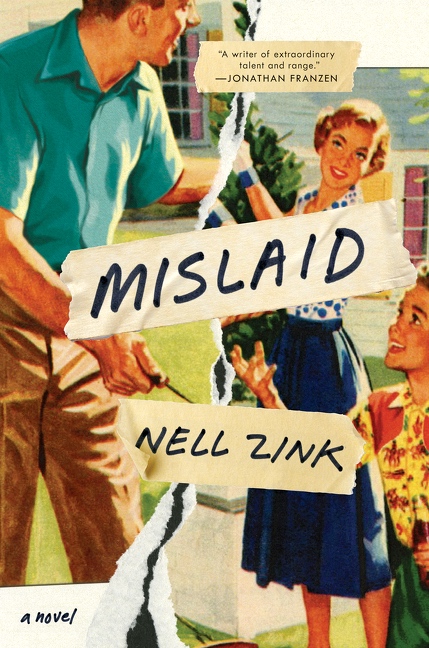
Reality wasn’t directly relevant,” one character thinks, all too relevantly, in Nell Zink’s manic new novel MISLAID … The fun begins in the hazy 1960s at the all-female Stillwater College, a former plantation decked out with Virginia creeper: “A mecca for lesbians, with girls in shorts standing in the reeds to smoke, popping little black leeches with their fingers, risking expulsion for cigarettes and going in the lake.” One of these lesbians is a would-be playwright named Peggy, and before you can say “freshman orientation,” she’s shacked up with the resident campus queen, a gay male poet and professor named Lee Fleming who lives down the lake and paddles to class in a canoe. Their eventual marriage isn’t exactly a sham — “vestiges of heterosexuality . . . cosseted like rare orchids” produce two children — but neither does it provide what you might term fulfillment.

A wonderful turn of phrase.