(Warning: significant (homo)sexual content, though in generally decorous language.)
Yesterday morning’s name: a sexually scandalous Roman emperor who led a short but eventful life.
(Warning: significant (homo)sexual content, though in generally decorous language.)
Yesterday morning’s name: a sexually scandalous Roman emperor who led a short but eventful life.
The latest offering from Daily Jocks: the Diamond Sweat Short from SupaWear, now provided with a caption:

Todd insists on the right
Equipment for the job.
In a posting on some cartoons yesterday, I mentioned what I described as an “aversion” to cilantro that affects many people, an aversion that turns out to be genetically determined: people with Yuck Cilantro genetics (hat tip to Benita Bendon Campbell on the term) find the taste of cilantro disgusting and don’t appreciate the pleasures that others experience. For some people, the effect goes well beyond distaste or aversion; they suffer extreme symptoms that cause them to characterize their condition as an “allergy”, treating the symptomology as a definition of allergy.
But the medical literature insists on a technical definition of allergy that requires an immune response involving the antibody immunoglobulin E (IgE); without this antibody, we are looking at a food intolerance (or non-allergic food hypersensitivity), even if its manifestations are extreme: vomiting, even anaphylaxis. According to this literature, there is much less food allergy in the world than people think — because ordinary people use the term allergy loosely and incorrectly.
Now, from the point of view of ordinary people, it’s the symptomology that’s important, not the cause of the symptoms, and whatever the cause, the major part of treatment will involve avoiding the foods that trigger the symptoms. In the circumstances, it would be useful to have a technical term like true allergy or allergy proper (to distinguish those cases where antibody-suppressing drugs might be effective parts of treatment) versus a term allergy of wider application, or else a specially invented wider term, like allergoid condition.
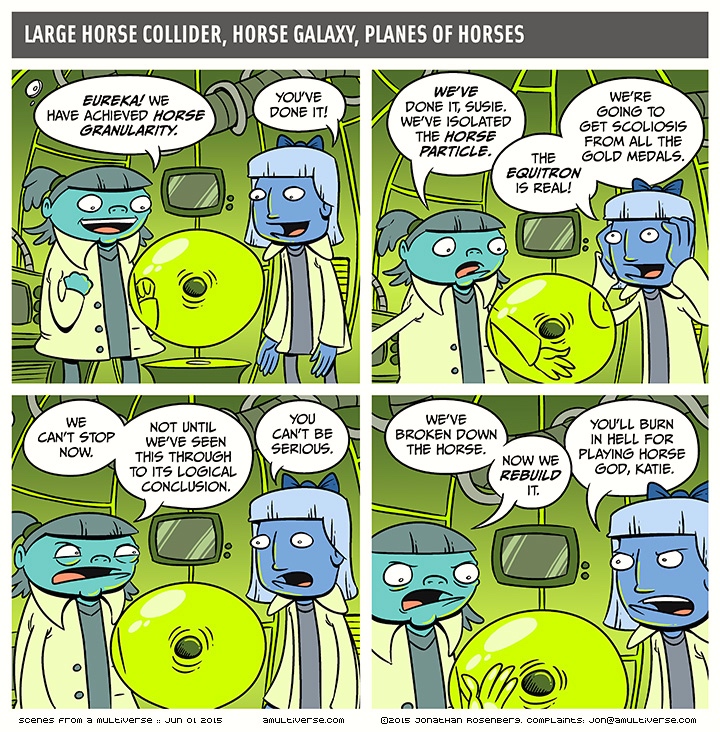
Yesterday’s Scenes From a Multiverse:
 (#1)
(#1)
Not the Large Hadron Collider, but the Large Horse Collider, which has found the equitron.
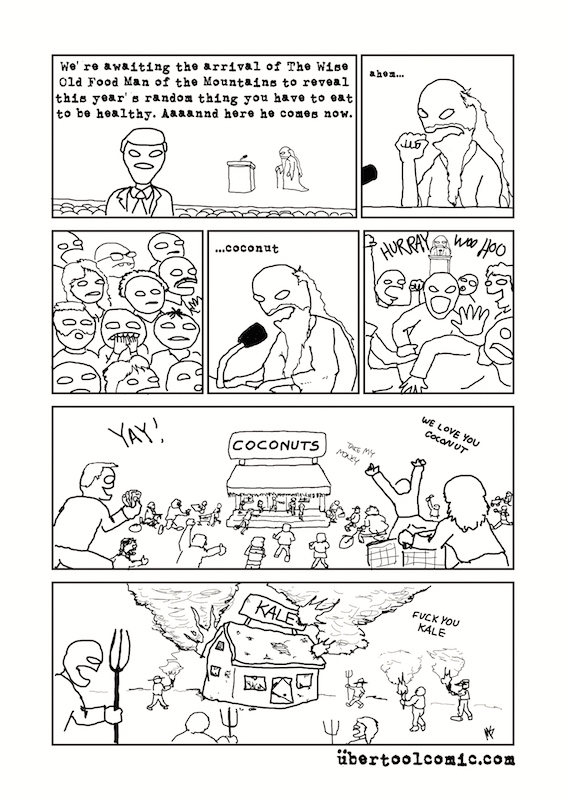
An übertool cartoon (#150 of 5/30/15) passed on by Melinda Shore, who had been wondering where that cilantro thing came from:
 (#1)
(#1)
Up with coconuts, down with kale!
A bit of edible greenery, in a posting I’ll soon use for another purpose: coriander / cilantro,
From the NYT yesterday, in “Who Will Watch the Charities?” by David Callahan:
Last week federal authorities disclosed that four cancer charities had bilked tens of millions of dollars from donors.
The subordinate clause here has a VP of the form:
(1) bilk MONEY from VICTIM
where I might have used one of the form:
(2) bilk VICTIM of MONEY
i.e., four cancer charities had bilked donors of tens of millions of dollars. Same verb, same participants in the event (a victim, some money), but different syntax: different argument structures, that is, different associations of the syntactic arguments (direct object DO and oblique object OO) with the participants. In more detail:
(1) V: bilk DO:MONEY P: from + OO:VICTIM
(2) V: bilk DO:VICTIM P: of + OO:MONEY
There is some tradition for referring to such a variation between argument structures as a diathesis alternation. In this case, both alternants are standard, and, so far as I can tell, are treated as such in the usage literature.
A paper given at Stanford on the 29th: “Pronouncing the Z’s: Epenthesis in English plural possessives” by Simon Todd (a Ph.D. student in linguistics). The beginning of the abstract:
The interaction between the English regular plural affix (PL) and possessive clitic (POSS) presents a theoretical puzzle (Zwicky, 1975). Both have the form /z/, and so the OCP [AZ: Obligatory Contour Principle] (Yip, 1998) predicts their combination (PL+POSS) should trigger epenthesis. Yet, in cases like my friends’ /fɹenz/ car, only PL is overtly realized. Why does the OCP fail to apply?
Two previous theories address this non-application of the OCP in PL+POSS constructions. The POSS-suppression theory (Stemberger, 1981; Zwicky, 1987) claims that POSS essentially inspects the morphological composition of its host and is actively suppressed by adjacent PL /z/, without exception. The alternative POSS-allomorphy theory (Bernstein & Tortora, 2005; Nevins, 2011) claims that POSS has a phonologically null allomorph, which is chosen when the possessor has the plural feature. Either POSS allomorph may be chosen for a singular possessor with embedded PL; thus, contra the suppression theory, epenthesis may be triggered in cases like the son of my friends’s /fɹenz ~ fɹenzəz/ car.
(Some of this is seriously technical, but try to get the drift.)
The crucial paper of mine comes from about 30 years ago, and the question can now be examined with tools that weren’t available then.
Another “graphic novelist” from the list in my posting “Comics books”: Harvey Pekar. A self-portrait: