Crowing

May 22, 2018

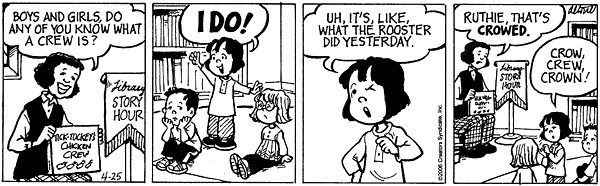
The One Big Happy from April 25th:

(Tick-Tocket’s Chicken Crew seems to be a children’s book invented for this cartoon. But the title is plausible.)

Library Lady asks abut the noun crew, Ruthie (who often marches to the beat of her own drummer) responds with crew, a PST form of the verb crow — and then goes on to conjugate

crow (BSE/PRS), crew (PST), crown (PSP)

Read the rest of this entry »

Everything under comptrol

May 21, 2018

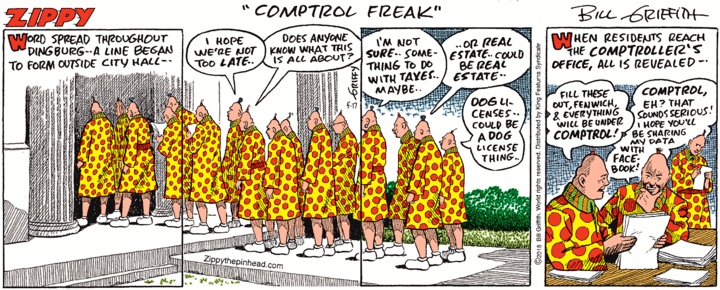
The Zippy from the 17th, with some droll play on the occupational title comptroller:

(#1) The last panel brings us the N comptrol, back-formed from comptroller

Read the rest of this entry »

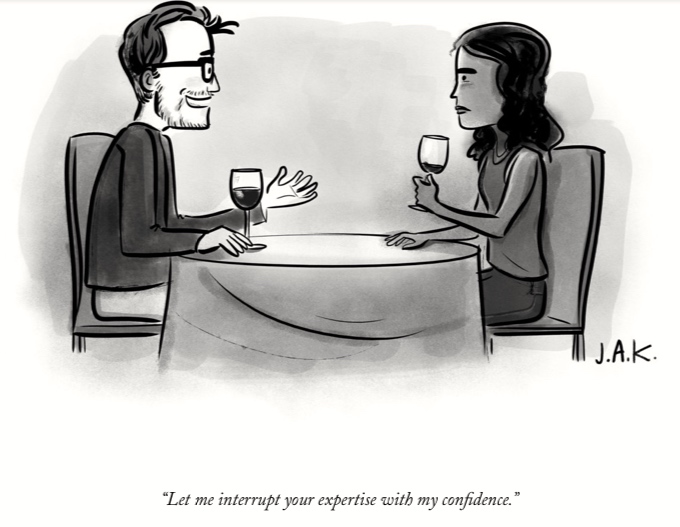
If I might interrupt…

May 21, 2018


Jason Adam Katzenstein in the New Yorker — from a 1/11/18 posting on my blog, “The triumph of confidence over expertise”

Happening on Friday: a PhD oral dissertation defense by Katherine Hilton: What Does an Interruption Sound Like?, Friday, May 25th

(AMZ: About the subjective experience of interruption in conversation and how you might investigate it.)

Read the rest of this entry »

bunny ears

May 21, 2018

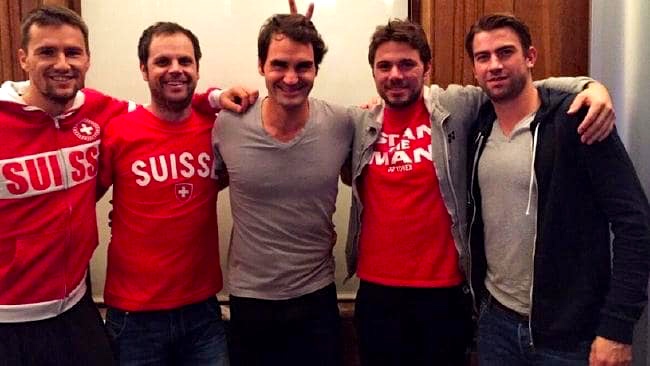
It started with a candid photo of people at a social gathering, with one person making a V hand gesture behind the head of the person next to them, much as in this photo of pro tennis players:

(#1) Swiss jock jokery:  Stan Wawrinka doing the ‘bunny ears’ gesture behind Roger Federer

Bunny-earing someone is a prank (NOAD on the noun prank: ‘a practical joke or mischievous act’), pranks being a very culture-specific form of play + humor that deserve analytic attention that I’m not able to provide, but will just take as a cultural given here.

To come: a bit of the history of bunny-earing; senses of the expression bunny ears (illustrating (mostly metaphorical) sense developments in many directions); and uses of the V hand gesture (illustrating symbolic functions of many different kinds; the gesture itself is “just stuff”, without intrinsic meaning, which can be exploited for many different symbolic purposes). The act, the meanings of the linguistic expression for the act, the cultural significances (or “social meanings”) of the act.

Read the rest of this entry »

A zombie lurches in the NYT

May 20, 2018

From the New York Times, “Is a Dumber Phone a Better Phone?” by John Herrman, on-line on May 16th, in print today under the title “A new crop of smartphones has arrived, aiming to improve on the iPhone — not by being better but by being substantially worse” (crucial bit boldfaced):

[Nokia’s model] 3310 is at its genuine best when it falls like a smooth stone into your pocket, where, rather than constantly buzzing at the periphery of your consciousness, it sits inert, ready mostly to be ignored.

The alternatives, which turn on what’s in the scope of the modifying Adv mostly ‘usually, generally’ (NOAD):

(a) mostly ready to be ignoredmostly modifies the predicative AdjP ready to be ignored

(b) ready mostly to be ignored (above) – mostly is either a postmodifer of ready or modifies the infinitival VP to be ignored

(c) ready to mostly be ignored (“split infinitive”) – mostly modifies the predicative BSE-form VP be ignored

(d) ready to be mostly ignored (“split verb”) – mostly modifies the predicative PSP-form VP ignored

The intended meaning is that what is usual or general is for the user to ignore the smartphone.

Alternative (a) has the wrong meaning; alternative (d) has things just right; alternative (c) is very close to equivalent in meaning to (d); and alternative (b) is ambiguous, with one meaning not the intended one and one close to equivalent in meaning to (d), but with modifying mostly quite distant from the crucial verb-form ignored, which makes (b) really clunky (as well as potentially misleading. I’d go for something like (b) only if it was the only available alternative, and it jumped out at me unpleasantly when I read Herrman’s piece.

A great many writers and editors would avoid (c) because it’s a (so-called) “split infinitive” (SI), a construction with material intervening between the infinitive marker to and its VP complement. Irrational aversion of SIs has a long sad history, but even peevish and sticklerish usage advice has been shifting in their favor in many circumstances: the Economist and the AP Stylebook, among others, have now gotten on board.

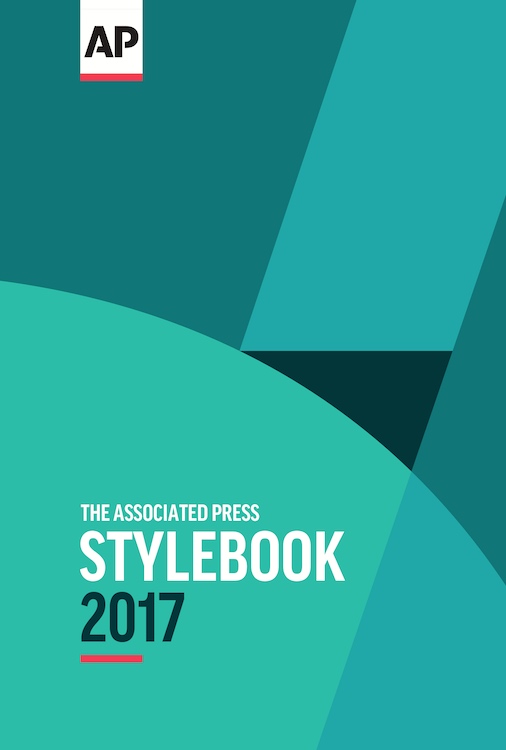
(The 2017 print edition; 2018 is available on-line to subscribers.)

Alternative (d) — which, I remind you, ought to be the clearly favored one — falls foul of an irrational aversion that has an even sadder, and weirder, history than the proscription against SIs: a proscription against “split verbs” (an SV has material intervening between an auxiliary and its head verb), as in I will soon leave as an alternative to I soon will leave (and Soon I will leave and I will leave soon). Part of the weirdness of the no-SV “rule” is that it’s a journalist thing, essentially unknown outside of style/usage advice for journalists, but held to with great ferocity there.

There’s considerable discussion on Language Log on the SV ban, especially by Mark Liberman (search under “split verb”), and some on this blog, but the most pointed treatments of the SV ban have come from John McIntyre in his copyediting column in the Baltimore Sun. John periodically rages against this usage superstition (as Bryan Garner terms such “rules”), this zombie rule (my terminology), heaping piles of steaming abuse on it as “the dumbest rule in the AP Stylebook” and the like. On this blog, me writing about John in a 6/19/09 posting “McIntyre, simmering”.

Maybe the AP Stylebook folks finally listened to John (he talks this way at copyeditors’ conferences, after all), or maybe the revelation came down to them in a flaming pie, but it seems they’re no longer insisting that writers and editors undo SVs in favor of something else, anything else (except an SI, of course).

But old habits die hard, and we see in the passage from John Herrman’s piece (above) an experienced journalist’s adherence to the SV ban, at the cost of producing a little bit of strikingly unlovely prose. All the more noticeable because it immediately follows some lively, nicely crafted writing.
Blue light special

May 20, 2018

(Mansex in street language, not suitable for kids or the sexually modest.)

As Pride Month approaches, the image from the May 14th Daily Jocks ad, for Breedwell harnesses and underwear (with my caption under the fold):

Flip breeds well

Read the rest of this entry »

Two from Fairbanks

May 20, 2018

Two cartoons recently passed on to me by Chris Waigl in Fairbanks AK: a Cheer Up, Emo Kid (CUEK), about technical uses of words; and (actually from Alaska) a Tundra, about point of view in the interpretation of compound nouns.

Read the rest of this entry »

Charmed, I’m sure

May 20, 2018

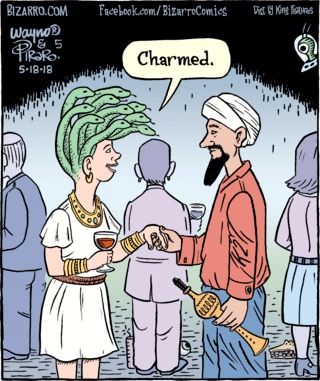
The Bizarro/Wayno from the 18th, another exercise in understanding cartoons:

   (#1) (If you’re puzzled by the odd symbols in the cartoon — Dan Piraro says there are 5 in this strip — see this Page.)

Three things to recognize: the figure of Medusa, the figure of the (Indian) snake handler, and the politeness formula charmed. And then, of course, you need to know that such snake handlers are conventionally known as snake charmers in English and that  the politeness formula is part of the social ritual of introduction, where it serves as an alternative to Pleased / Pleasure / Nice to meet you, formal How do you do?, and the like.

Read the rest of this entry »

The egg patrol: plastic to porcelain

May 20, 2018

It started on cable tv (in a commercial) and ended in England’s industrial Midlands (with birds — wrens and a finch — and a museum). All to cook eggs.

Read the rest of this entry »

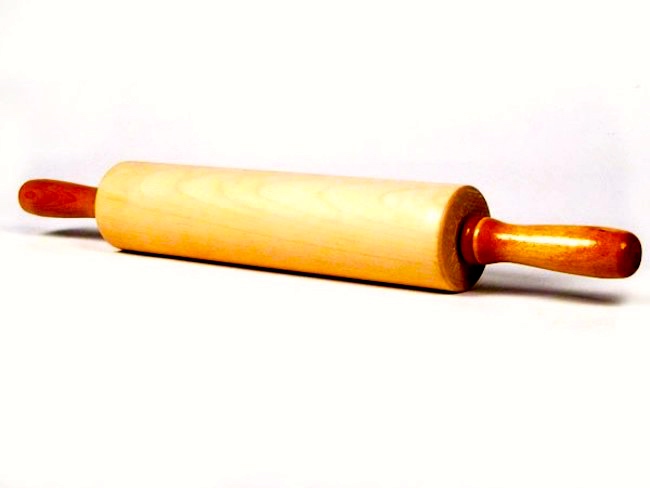
Rolling pin

May 19, 2018

Today’s morning name. I’m baffled as to what might have dredged this compound noun (for an ordinary kitchen utensil) out of my unconscious, but there it is.

(#1) A particularly handsome rolling pin (wooden roller style) from The Ceramic Shop

Read the rest of this entry »