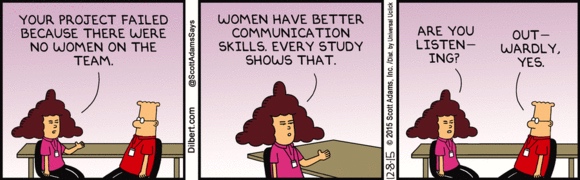
From the 8th, featuring Alice:
 (#1)
(#1)
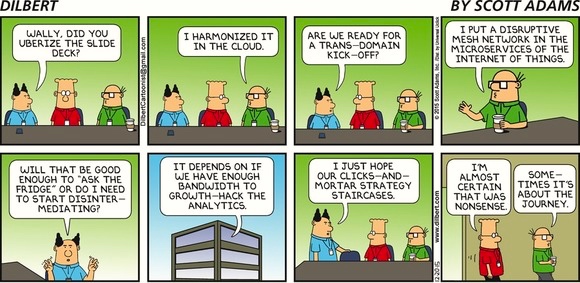
and from the 20th, featuring Wally and the pointy-haired boss:
 (#2)
(#2)
From the 8th, featuring Alice:
(#1)
and from the 20th, featuring Wally and the pointy-haired boss:
(#2)
Back on April 4th, I posted about two language-related pieces in the New Yorker, the first a reminiscence by Mary Norris about jobs she had held, tracing her route to the copydesk at that magazine and her career as a “comma queen”. About that time the expansion of this essay into a book appeared: Between You and Me: Confessions of a Comma Queen (W. W. Norton). And now some reviews, including one by Patricia O’Conner in the NYT Book Review on April 19th, beginning:
Copy editors are a peculiar species (I’ve been one myself, and at the very publication you are now reading). But those at The New Yorker are something else entirely, a species nova that mutated into existence in 1925 and would hurl itself off a cliff rather than forsake the dieresis in “coöperate.”
Today’s Zits:
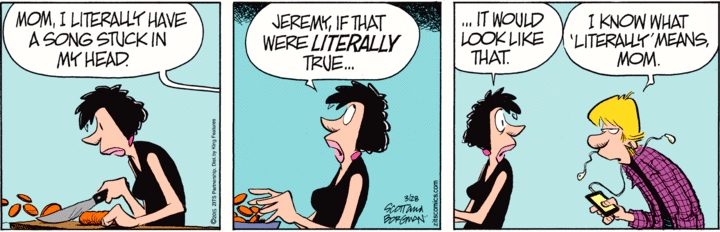
Instances of literal literally are surely outnumbered these days by intensive literally, but there’s still a place for it.
Today’s Dilbert, in which the pointy-headed boss asks for investment advice:

The boss is fine with colorful figurative jargon in the investment world, but balks at the term diversification because of the spelling challenges it presents.
Back in November, Business Insider posted a piece, “A Leaked Internal Uber Presentation Shows What The Company Really Values In Its Employees”:
One page of the document defined which qualities all Uber employees are expected to possess. Those qualities, or “Uber Competencies,” are: Vision, Quality Obsession, Innovation, Fierceness, Execution, Scale, Communication, Super Pumpedness
Business Insider picked out two of these, super pumpedness and fierceness, as especially worthy of mockery. And now Scott Adams’s comic Dilbert has exploited these in two strips, from yesterday and today.
Two usage queries came to me recently: one on uses of a noun doxy; one on two informal idioms (the whole shooting match and wham, bam, thank you ma’am (with some variant versions)): Max Vasilatos reported coming across two Californian young men, one of whom didn’t understand the first, the other of whom didn’t understand the second.
It starts with ISIS or Isis as a name for the Sunni jihadist group, inadvertently echoing the name of a goddess of ancient Egypt; the name of the good-guy organization on the tv show Archer; and the name of a non-standard construction in English. The tv show is going to phase out the ISIS name, but I’m sticking with the English usage name ISIS / Isis.
From Martin Kaminer to ADS-L on the 28th, a link to this wonderful 2000 comic strip by Neil McAllister (apparently the only extant episode of Adventures of Action Item):
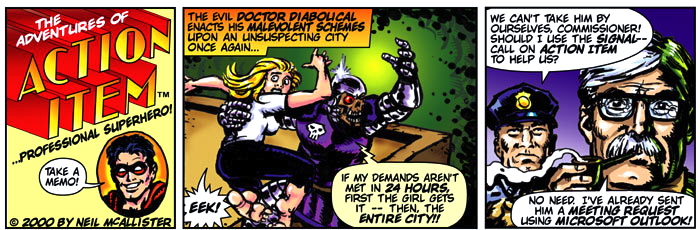
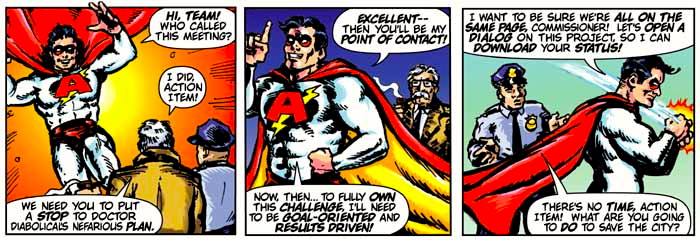
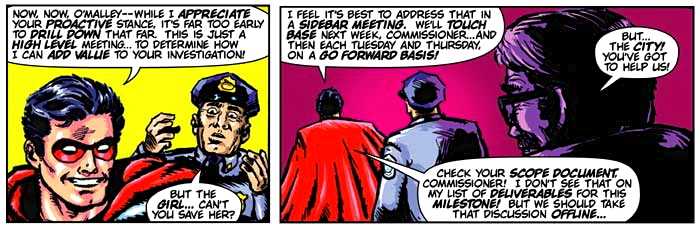
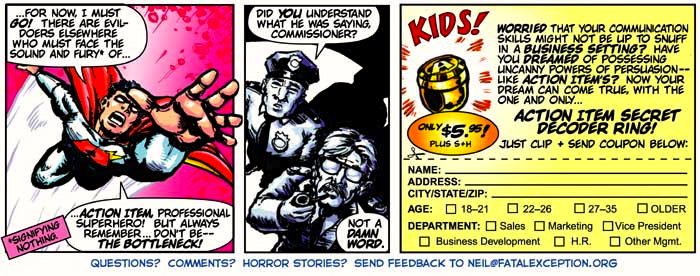
Mostly about jargon, but it also raises questions about discourse organization, in this case about how business meetings are organized.
Today’s Zippy has Dingburgers, drawn into camps on issues of linguistic variation and usage, slinging lots of technical terminology:
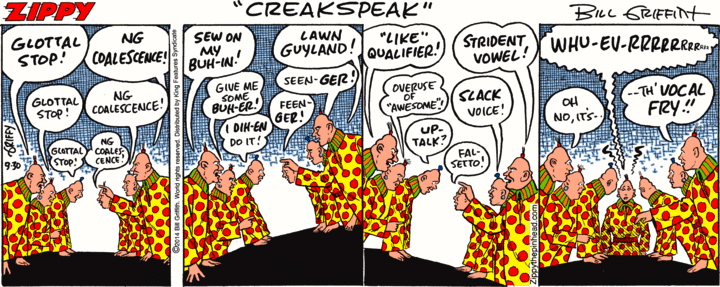
Most of these features — the glottal stop, NG coalescence, like, awesome, uptalk, whatever, vocal fry (creak, creaky voice) — have been discussed on Language Log or here, because they are associated with a collection of geographic or social dialect characteristics (region, age, sex, class, etc.) or particular styles and registers; they are socioculturally significant, usually in quite complex ways. The remaining three — strident voice, slack voice, and falsetto — are phonation types that have, I think, escaped attention on these blogs
The short version of an ad for a gay dating/cruising app:
MISTER is an online community for men who value themselves and other men. Unlike other gay social networking apps, MISTER encourages users to show their faces, show respect, spend less time searching and more time meeting men in the real world. The users of our app are proud to say, “I am MISTER.”
(There will eventually be a linguistic point.)