Today’s Bizarro:

(medical) marinara as a pun on (medical) marijuana: same prosody (double trochee), same first syllable, same final schwa. Then there’s Mrs. Rotini, the (literal) pasta woman, suitable for treating with marinara sauce.
Today’s Bizarro:
(medical) marinara as a pun on (medical) marijuana: same prosody (double trochee), same first syllable, same final schwa. Then there’s Mrs. Rotini, the (literal) pasta woman, suitable for treating with marinara sauce.
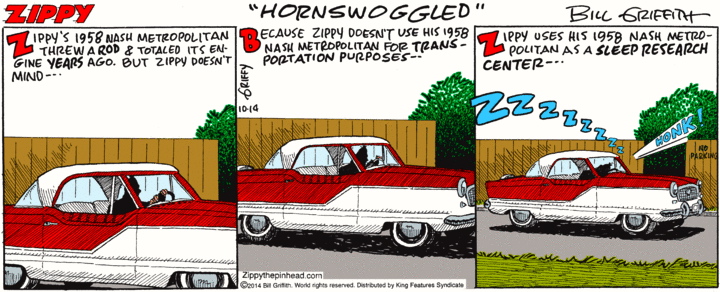
Today’s Zippy, with not much linguistic in it, but it recalls an earlier Zippy posting:
 (#1)
(#1)
Earlier on this blog: a posting of 10/3/14 on Zippy’s Unicar, a fanciful hybrid creation with a Nash Metropolitan chassis on a unicycle body — and a portmanteau name.
Three cartoons today on some version of this theme: a One Big Happy, a Bizarro, and a Zits.
Today’s Zits:
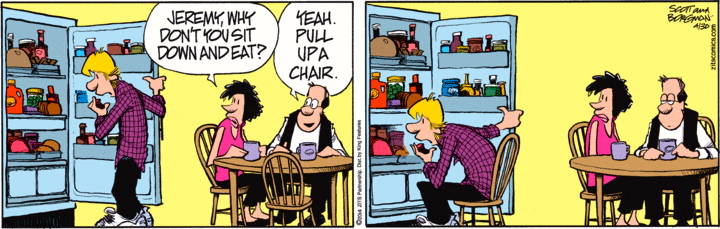
Jeremy’s parents don’t say this, but they intend to convey (something like) ‘…sit down and eat with us‘ and …pull up a chair at the table‘, but Jeremy chooses to disregard this possibility and pulls up a chair in front of the open refrigerator, so he can browse the food there.
Today’s Zits:
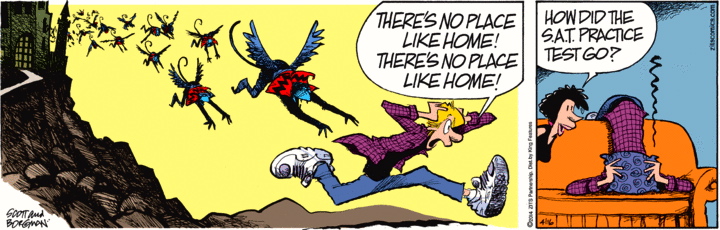
Two things from the 1939 movie The Wizard of Oz: the flying monkeys and the mantra “There’s no place like home”.
On Facebook, Karen Chung has passed along this Xmas posting of 2013 (19 December) from the estimable Arika Okrent in The Week:
‘Tis and 10 other fun proclitic words
English likes to stick contractions on the end of words. “They have” becomes “they’ve,” “I will” becomes “I’ll,” and “do not” becomes “don’t.” The shortened parts of these words are called enclitics — they are a bit more independent than suffixes, but like suffixes, they attach to the ends of words. English also used to have a number of proclitics — shortened words that attach to the beginning of other words. Most proclitic words are now archaic or obsolete, but every December the neglected proclitics get their revenge, as a holiday avalanche of “’tis” rolls through town.
(Yes, ’tis shifts to it’s eventually.)
Extracting this from John Baker’s comment on my previous posting, the image of the Tilt’n Diner in Tilton NH:

Now, this matches the image in the Zippy in my previous posting. Nice photo.
From the 21st, this posting by a woman looking for a home for her two daughters:
My name is Sarah and I live in Edmonton, Alberta. I have two extra-ordinary daughters (aged 8 and 9) whom have been handed a rough time due to life’s unpredictable circumstances.
Notable whom. There are circumstances (examined on Language Log and this blog) when for structural reasons the choice between who and whom is complex and debatable. This is not one of them; the prescriptive standard here is who. But we can speculate as to where the whom might have come from.
Elizabeth Traugott/Arnold Zwicky
Linguistics 63N. Week 3. Varieties: Gender stereotypes. Jan 23rd.
Models: broad frames of reference used in various fields. In social sciences there were two main competing models in the 20thC, commonly referred to as “nurture vs. nature”:
a) “Nurture”, social construction: “[T]he process [of cultural transmission from generation to generation] is maintained through learning, a well-understood and unitary process, that acts to make the child like the adult of her culture”, which as a group process is “called ‘socialization’, imposed on the child by the group”, and “the individual is the…passive recipient…and product of her culture” (John Tooby and Leda Cosmides. 1992. The psychological foundations of culture. In Jerome H. Barkow, Leda Cosmides, and John Tooby, eds., The Adapted Mind, chapter 1, pp. 19-136. Oxford: Oxford University Press.) Therefore “the mind of the individual is almost entirely shaped by their culture and facts about a culture are not products of human nature”. (http://www.goldmark.org/jeff/papers/ridley/html/node1.html)
b) “Nature”: involves at least some degree of universalism. Human nature determines culture to at least some degree.
Likewise in linguistics, there were two major competing models of the mind:
a) First half of 20thC: the mind as a blank slate shaped largely by input and culture (see e.g. Leonard Bloomfield, Language, 1933).
b) Second half of the 20thC: the mind as a highly structured language learning device shaped by an innate Universal Grammar (see e.g. Noam Chomsky, Syntactic Structures, 1957). The focus is on cognitive structures, the language capacity, and language as a unique property of the mind. Communication is considered to be secondary.
In both these linguistic models, the child is relatively passive, and interlocutors more or less mirror each other. Variation, especially social variation, is not a particularly important factor. Here is a famous sketch of communication by Ferdinand de Saussure. 1916. Course in General Linguistics. Trans. By Roy Harris, Open Court: La Salle, IL, USA, 1983.

A model of growing importance in the 21st century (but going back to the 1960’s) is interactional and social. It combines elements of nature and nurture. The child is thought of as actively interacting with caregivers and the environment, so environment and use influence mind and mind in turn influences environment. Whatever universal abilities there are, are considered to be minimal. Language is one of many cognitive abilities, and is not sharply distinct from communication (see e.g. Adele E. Goldberg. 2006. Constructions at Work: The Nature of Generalization in Language. Oxford: Oxford University Press). Emphasis is on practice (see Eckert, Penelope. Linguistic Variation and Social Practice. Oxford: Blackwell, 2000).
In this model, interlocutors may be very different. Factors such as differences in age, gender, etc., play a large role. Men have been shown by sociolinguistic work to promote local, often vernacular, varieties, whereas women promote supralocal, more standard varieties (see Labov, William. 1990. The intersection of sex and social class in the course of linguistic change. Language Variation and Change 2: 205-254).
All humans categorize. Depending on the model adopted, this may be because they learn the categories already established a) in their culture or b) in their cognitive system. Categorization is a major research issue in linguistics.
a) Are linguistic categories (e.g. animacy, obligation, motion) discrete with sharp boundaries?
b) Are categories prototypical, with marginal members and fuzzy boundaries?
Many comics comment on variation, and either further or laugh at social categories/stereotypes such as teen-talk and gender-talk.
What teen stereotypes have we encountered?
Gender stereotypes
Jerry Scott and Jim Borgman, Zits, (date? Appears to be 2005)

http://itre.cis.upenn.edu/~myl/languagelog/archives/002101.html
Cathy Guisewite, Cathy, 4/26/2005

http://itre.cis.upenn.edu/~myl/languagelog/archives/003609.html
Scott Adams, Dilbert, 9/21/2006

http://itre.cis.upenn.edu/~myl/languagelog/archives/003609.html
Mark Liberman says in the blog at this site that this comic strip reminds him of “Many women find biological comfort in one another’s company, and language is the glue that connects one female to another” (Louann Brizendine, The Female Brain, Morgan Road Books, 2006).
Today’s Pearls Before Swine:

Love flatula.