Archive for the ‘Syntactic categories’ Category
October 26, 2025
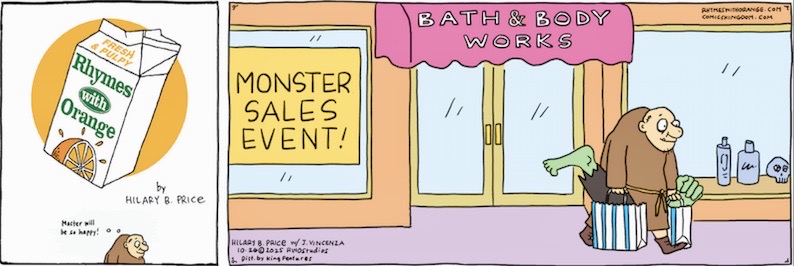
In today’s Rhymes With Orange strip, a sale at Bath and Body World:

A sale of body parts from and/or for monsters — not what comes to mind when you come across the N + N compound monster sale, which is a dauntingly large sale, one that’s (metaphorically) a monster
Now the details.
(more…)
Posted in Ambiguity, Language and the body, Lexical semantics, Linguistics in the comics, Metaphor, Semantics of compounds, Syntactic categories | 2 Comments »
January 20, 2025
There was this paper of mine (“Jottings on Adpositions, Case Inflections, Government, and Agreement”), originally from 1988 but not properly published until 1992 (in The Joy of Grammar: A festschrift in Honor of James D. McCawley), that I wanted to quote from in an on-line discussion a week ago, only to discover that after the great dispersal of almost all my books and files some years back, I had no trace left of the thing, no copy of any kind (this sort of thing keeps happening to me). I couldn’t find a way to get a copy on-line, but in a stroke of luck it turned that Benjamins was selling off its remaining stock of the paperback edition of Joy at a price I could actually afford, so I bought their last copy and had it mailed to me next day delivery. This morning I created jpegs of all 15 pages (369 through 384); the quotation I need is on the first page, but now I can add this posting of all 15 pages to the little set of publications of mine available on-line.
(more…)
Posted in Adpositions, Agreement, Articles, Case, Government, Inflection, Linguistic theory, Morphology, Syntactic categories, Syntax | 2 Comments »
July 1, 2024
Posted on the LINGTYP (Linguistic Typology) mailing list today, reproduced in this posting to illustrate one of the ways linguists play around with data and ideas as they try to figure out what’s going on on some specific case — looking for inspiration in (roughly) similar cases in other varieties of language.
If that’s what you want to do, you want to go where the linguistic typologists hang out. On LT, from Wikipedia (very briefly):
Linguistic typology (or language typology) is a field of linguistics that studies and classifies languages according to their structural features to allow their comparison. Its aim is to describe and explain the structural diversity and the common properties of the world’s languages.
LTists have a society, the Association for Linguistic Typology (webpage here), which organizes meetings, publishes a journal, and sponsors that mailing list, for open discussion of typological matters. Like the one I brought up today:
(more…)
Posted in French, Language change, Languages, Linguistic diversity, Poetry, Syntactic categories, Variation | 1 Comment »
August 14, 2023
What her mother says to Ruthie in a vintage One Big Happy comic strip that came up in my comics feed some time ago:

How to understand the sentence (X) You look pretty dirty? Ruthie’s mother intends X to be understood as something like ‘You look rather dirty’, while Ruthie understands X as “You look pretty when you’re dirty’ — no doubt a willful misunderstanding, finding a compliment in her mother’s words — and responds accordingly
(more…)
Posted in Ambiguity, Argument structure, Constituency, Constructions, Lexical semantics, Linguistics in the comics, Relevance, Semantics, Syntactic categories, Syntax | 2 Comments »
September 21, 2021
Back in my 9/4 posting “How does Wilderrama sleep at night?”, I appealed to my colleagues in semantics:
Dictionaries seem not to do a lot of sense differentiation for how — NOAD boils the relevant OED2 entry down to ‘in what way or manner; by what means’, all as one sense — and I don’t know anything in the semantics literature that covers this territory (but then I’m basically pig-ignorant of the semantics literature [this is hyperbolic, meant to be entertaining, but the truth is that what I know of semantics is unsystematic and patchy, things I’ve picked up as a syntactician outsider], so I’m sketching a treatment improvisationally here. I would be happy to be illuminated.
And got a fine thoughtful response from Hana Filip (Professor of Semantics in the Dept. of Linguistics at Heinrch-Heine-Universität Düsseldorf), in several installments, which I will incorporate (lightly edited) below, with her permission, as a guest posting. I induced her to agree to release this material, despite its being preliminary and far from publication style, with this appeal:
The point would be not that [you and I are] hammering out an answer, but that we’re thinking things through. My readers are mostly not linguists, so they don’t get to see linguists at work, before things turn into published material. In particular, they don’t get to see us using a conceptual apparatus (and the technical vocabulary to go with it) to try to make sense of the world; we don’t inject that technicality into the discussion just for show — but much of it is really necessary to get past the point of just accumulating judgments and examples from texts.
That will involve my contributing explanatory text at various points, to fill in things that Hana and I take for granted (on her side, she’s not a specialist in syntax, but shares a considerable body of conceptual background with me in syntax). The result is then something like a public conversation between us, with me turning to the audience every so often with commentary on the proceedings.
(more…)
Posted in Modality, Semantics, Syntactic categories | Leave a Comment »
April 8, 2020

… not Monty Python’s Flying Circus, but: Auxiliary Reduction (AuxRed) in English (one of the phenomena sometimes known as contraction), which I’ve been thinking about on and off since, oh, 1968.
AuxRed, as in: The proof’s in the pudding. We’re off to see the Wizard. It’s a long long way to Tipperary.
Some background material on AuxRed and an inventory of postings on this blog are now available on a new Page on this blog.
Posted in Movies and tv, Resources, Syntactic categories, Syntax | Leave a Comment »
February 15, 2020
In my “Socka Hitsch” posting yesterday, Christian Zwicky / Socka Hitsch described by the nominal
old eccentric rural Swiss roadside sock vendor ‘old, eccentric sock vendor on the roadside of rural Switzerland’, ‘seller of socks along the road in the countryside of Switzerland who is of advanced age and exhibits unconventional behavior’
An unusually long nominal — I was showing off some — but not one with unusual components, put together in unusual ways. In the middle of it, rural Swiss roadside, with the complex adjectival rural Swiss, modifying the compound noun roadside — a perfectly routine and unremarkable expression (compare rural Dutch in the attested rural Dutch landscape, urban English in the attested urban English roadworks, etc.), but one of some interest to people who fret about how the form — the morphology and syntax — of expressions (like rural Swiss) links to their meaning — their semantics and pragmatics.
(more…)
Posted in Categorization and Labeling, Language and plants, Lexical semantics, Modification, Semantics, Semantics of compounds, Switzerland and Swiss things, Syntactic categories, Syntax, Words and things | Leave a Comment »
March 21, 2019
From Karen Chung on Facebook a while back, this complex pun in the 9/25/15 Bizarro, illustrating (among other things) a nice contrast in accentual patterns: front stress (or forestress), the default for N + N compounds, in MOVING sale; back stress (or afterstress), the default in Adj + N nominals, in moving SALE:

(#1) (If you’re puzzled by the odd symbols in the cartoon — Dan Piraro says there are 5 in this strip — see this Page.)
So the hinge of the pun is the ambiguity of moving: as N, (roughly) ‘the act or process of changing residence’; or as Adj, (roughly) ‘causing strong emotion, esp. of sadness’ (both senses are ultimately semantic developments from the simple motion verb move, intransitive or transitive; but they are now clearly distinct lexical items). Then from the difference in syntactic category follows the difference in accentual pattern.
(more…)
Posted in Ambiguity, Common vs. proper, Compounds, Derivation, Linguistics in the comics, Movies and tv, Names, Phonology, Pop culture, Semantics, Syntactic categories, Variation | 3 Comments »
February 3, 2019
The Hi and Lois cartoon from 2/7/16:
 (#1)
(#1)
Super Bowl Sunday — today, this year — joins Thanksgiving and Christmas as a holiday that serves as an occasion for gatherings of family and friends plus a spread of characteristic food. A family food holiday, for short.
The SBS holiday crucially involves the Super Bowl football game, for the NFL championship: this year, SB LIII (El Ay Ay Ay!), New England Patriots vs. Los Angeles Rams at Mercedes-Benz Stadium in Atlanta GA (6:30 ET).
While much of the US population gathers around tv sets for the game, its half-time show, and its ads — virtually emptying out many public spaces — others seek out alternatives. (I myself have an unbroken record of studied inattention to the game, from SB I in 1967 on.) Alternatives that are cultural, recreational, commercial, and even sexual. (This posting will devolve into tales of SBS mansex, but I’m putting that material at the end, so kids and the sexually modest can enjoy the rest of this material and then bail out when the gay guys strip and go at it with one another like weasels in heat.)
(more…)
Posted in Compounds, Expressive language, Gender and sexuality, Holidays, Language and food, Language and sports, Linguistics in the comics, Spelling, Syntactic categories | 5 Comments »