Four in my comics feed Sunday morning: a One Big Happy with the derived adjective quotatious; a Zippy on pangrams; a Mother Goose and Grimm with an ambiguity in marine biologist; and a Doonesbury nominally about pronoun choices, but about much more.
Archive for the ‘Syntactic categories’ Category
Language Sunday in the comics
December 12, 2016The pronoun strip
February 22, 2016Today’s Calvin and Hobbes is a replay of a strip from 2/24/86:
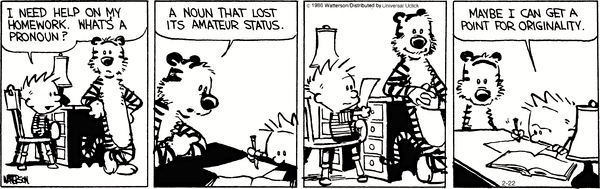
I remember this strip (with its play on two senses of pro) with great fondness, and I was sure it had been posted (possibly by me) on Language Log or this blog, but an hour’s searching found nothing, so I’m posting it here.
Conjunction or preposition?
May 21, 2015In the NYT yesterday, p. 19, in “Happy Rockefeller, 88, Whose Marriage to Governor Scandalized Voters, Dies” by Robert D. McFadden:
many Americans were shocked when Margaretta Fitler Murphy, called Happy, and Mr. Rockefeller, who was nearly 18 years older than she, married on May 4, 1963.
The point is than she, with a nominative pronoun in construction with than — where many people (I am one) would have used the accusative her. There’s a long-standing issue in usage here, which I’ve posted about on this blog (as “Dinosaur grammar”), in connection with a Dinosaur Comics.
Adverb and Adverbial
November 7, 2014While I was preparing a posting on xkcd‘s “Language Nerd” strip — I think very slowly and write even more slowly — my Language Log colleagues Geoff Pullum and Mark Liberman zipped into gear on the way language nerd is used in the strip in the expression (1), an instance of the construction in (2):
(1) to go all language nerd on you
(2) to go (all) X (on s.o.)
In my posting I referred, rather too hastily, to
the construction in go (all) X (on s.o.), where X is a nominal — here, a N + N compound (language nerd, sentence fragment) — converted to an adverbial in construction with the verb go
The problem is my use of converted, suggesting that language nerd (also sentence fragment) is converted from one syntactic category (or “part of speech”) to another, as in other examples in the strip, which involve true conversion, specifically the verbing of nouns. But what’s going on in (1) (and more generally in (2)) is not conversion, but the use of expressions of one syntactic category (here, a N-headed expression) in a syntactic function characteristic of a different category: in this case, not conversion of N to Adverb, but use of N in the syntactic function Adverbial, specifically the Adverbial subtype Modifier-of-V.
Fap!
September 10, 2014Following up on my posting on the verb fap(p) ‘to masturbate furiously’, Robert Coren thought he recalled Fap! as “an exclamation of annoyance commonly used by a character in some ancient comic strip — I think maybe Major Hoople”. Yes, indeed, Aric Olnes replied, Major Hoople, and supplied this strip:

(Chris Ambidge added that “FAP is one of my favourite words to use when annoyed or frustrated.”)
A Bizarro replay
August 13, 2014On Facebook recently, this Bizarro cartoon (from 1/29/07) passsed on by Grammarly:

Michael Siemon then asked if I was aware of this cartoon. As it turns out, I posted about it on Language Log on 1/30/07, under the heading “Pronouns: The early days” — but, unfortunately, because of changes in the LLog platforms, the cartoon itself has became unavailable in the LLog archives. So here’s a replay.
Three on Mothers Day
May 11, 2014This morning’s crop of cartoons with some linguistic interest: a Rhymes With Orange that is, among other things, about Mothers Day; a Mother Goose and Grimm with, in passing, an interesting example of out as a preposition; and a Doonesbury on outsider / folk art.
The new word slash
April 25, 2013From Anne Curzan’s column on the Lingua Franca blog yesterday:
Slash: Not Just a Punctuation Mark Anymore
Lots of us use the slash (/) in writing to capture two or more descriptions of the same thing, with a meaning something like “or,” “and,” or “and/or” — e.g., “my sister/best friend” or “request/require.” The slash typically separates two things that are the same part of speech or parallel grammatically; and we can say that slash out loud if needed: “my sister slash best friend.”
Now I wouldn’t write that phrase down that way, with the slash spelled out, but students tell me they now often do.
to long grass
August 30, 2012Caught by Chris Hansen (posting on Facebook) in the Guardian, here:
[Boris] Johnson [Mayor of London], who had been a siren voice within the Conservative party over airport capacity until the Heathrow reversal campaign gathered momentum, urged Cameron to come up with a definitive answer to the capacity issue. “It is plain that the argument over aviation capacity is not going to vanish and he can’t long grass this. It is necessary to come up with an answer.”
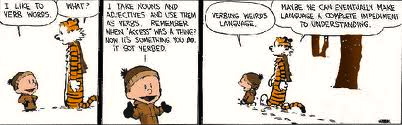
That’s a verbing of the phrase long grass — a phrase extracted from the (metaphorical) idiom to kick into the long grass.
This would be a good time to post the famous Calvin and Hobbes cartoon on verbing (which has often been quoted on Language Log and this blog):
Zits replay, slower and faster
August 27, 2012Today’s Zits — with Jeremy talking so fast his mother can’t understand what he’s saying — turns out to be a repeat performance; I posted about this strip on Language Log in 2009, under the title “Teen speech in overdrive”.
Jeremy’s mother: “Can’t you just talk slower?” Jeremy: “Can’t you just listen faster?”
On slow/slowly, see Language Log here and here and Motivated Grammar here.