Archive for the ‘Syntax’ Category

Spem in alium

December 20, 2010

A few days ago, my iTunes brought me Thomas Tallis’s magificent motet Spem in alium (ca. 1570), as performed by the Choir of King’s College, Cambridge — causing me to stop what I was doing and just listen to this extraordinary 40-part masterpiece (eight choirs of five singers each) for 11 minutes. I’ve never experienced a live performance of it, much less a performance with the singers arrayed in a horseshoe around the listeners. (Understandably, it’s not often performed, because of the extraordinary demands it makes on the singers.)

I bring it up here because of the name Spem in alium — the first three words of the Latin text, which begins

Spem in alium nunquam habui praeter in te ‘I have never put (my) hope in any other but in You, I have never had hope in another beyond/besides/except in You’

That is, spem in alium ‘hope in another’. Without the context you can’t tell that this phrase is not in fact a constituent in Latin; it’s not spem in alium ‘hope in another’ functioning as a NP, but rather the sequence of the NP spem ‘hope (acc.)’ and the PP in alium ‘in another’, both functioning as complements of the perfect verb habui ‘I have had’. So it’s a part of a VP constituent but not a constituent on its own.

A while ago, Geoff Pullum collected examples of non-constituent book titles, for example Andrew Holleran’s Dancer From the Dance (like Spem in alium, a non-constituent of the form NP + PP); see Language Log postings here and here. He observed that such titles seem to be pretty rare in English. I’d imagine that the practice of referring to Latin texts by their first few words will yield many more Latin examples, especially given the famously free word order of Latin.


 

Data points: non-parallelism 12/16/10

December 16, 2010

From the NYT on December 13, relevant portion boldfaced:

Inmates in at least seven Georgia prisons have used contraband cellphones to coordinate a nonviolent strike this weekend, saying they want better living conditions and to be paid for work they do in the prisons. (Sarah Wheaton, “Inmates in Georgia Prisons Use Contraband Phones to Coordinate Protest”)

Here, the verb want has two complements: a direct object NP and an infinitival VP. Not the same in their internal structures or constituent category, though infinitival VPs can function like NPs in many contexts. Examples of NP + VPinf are in fact common, to the point where it’s not clear to me that they should be treated as grammatically problematic. A few more examples from my files:

If you want prints or to join my email list, ask me by email. (artist and photographer Clint McClintick, on his site)

[She] wanted more personal time and to play in a drum and bugle corps. (NPR’s Morning Edition 4/2/08)

His future plans include more time with his family and to write a book. (NPR’s All Things Considered, 8/13/07)


The Xmas package

December 15, 2010

From Undergear today, a holiday offer with a pun on package:

The model is presenting his (genital) package as a gift package. On offer on the site is this remarkable California Muscle® Under World Jockstrap (model costs extra):

With a description emphasizing the sexual properties of the clothing:

Made with bold silver accents, this tough-looking jockstrap will help you make someone an offer they can’t refuse. The pouch and waistband come together at a silver ring that lets everyone know just what kind of a hardware you’re packing. Made from a comfortable nylon/spandex blend, this jockstrap underwear is designed to leave a lasting impression.

“Just what kind of a hardware you’re packing” has a play on the verb packing and on the noun hardware, plus the treatment of hardware as a count noun, with the determiner a — “countification”, as discussed on Language Log here.

Similar usages aren’t hard to find. One example with a:

I am not egocentric, all I would like to do is to collect information for people (like me) that wonder what kind of a hardware they really bought. (link)

And plural hardwares ‘pieces of hardware’ is incredibly common, as in this example:

i have my numark total control and 2 technics 1200 mk2 and my sl3 hardware how do i connect the hardwares to work together (link)

Data points: WH-that 12/4/10

December 4, 2010

Sen. John McCain on the “Don’t Ask Don’t Tell” survey of the military, in a Morning Edition Saturday story this morning on NPR:

… it’s a little bit like studying the Bible: you can draw most any conclusion from what part of it that you examine ___.

The WH complement clause (serving as the object of the P from) is boldfaced. It has an initial (“fronted”) WH phrase what part of it that functions, within the complement clause, as the object of the verb examine; the fronted phrase is underlined above, and the the position of the “extraction gap” is indicated by underscores.

Ordinarily we’d expect the fronting of the object in the complement clause to yield

what part of it you examine ___

but the complement clause in the McCain quote has a that in it. That is, the complement is doubly marked, with a WH word and a that, in what I call the “WH-that” construction.

(more…)

+of EDM in the comics

December 2, 2010

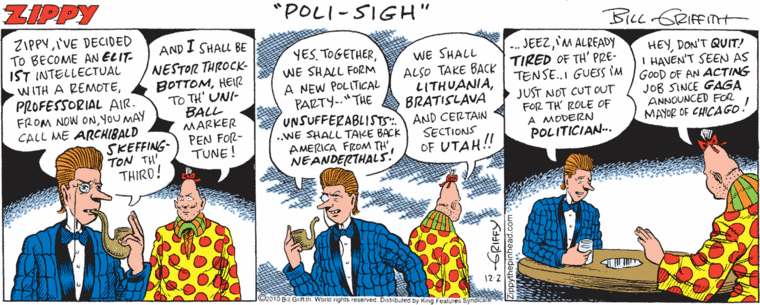
Today’s Zippy:

The point of linguistic interest here is the exceptional degree modification (EDM) with of (+of) in the boldfaced portion of Zippy’s

I haven’t seen as good of an acting job since Gaga announced for mayor of Chicago.

These days, this particular configuration is not even slightly remarkable, though some usage critics, and many peevers-in-the-street, are driven wild by it. The rise of +of EDM as an alternative to the older -of EDM, followed by the replacement of the -of variant by the +of variant (taken to completion by many younger American speakers), is a syntactic change that’s happened in my lifetime.

Some brief notes on these developments follow.

(more…)

Good Fucking Design Advice

November 30, 2010

From Brian Buirge and Jason Bacher on their GFDA site (“Because sometimes, being your own worst critic isn’t enough”). The poster:

There are t-shirts with the individual pieces of advice, and free downloads of wallpaper for them.

Syntactically, there’s a wide range of uses for fucking on the poster: mostly modifying nouns, but also verbs (“Know when to fucking speak up”) and adjectives (“Make it fucking sustainable”). And as in “my hot self” (here), there’s a reflexive broken into its two parts, with a modifier (fucking in this case) intervening between them — really the only natural way to modify a reflexive, since “Believe in fucking yourself” isn’t going to convey the intended sentiment.

The idea seems to be that every piece of advice is more forceful and memorable with a fucking in it.


VPE mismatches

November 29, 2010

A very brief summary of the English construction known as Verb Phrase Ellipsis (VPE), from a 2006 Language Log posting of mine:

Background about VPE: this is an English construction in which the complement of an auxiliary verb (a modal, BE, or perfect HAVE, plus a few other things for some speakers) or infinitival TO is omitted:

(1) I can’t juggle knives, but Dmitri can ___.
(2) I’m not going, but Dmitri is ___.
(3) I was attacked by the wolves, but Dmitri wasn’t ___.
(4) I’ll be unhappy, and Dmitri will be ___, too.
(5) I’ve finished my work, and Dmitri has ___, too.
(6) I don’t want to eat the sashimi, but Dmitri wants to ___.

(The “remainder” elements are bold-faced here, and the missing complements are indicated by underscores.)

Though the construction is usually known as Verb Phrase Ellipsis (sometimes Verb Phrase Deletion), the omitted phrase is not always a VP.  In (4), it’s an AdjP.  “VPE” isn’t a bad name, but it doesn’t tell you everything.  The slogan is: Labels Are Not Definitions.

VPE requires a linguistic antecedent — it’s not enough that the appropriate verbal semantics be “in the air” — but it doesn’t require that the omitted complement match the antecedent perfectly.

I’ve been collecting VPE examples for years now. This is a summary report on the relationship between antecedent (ant) expressions and ellipses (ell) in VPE, focused on the inflectional categories of Vs.

(more…)

Data points: gapless relatives 11/25/10

November 25, 2010

From a commercial for Mr. Clean (a household cleaning agent), seen recently on tv:

(1) He’s cleaning things that we don’t even know what they are.

The relative clause, boldfaced above, has no gap of “extraction” in it; instead, the pronoun they is anaphoric to the head of the relative, things. The gapped version is stunningly worse:

(2) He’s cleaning things that we don’t even know what ___ are.

In (2) the gap is inside an “anaphoric island”, a WH clause, and worse, it’s a subject gap, so using a “resumptive pronoun” instead of a gap, as in (1), repairs the problem in processing the relative clause — yielding something that’s not standard English but is comprehensible.

So (1) is an example of what I called in a Language Log posting from three years ago a ResIsland gapless relative (with a resumptive pronoun repairing an island violation). They are pretty common, and many of them have a somewhat vernacular and playful feel to them, an effect that might make the Mr. Clean commercial noticeable and memorable.


how / that

November 25, 2010

Comic Blunt Card with how used as a complementizer, roughly like that:

(Hat tip to Chris Ambidge.)

(more…)

Determiner-head selection

October 24, 2010

In a single short editorial (“End of One Scourge”, about the elimination of the cattle disease rinderpest) in the NYT yesterday, two anomalous plurals (boldfaced below):

(1) Rinderpest spreads rapidly and kills nearly every animals it infects.

(2) [Rinderpest and smallpox] share a similar history, since both diseases were among the first to be treated by inoculation in the 18th century. Eradication was also made possible by the fact that neither diseases mutated rapidly…

(Both plurals remain in the on-line version.)

(more…)