This morning on Facebook, Otto Santa Ana added a temporary profile picture:
The X NO KINGS signage, taking us into the territory of “double negation”, since both the X and the NO of NO KINGS convey a variety of negation, namely prohibition
This morning on Facebook, Otto Santa Ana added a temporary profile picture:
The X NO KINGS signage, taking us into the territory of “double negation”, since both the X and the NO of NO KINGS convey a variety of negation, namely prohibition
E-mail today from Luis Casillas to me and Luc Baronian (it’s a Stanford connection), with his header:
Apparently English “n’t” is trulyn’t an inflectional affix after all
(intending to convey ‘truly not an inflectional affix after all’) and then the comment:
Seen on Twitter:
(#1) deranged grammar advice on-line
Well, actually, concept time. First come the useful concepts, then come the terms for them. My comments are prompted by Martin Haspelmath on Facebook today, on the useful terms (due to Alexandre François) colexification and dislexification for the expression, in some language, of distinct concepts in a single lexical form or distinct lexical forms, respectively; with MH citing this 2024 article from the journal Asia Pacific Translation and Intercultural Studies: “Colexification of “thunder” and “dragon” in Sino-Tibetan languages” by Hongdi Ding and Sicong Ding. From the abstract:
[372] languages were classified into colexifying and dislexifying languages, depending on whether the two concepts are associated with shared lexical forms. The findings reveal that 47 languages in the sample exhibit thunder-dragon colexification; most of them are Bodic and Na-Qiangic languages, with a few Sinitic, Mongolic, and Turkic languages. This areal pattern results from both inheritance and language contact.
So, patterns of colexification spread areally, through both inheritance and language contact, just like other linguistic features.
Note that colexification must have arisen in at least one language at some time, but this article isn’t about the mechanisms that might have given rise to colexification of ‘thunder’ and ‘dragon’ or to simple examples of colexification in English: ‘grain stalks’ (in the mass N straw) and ‘drinking tube’ (in the count N straw); ‘riverside land’ (in the count N bank, as in both banks of the Seine) and ‘financial institution’ (in the count N bank, as in savings banks).
But now the terminology.
A very much not-dead-yet posting to hold this space while I cope with an avalanche of posting material, plus my suddenly much improved medical condition (which is totally exhilarating). In any case, an old One Big Happy cartoon (originally from 9/4/14) in which Ruthie asks her defiantly working-class neighbor James to name something that comes in pairs, but James hears the homophone pears (both nouns pronounced /perz/ in my variety of English) and just can’t get shift his perspective:
Note James’s multiply non-standard negative existential construction in his ain’t no shoes
In yesterday’s installment, the two kids of the Lombard family in the comic strip One Big Happy, Ruthie and Joe, advance a devious — and transparently malicious — idea about the pragmatics of conversation. As a slogan,
Two nasties make a nice.
That is, saying two nasty things about someone counts as saying a nice thing about them, yuk yuk. We-e-ell, the kids maintain, with impish speciousness, that that’s just a special case of the general principle that
Two negatives make a positive.
First thing: such a slogan is a highly abbreviated formula in ordinary language of some significant technical principle, the virtue of the slogan being that it is striking and memorable; it’s an aide-memoire. But it’s just a label, and labels are not definitions.
Second thing: the kids’ version exploits a massive ambiguity in the adjectives negative / positive, and a corresponding ambiguity in the verb make. To which I now turn.
Two One Big Happy strips on double negatives, in which Joe and Ruthie take the slogan Two negatives make a positive into fresh territory. Today, I’ll give you the two strips, with my complete commentary on this blog for the first of these strips, and put off until tomorrow a broad-scale analysis of what’s going on here.
Background, from my 3/12/20 posting “Higashi Day cartoon 1: grim Bliss surprise” about the series of 6 cartoon postings (of which this is the 3rd)
to celebrate March 15th: Higashi Day, formerly known in these parts as (spring) Removal Day, marking the day when, for roughly 10 years in the fabled past, Jacques and I set off to car-trek east, from Palo Alto (and Stanford) to Columbus OH (and Ohio State).
The Frazz strip of March 8th:
(#1) School custodian Edwin “Frazz” Frazier and 8-year-old bored genius Caulfield take on “I Heard It Through the Grapevine”
In more or less reverse order: (a) the positive anymore of Caulfield’s
(ex1) Anymore, I just believe what rhymes
in the last panel; (b) the song and some of its most famous performances; and (c) the quote in the first panel,
(ex2) Believe half of what you see, and none of what you hear
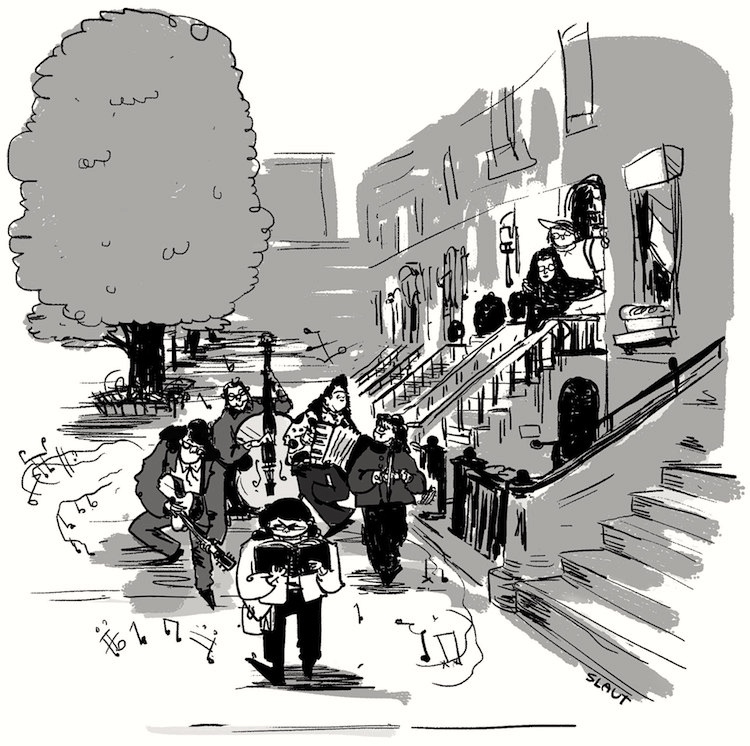
This touching Sara Lautman pun cartoon from the 10/14 New Yorker:
(#1) “You know, sooner or later we’re going to have to let her go out unaccompanied.”
It all depends on what you mean by unaccompanied.
The 12/5/17 One Big Happy, which came by in my comics feed a few days ago:
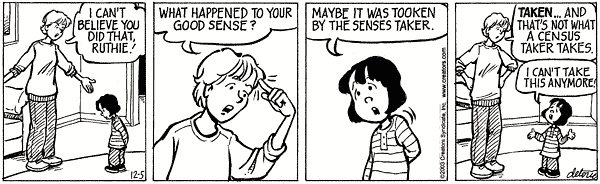 (#1)
(#1)
Three things here: Ruthie’s eggcornish reshaping of the unfamiliar word census (ending in /s/) as the familiar senses (ending in /z/); her tooken as the PSP of the verb take; and (in the last panel) her use of take ‘tolerate, stand, endure’ (here with the modal can of ability and also negation; and with the pronominal object this).