Archive for the ‘Danglers’ Category

Dangling in the comics

July 10, 2012

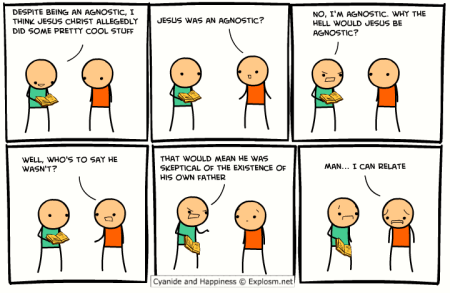
Via Bert Vaux on Facebook, this Cyanide and Happiness cartoon (from 10/24/10):

Putting aside the matter of paternal-filial relationships, there’s a (possible) syntactic point here (which is why Vaux posted the cartoon), in:

A: Despite being an agnostic, I think Jesus Christ allegedly did some pretty cool stuff.

B takes his to be presupposing that Jesus was an agnostic, while A intended to convey that he, A, is an agnostic.

(more…)

as a SPAR

June 2, 2012

From a few weeks ago, Armistead Maupin, interviewed on NPR about Barack Obama’s endorsement of same-sex marriage:

A lot of pundits have been kind of analyzing, oh, what does it mean and why did he do it. But as a gay man who’s been an activist for almost 40 years now, it was an extraordinarily moving thing to hear an unequivocal statement to the effect that gay love was the equal to opposite sex and attraction.

The relevant bit is boldfaced: a SPAR (a Subjectless Predicative Adjunct Requiring a referent for the missing subject) that’s non-canonical, in that the adjunct doesn’t obey the Subject Rule (doesn’t pick up its referent from the subject of the main clause); such non-canonical SPARs, or X-SPARS, are popularly known as “dangling modifiers”, a condemnatory label. But some types of X-SPARs are in fact acceptable (except to those who have internalized the teaching that X-SPARs are necessarily ungrammatical), and the Maupin sentence falls into not one, but two, of these types.

(more…)
The context of danglers

October 1, 2011

What follows is an abstract for an academic conference (explanation to come) on “dangling modifiers” in context. This is only an abstract, with a 200-word limit and no space for a bibliography (though I’ll add two items below).

(more…)

Disregarding context

July 24, 2011

From an earlier posting on danglerology, a promissory note:

[this example] illustrates that the acceptability of such sentences depends not merely on their internal syntactic structure, but also on their place in a larger discourse. (For a later posting: why so many people have thought otherwise.)

Consider:

(1) After writing a book, it seems that Harry is at loose ends.

(1) has no overt subject for the predicate writing a book, and such sentence adjuncts require that the referent of this subject be supplied (they are SPARs, in my terminology); a general principle, the Subject Rule, says that this referent is supplied by the subject of the main clause (the clause the adjunct modifies). But what’s the status of the Subject Rule?

(more…)

Playing with morphology

July 13, 2011

From several sources: repticide, reptard, danglology.

(more…)