A return to the Saint Sebastian theme, in a pincushion from the Ship of Fools site (last sampled in “Madonna of the Memories”):

A return to the Saint Sebastian theme, in a pincushion from the Ship of Fools site (last sampled in “Madonna of the Memories”):
In an interview on NPR’s Weekend Edition Sunday yesterday, Steve Kleinedler talked about the new edition (#5) of the American Heritage Dictionary, of which he is the executive editor. Partway through, he talked about the Usage Panel, saying:
(1) Every year, we send out the panel a ballot full of questions asking their opinions.
This is at the very edge of grammaticality for me (and many others), though there are some who find such examples acceptable, and they occur with modest frequency. What’s the problem?
For years, some of the ADS-Lers have been collecting examples of ancestor ‘descendant’. By 2004 Jon Lighter and Jesse Sheidlower had a dozen of so examples of this reversal from the earlier argument structure
EARLIER-KIN be ancestor of LATER-KIN
to
LATER-KIN be ancestor of EARLIER-KIN
Here I’ll note the examples from my files. In a later posting I’ll write about other semantic reversals.
It started on the 18th with Barara Partee’s doing a double-take (in Facebook) on this headline she read in Yahoo! News:
Obama blames Congress Republicans on bus tour
She read it (as did I) as involving blame (A):
(A) blame RESULT on SOURCE
Eventually I came to see another possible argument structure for the headline (in addition to (A) and the intended reading).
In the last posting: depends + WH-clause. Now another transitive use of depend (discussed in this posting). This one I first noticed in a CSI: Crime Scene Investigation episode, “Ending Happy”, first aired 4/26/07:
They depended me on that ‘They depended on/upon me for that’
From Michael Palmer on Facebook this morning:
Terry, it depends where you work.
(where I’d usually have depends on, or maybe upon). Historically, this is transitivizing P-drop; the transitive argument structure isn’t in OED2 (1959), and at the time MWDEU (p. 329) remarked:
Many commentators point out that in speech this construction can be followed by a clause with no on or upon intervening, as in “It all depends how many times you’ve seen it” or “It all depend whether it rains.” We have no evidence of these conversational patterns in ordinary prose.
That was then, this is now, and examples of depends + WH-clause are all over the place in “ordinary prose”, in fact in educated prose, like Palmer’s above (trust me on Palmer’s erudition and writing experience).
On Language Log, Mark Liberman has returned to the antique (and deeply inadequate) assumptions of school grammar, in a piece on Stanley Fish’s recent booklet “How to Write a Sentence: And How To Read One“:
in his tour of great sentences, there’s almost no syntactic analysis — and neither is there any careful analysis at any other level of linguistic structure. Nor is there any advice to the reader about where or how to learn more about the structure and function of these “little world[s] made cunningly” …
This is probably just as well, because what little linguistic analysis Prof. Fish gives us is full of assumptions from old-fashioned grade-school grammar, about whose inadequacies he’s curiously incurious. If he were writing about about the body, he’d be enthusing about the precarious balance of the four humours; but since he’s writing about syntax, his central assumption — obviously false and curiously unexamined – is that sentences are all about agents, actions, and (optionally) things acted upon
As a contribution to this discussion, I offer a file I’ve been assembling for some years (for introductory syntax courses) confronting one piece of the Agent-Action View of syntactic organization, in which the building blocks of syntax are identified semantically — as agents, actions, and (optionally) patients (things acted upon) — rather than (correctly) by syntactic category (like NP and V) and syntactic function (like subject, predicator, and (direct) object). This piece is the association between subjects and agents, which is much more complex than in the Agent-Action view: in the real world, agents are sometimes expressed by non-subjects (as in the by-phrases of agentive passives) and subjects very often denote non-agent participants in some situation; concomitantly, the predicators in clauses with non-agentive subjects don’t denote actions (but other sorts of situations).
There’s still some relationship between subjects and agents, but that relationship isn’t identity.
On to the inventory of the participant roles of subjects.
Ann Burlingham writes with a query about this really geeky Saturday Morning Breakfast Cereal cartoon by Zach Weiner:
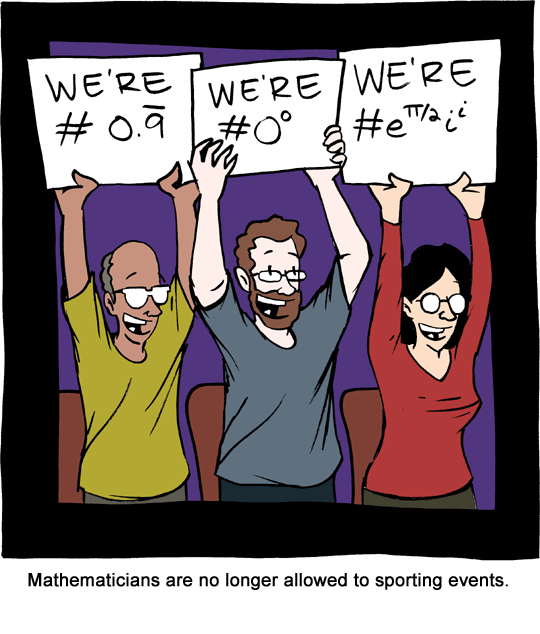
The query was about allowed to sporting events, with the preposition to, rather than the at she would have preferred. I myself would have preferred at or into, but don’t reject to.
As usual, the full story is complex.