Archive for the ‘Style and register’ Category

A monument of mail vacuity

April 3, 2024

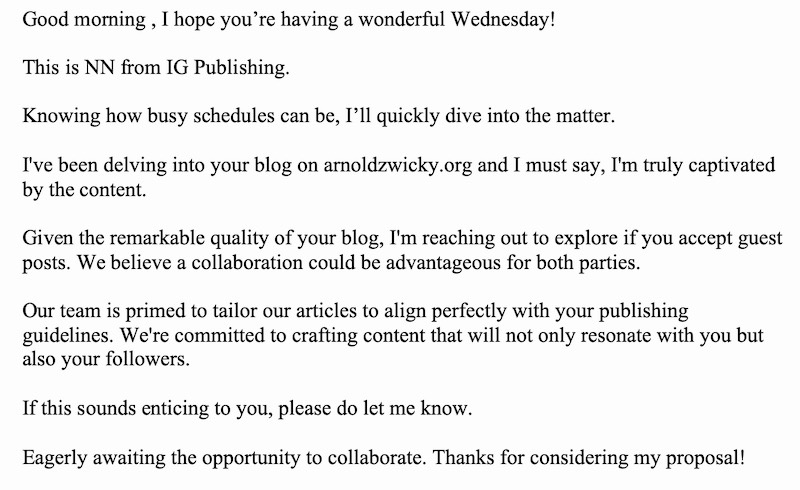
In today’s solicitation e-mail — I get an enormous amount of this crap — a monumentally vacuous offer from a source that, despite a superficial appearance of legitimacy, turns out to be equally suspect.

The mail as it came to me, with only the dummy name of the sender suppressed:


These days, the solicitation e-mail I get mostly takes advantage of AI resources to refer to specific content on my blog, making it appear that some actual person has read this material, but NN’s message steadfastly avoids all specificity, in favor of empty fawning

A truly stunning performance.

(more…)

Love what Scrivan did with the rabbit pun!

April 1, 2024

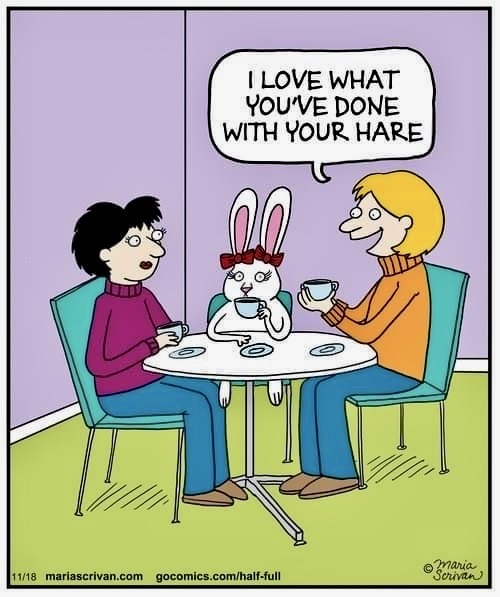
šŸ‡ šŸ‡ šŸ‡ three rabbits to inaugurate the new month, šŸƒ šŸƒ šŸƒ three jokers for April Fool’s Day, and 🌼 🌼 🌼 threeĀ jaunes d’Avril. yellow flowers of April, all this as we turn on a dime from yesterday’s folk-custom bunnies of Easter to today’s monthly rabbits; for this intensely leporine occasion, a Maria Scrivan hare-pun cartoon:


(#1) (phonologically perfect) punĀ hareĀ on modelĀ hair, taking advantage of I love what you’ve done with your hairĀ as an common exemplar of theĀ stock expression (I) love what you’ve done with X; aĀ cartoon posted on Facebook by Probal Dasgupta, who reported, “Even I groaned at this one”

Things to talk about here: my use of turn on a dime just above; Easter + April Fool’s; the yellow flowers of April (which will bring us to Jane Avril — Fr. Avril ‘April’); and theĀ stock expression (I) love what you’ve done with X.

(more…)

Slutty T-Rex

November 30, 2023

šŸ… šŸ… tiger tiger for ultimate November, also St. Andrew’s Day (Scotland’s national day); meanwhile, I bring you two dinosaurs trading ideas about popularity and sluttiness

A pair of Ryan North’s Dinosaur Comics strips, coming in succession on 11/10 and 11/13, in which T-Rex rambles on to his buddy Utahraptor about a fairly well-known paradoxical-sounding phenomenon in social networks, the friendship paradox. Actually, it applies more generally, and I’ll talk you through the (apparent) paradox in the general case. Yes, I’ll get to the comics, and to the way T-Rex uses the adjective slutty, but first let’s talk about your lunch partners.

The symmetric-relation paradox. Brace yourself for some mathematician-talk, but don’t despair: I’ll work up a concrete example (about you and your lunch partners) along the way.

Consider a a set N (for example, the set of people in a social network) and a symmetric relation R between members of N; R might be being friends with, say, or having gone to grade school with or — my concrete example —Ā having had lunch with. Then for any member m of N (like you, for definiteness), define m’sĀ R:N-cohortĀ to be the set of members of N that m bears R to (like, the set of all your lunch partners), and m’sĀ R:N-indexĀ to be the size of m’s R:N-cohort (like, how many lunch partners you’d had). Then it can be shown that, on average, the R:N-indices of members of m’s R:N-cohort are greater than m’s R:N-index — like, on average, the number of lunch partners your lunch partners have had is greater than the number of lunch partners you have had. Yes, it sounds paradoxical. But it’s provably so.

Now, listen up: what the symmetric-relation paradox does not say is that (all) your lunch partners have more lunch partners than you do. That would be genuinely paradoxical. All it says is that the (arithmetic) mean of their lunch-partner figures is higher than yours, which is a great deal less thrilling (though it still has a whiff of the perverse about it). So let’s look at the special case, the friendship paradox,Ā where N is a social network and R is the being friends with relation (which is where T-Rex starts in his Dinosaur Comics ramble, before he goes on to the having had sex with relation (parallel to the having had lunch with relation) and to sluttiness, having had many sexual (rather than lunch) partners.

(more…)

jack or jerk?

August 22, 2023

(It’s about vernacular masturbatory verbs, so it’s deemed not suitable for kids, and of course it’s not to the taste of the sexually modest.)

Why would anyone care whether a guy favorsĀ jack off or jerk offĀ — or something else, like jag off or toss off orĀ wankĀ — as his masturbatory verb?

Street talk about sexual practices and unsavory bodily substances varies over time and place and context, differs from one speech community to another, just like all kinds of talk: wank and toss off are distinctly BrE, jag off distinctly AmE, and jack off and jerk off both seem to be originally AmE, though they’ve spread more widely; guys will have different preferences for vocabulary in this domain, mostly according to their personal experience with the verbs, and they’ll know that some guys use different verbs. Why doesn’t it stop at that?

Well, this is linguistic variation, and it pretty much never stops at that. There’s a general human inclination to believe that your own practices are the best ones, the right ones; and also a general human inclination to accept the practices of your community, which are likely to be supported by explicit teaching and advice, and even enforced with sanctions, as the best ones, the right ones.

So we find people deploring other people’s linguistic practices, often in extravagant terms (disgusting, ignorant, …), sometimesĀ ascribing dubious or discreditable motives to other people’s choices (hypercorrection and varieties of avoidance are often cited, as are faddism, reflexive following of fashion, and misguided attempts to sound clever). Even for masturbatory verbs, where there’s no explicit teaching and no advice literature.

Now, one such example, in a recent Facebook exchange between Jeff Shaumeyer (a jerk-off user) and me (a jack-off user), which turns out to be surprisingly complex, because it involves a second-order effect, with responses to (first-order) critiques of the usage jerk off, that it’s too crude, too vivid (the imagery is of the jerking motion in masturbation, and in the jerking of the body in orgasm — jerk was used for ‘copulate with’ before it was extended to masturbation, and is still so used by some speakers). This critique has led to the idea that guys who use jack off do so (only) because they’re (fastidiously) avoiding the gutsy, authentically masculine jack off — a gratuitous attribution of motives that I stringently objected to.

(more…)
Sausages, no preservatives

May 29, 2023

An extremely busy photo that my Peruvian colleague Ernesto Cuba took on 5/24 inside the St. Lawrence Market in downtown Toronto. The shop in the photo is offering sausages, no preservatives — innocent enough, but EC immediately translated the sign into Spanish, got salchichas, no preservativos, and protested against the content of the slangy and figurativeĀ salchicha sin preservativoĀ ‘penis without a condom’ (vs. the literal salchicha sin preservativo ‘sausage without a preservative’)

It was as if the sign had said, in English sausages, no prophylactics, which would instantly have allowed the English slang sausage ‘penis’ to surface. As it happens, the Spanish word for ‘preservative’ has been pressed into service as a rather technical-sounding euphemism referring to a life-preserving condom; that makes sense, but the parallel development just hasn’t happened in English, where the corresponding technical-sounding euphemism is prophylactic ‘preventive’, referring to a disease-preventing condom.

(more…)

Who am I kidding?

May 24, 2023

(Note: in this posting I’m going to be unrelentingly careful about the way I frame descriptions of linguistic phenomena (not falling back on the descriptive language of school grammar, which would be familiar to readers but which I believe to be fucked up beyond repair). So there will be a lot of technical talk here; please try to play along, but I don’t think there’s any way to do this right without re-thinking everything from the ground up.)

This is about a perfectly common expression — Who am I kidding? — that went past me in a flash on Facebook this morning but caused me (as a student of GUS — grammar, usage, and style / register) to reflect on the pronoun case in it. On the interrogative human pronoun, appearing here in what I’ll call its Form 1, who, rather than its Form 2, whom.

The pronoun in this expression is the direct object of the verb in the expression, KID, appearing in sentence-initial position (appearing “fronted”) in the WH-question construction of English.Ā There’s nothing at all remarkable about this: in general, both forms of this pronoun are available as syntactic objects (of verbs or prepositions) in the language, differing only in their style / register (very roughly, formal whom vs informal who), with the special case of an object pronoun actually in combination with its governing preposition, which is Ā obligatorily in Form 2:

Who / Whom did you speak to? BUT *To who / āœ“to whom did you speak?

So there’s nothing remarkable about Who am I kidding? It’s just informal.

What’s remarkable is the unacceptability of Whom am I kidding? The stylistic discord between the formality of object whom and the informality of the idiom WH-Pro am I kidding? is unresolvable. To put it another way, the choice of the Form 1 pronoun here is part of the idiom. Just like the choice of the PRP form of the verb KID, conveying progressive aspect: Who do I kid? lacks the idiomatic meaning.

(more…)

Kentucky country ham

April 9, 2023

An exercise in nostalgia (much transformed) for Easter lunch today: sandwiches of slices of Kentucky country ham — KCH for short — and melted cheddar cheese. The nostalgia is in the ham:


(#1) Thinly sliced ham from Broadbent B & B Foods in the little country town of Kuttawa KY (in Lyon County in far (south)western Kentucky)

To come: on country ham the compound noun and country ham the foodstuff; on my personal history with KCH (associated in my household with Christmas rather than Easter); and on the Broadbent company.

(more…)

From parts unknown

March 21, 2023

In yesterday’s (3/20) Wayno / Piraro Bizarro, a cowboy — call him FM — Ā bellies up to the bar in a saloon in the fabled Old West:


(#1) Though he’s wearing jeans and Ā a handsome Western dress shirt, FM’s greenish pallor, eccentric hair, and neck bolt mark him as an outsider, not from these parts, not from around here; meanwhile, FM is a composite being, cobbled together from random parts — bodyparts — by Victor FrankensteinĀ (If you’re puzzled by the odd symbols in the cartoon — Dan Piraro says there are 4 in this strip — see this Page)

So there’s parts and there’s parts. And FM’s from parts unknown Ā is a parts ‘bodyparts’ pun on the model of parts ‘places’ in what is now a rather formal and poetical expression from parts unknown ‘coming from an unknown place’. The Frankenstein world superimposed, absurdly, on the Gunslinger world.

(more…)

Ruthie meets the challenge of the unfamiliar

February 24, 2023

It’s an old theme on this blog: 6-year-old Ruthie in the comic strip One Big HappyĀ asĀ a constantly entertaining source of efforts to cope with unfamiliar words and larger expressions byĀ assimilating them, in one way or another, to things that are familiar to her. Some examples surveyed in myĀ 2/3/19 posting “Ruthian lexical items in real life”; and then, yesterday, in the postingĀ “Ruthie goes for the donuts”, she understands windchill as Winchell’s (donuts):Ā the unfamiliar element is the technical meteorological term windchill. and Ruthie copes with it by replacing it with a phonologically similar item that’s familiar to her (she’s fond of Winchell’s donuts):

(#1) unfamiliar windchill / familiar Winchell’s

Over the past three years or so, I’ve been accumulating One Big Happy strips in this vein and am now disgorging six of them: aĀ similarity case, in which Ruthie copes with unfamiliar material by treating it as phonologically similar familiar material (as with windchill / Winchell’s); twoĀ ambiguity cases, in which unfamiliar material is homophonous with familiar material, so she has to cope with her mistaken interpretation of what she hears; and three more complex cases (one involving portmanteaus, one involving orthographic abbreviations, and one involving Ruthie’s own analogical creation — Ruthie is indeed ingenious).

(more…)

More from the Cavewoman Culture Club

February 22, 2023

The CCC — last seen in action in myĀ 2/18 posting “A Neanderthal breakthrough”, in which anĀ inventor cavewoman carves the first definite article out of stone — strikes again in theĀ Piccolo / Price Rhymes With Orange cartoon of 5/21/21, in which a cavewoman devises a precursor of the candlelit dinner:


(#1) An announcement in Caveman Talk of the first romantic dinner for two; since these beginnings, it has evolved into a elaborated cultural practice

Cultural innovations often come with bold experiments in form at the outset (consider the history of photography and film) — in this case, apparently, in the adventure of scented fire.

(more…)