In the NYT on the 20th, a piece ,”The ‘How Are You?’ Culture Clash” by Aline Simone, on a difference between Russian and American conversational patterns, having to do with the question “How are you?” and the answers it gets.
Archive for the ‘Social life’ Category
London Underground
January 22, 2014All over Facebook recently, this site, on “Fake Signs in London Underground”. Here are two of some linguistic interest — on visual communication in social space and on apologies:
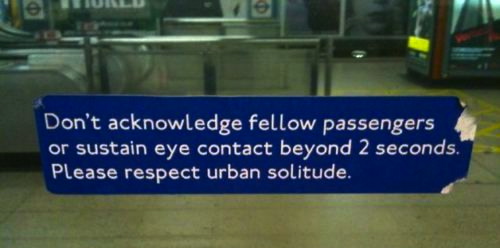
Other signs have extra stations: Shepherd’s Pie, Stop Staring, The End, Nightmare on Elm St. And one station offers a submarine to Somalia.
Posted in Apologies, Pragmatics, Social life | Leave a Comment »
-ify again
January 18, 2014Last installment, on bossification, here. Now, a double-header, with Shoreditchification and hipsterfication (plus simple verbing of Shoreditch). From the Telegraph, Alex Proud on 1/13/14, “Why this ‘Shoreditchification’ of London must stop: The relentless hipsterfication of run-down urban areas leaves a bad taste in Alex Proud’s mouth”. From the piece:
But bear with me here. What I hate more than Shoreditch itself is the idea of Shoreditch and the way that so many of London’s neighbourhoods have been Shoreditched, are being Shoreditched or will be Shoreditched.
… Shoreditch is just a metonym for all those unlucky pieces of real estate that have had the hipster formula applied to them. The real problem is hipsters themselves.
Posted in Conversion, Derivation, Morphology, Social life, Verbing | 2 Comments »
Diversity
December 2, 2013Today’s Dilbert, with the pointy-headed boss and Catbert:
Note the internal contradiction: I want diversity of thought, so long as everyone agrees with me.
Posted in Linguistics in the comics, Social life | Leave a Comment »
Arnie Levin
June 19, 2013This fine New Yorker cartoon by Arnie Levin, sent to me by Sally Page Byers and Amanda Walker (along with an X-rated composition by Pierre et Gilles and an X-rated photograph by Wolfgang Tillmans; posting on Tillmans on AZBlogX, here):
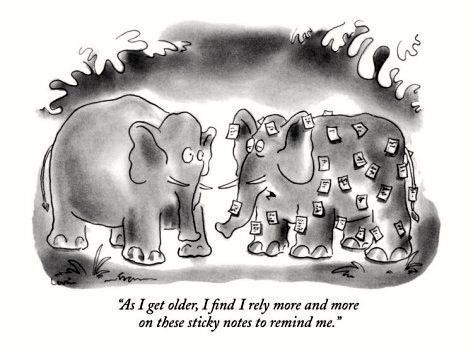
A play on the proverbial “An elephant never forgets”.
Posted in Ambiguity, Language play, Linguistics in the comics, Memory, Playful morphology, Proverbs, Social life | 1 Comment »
The start-up interview
June 1, 2013(More about social and business life than about language, but today’s Dilbert struck a chord in many readers when I posted it on Facebook, so I thought I’d post it for a somewhat different audience.)

Dress for success.
(And awesome is a nice word choice in this context — conveying self-conscious hipsterdom.)
Posted in Linguistics in the comics, Social life | Leave a Comment »
Adulthood
May 27, 2013Today’s Scenes From a Multiverse:
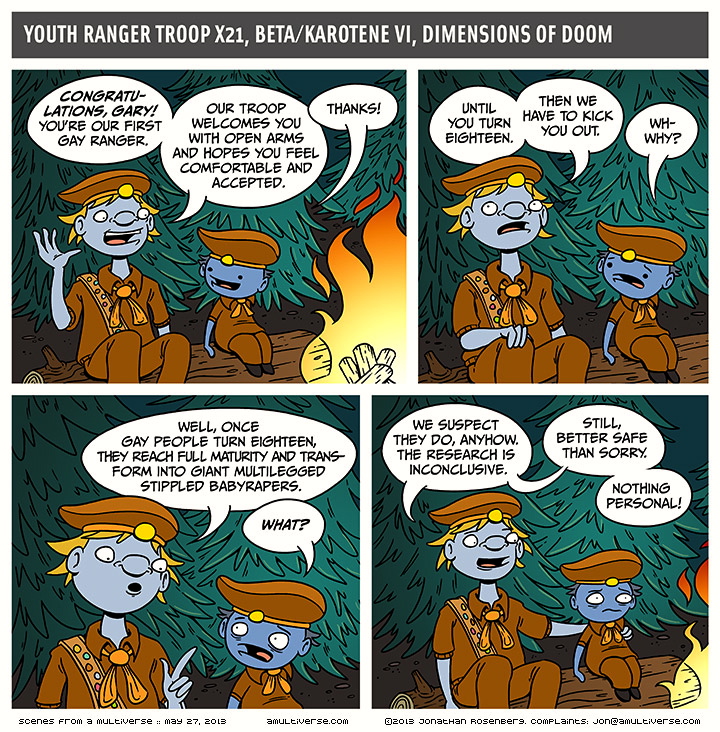
In everyday dealings, we tend to judge the stages of life by physical and behavioral signs, and the categorization is somewhat fuzzy, but for legal and administrative purposes, crisp categorizations are necessary, and chronological age provides the basis for them — however irrational it might seem to label someone as a child one day and an adult the next.
In this case, Jon Rosenberg is remarking not only on that irrationality, but also (as his comments on the strip make clear) on the bizarreness of treating gay adults (however adult is defined) as unsafe or untrustworthy in a way that gay kids are not. (I note further that the onset of puberty comes well before the age of 18.)
Posted in Categorization and Labeling, Gender and sexuality, Linguistics in the comics, Ordinary vs. technical lg, Social life | 1 Comment »
Departments: There’ll always be an England
May 25, 2013In the NYT on the 21st, this entertaining story by Sarah Lyall: “Common Gnomes Pop Up at Rarefied Flower Show, to Horror of Many”, where it is reported that:
it was not surprising that the staid Royal Horticultural Society‘s decision to allow garden gnomes — creatures commonly associated with the landscapes of the unrich, the unfamous and the untasteful — at the Chelsea Flower Show this year elicited a variety of responses.
… Gnomes, which are called “brightly colored mythical creatures” in the handbook governing the show, are not really part of the Chelsea aesthetic. (Nor are balloons, flags, “feather flags,” or “any item which, in the opinion of the society, detracts from the presentation of the plants or products on display,” the handbook reads.)
Four topics come up in the article: social class in the UK; the two words gnome (and gnomic etc).; conversion of proper names to count nouns; and playful gnome-related morphology.
Posted in Combining forms, Conversion, Derivation, Etymology, Playful morphology, Semantics, Social life | 1 Comment »
boss
April 14, 2013Discussion of a brief note I posted here a couple of days ago, on boss as an address term, brings up two points; the need to clarify what kind of address term is at issue in this case; and the difficulty of gauging the sociolinguistic status of some usage, when all you have to go on is your own experience.
Posted in Address terms, Metaphor, Pragmatics, Social life | 7 Comments »
Brief notice: boss 4/12/13
April 12, 2013For some time now, I’ve noticed a pattern of address term usage in local restaurants and cafes (three of them): I am addressed by servers and other employees there as boss. The speakers are all Hispanic men, younger than me (I’ve never gotten boss from anyone else; I don’t have employees of my own); and of course it’s crucial that I’m male; and it might be relevant that I’m a regular customer in all three places; and it might be relevant that the atmosphere of all three places is informal. (Some of these men sometimes address me as Arnold, but other times as boss.)
I assume that this is a resolution of a puzzle in social relations: sir would be the standard address term in service contexts, but seems far too formal and distancing given the social situation in these three places; and Arnold might seem too intimate on some occasions; so what to use instead?
What I don’t know is where boss (said with a friendly, even jocular tone) comes from. And why just Hispanic men? (Non-Hispanic and female servers seem always to opt for first names in such places; if they don’t know them already, they find them out and then memorize them.)
(Address terms are a long-standing interest of mine. Discussion of pal and sport here, boy here, and medical address terms here.)
Posted in Address terms, Social life | 6 Comments »