Archive for the ‘Semantics of compounds’ Category
October 26, 2025
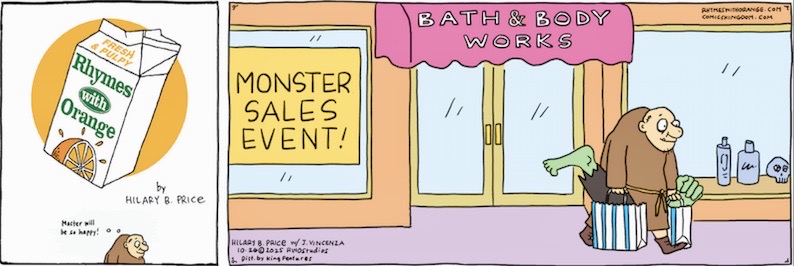
In today’s Rhymes With Orange strip, a sale at Bath and Body World:

A sale of body parts from and/or for monsters — not what comes to mind when you come across the N + N compound monster sale, which is a dauntingly large sale, one that’s (metaphorically) a monster
Now the details.
(more…)
Posted in Ambiguity, Language and the body, Lexical semantics, Linguistics in the comics, Metaphor, Semantics of compounds, Syntactic categories | 2 Comments »
October 21, 2025
Gretel Cunningham Young (of Columbus OH, where she grew up, with my daughter Elizabeth, many years ago) on Facebook yesterday:

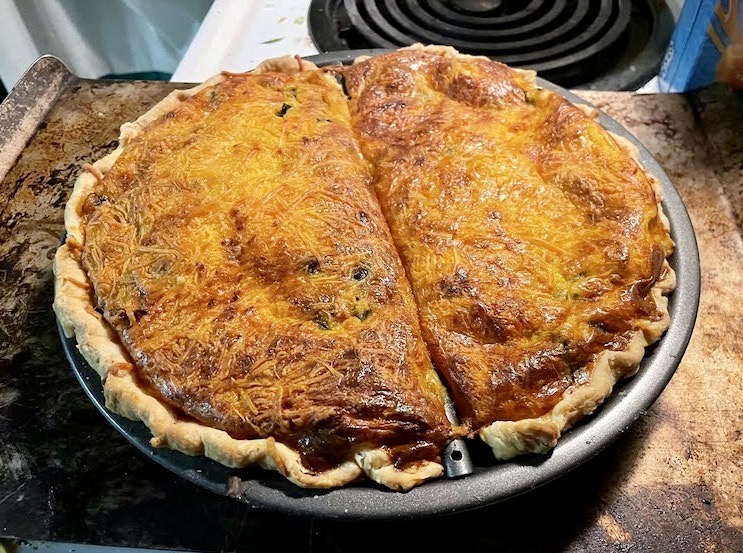
— GY: My goal was to make a half-vegetarian, half-carnivorous quiche, so I ordered this divided pan
Noting her reference to carnivorous quiche, plus an odd quirk in way English vegetarian is used, I reacted to her statement with some alarm (my response in an expanded and improved form here):
— AZ: But I don’t think I want to get near a carnivorous (‘meat-eating’) quiche, lest I be devoured by it. vegetarian quiche has the adjective vegetarian ‘(of food or diet), plant-based, excluding meat’, not the noun vegetarian ‘(of people) a vegevore, someone who eats only plant-based food; a non-carnivore, someone who does not eat meat’. A quiche that’s a vegetarian would not be a threat to me (as a being made of meat), but it would nevertheless be creepy, in a cannibalistic sort of way. The meaty correspondent to vegetarian quiche ‘quiche for vegetarians’ would be quiche for carnivores.
(more…)
Posted in Ambiguity, Compounds, French, Language and food, Lexical semantics, Puns, Semantics of compounds, Silliness, Slogans | 1 Comment »
October 12, 2025
An Ellis Rosen cartoon that came by on Facebook recently:

(#1) The hybrid creature the pomeranian-nimbus, being taken for a walk, on a leash, by its owner — so being presented as an extraordinary dog, a cloud canine; note that the woman’s dog recognizes the p-n as a dog, and appears to want to play with it (see the wagging tail)
(The name of the dog breed is standardly capitalized, because it’s a proper name denoting a creature originating in the geographical region of Pomerania, and I’ll use Pomeranian from here on.)
The compound Pomeranian-nimbus is a copulative N1 + N2 compound (like Swiss-American or hunter-gatherer), denoting a thing or things of both the N1 type and the N2 type. But in fact the creature is not just a mix of Pomeranian dog and nimbus cloud, but is actually a nimbus Pomeranian ‘Pomeranian dog that is (also) a nimbus cloud’ (your standard N + N compound in English is semantically modifier + head) — rather than a Pomeranian nimbus ‘nimbus cloud that is also, or at least resembles, a Pomeranian dog’. A nimbus Pomeranian, or, more compactly, a nimbopomeranian, a nimpom for short.
(more…)
Posted in Abbreviation, Compounds, Language and animals, Language and food, Language and plants, Lexical semantics, Linguistics in the comics, Meteorology, Music, Names, Poetry, Portmanteaus, Semantics of compounds, Silliness, Word attraction | 3 Comments »
September 18, 2025
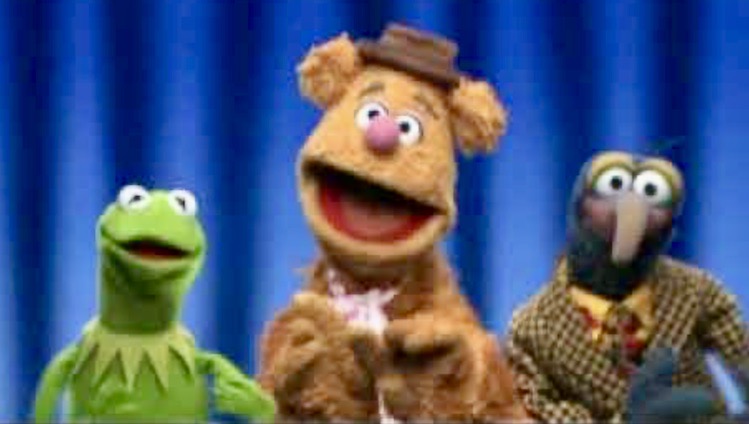
Encountered in going through stuff on Facebook: the episode “Fozzie encounters a bit of a language barrier” from “Rocky Mountain Holiday”, a 1983 Muppet special; in the episode, Fozzie Bear describes himself to Gonzo (a character of ambiguous species) following on reports of a bear in their vicinity:
Have you not noticed that I also am of the ursine persuasion … I’m a bear too and I speak fluent bearish
A huge ferocious bear appears, the main characters flee to Kermit the Frog, and Fozzie explains:
Gonzo! Gonzo! Just a slight dialect problem … she speaks Grizzly and I only speak Paddington
You can watch the episode on YouTube here.
(Nice ellipsis of the BEAR in grizzly bear (the name of a type of bear) and Paddington Bear (the proper name, on the pattern of FN + LN, roughly like Stanford Linguist) of a fictional bear, discovered in London’s Paddington Station), as if they were structurally parallel.
The principal characters:

Kermit, Fozzie, and Gonzo
(more…)
Posted in Ellipsis, Language and animals, Language change, Lexical semantics, Movies and tv, Semantics of compounds | Leave a Comment »
August 19, 2025
In human beings, the mouth is the only bodypart that comes equipped with teeth. Well, there are fables of the fearsome vagina dentata and even — top men, beware! — of the occasional anus dentatus. Now the wonderful world of prehistoric nature brings us a penis dentatus. Or so we learn from the latest WIRED.
From WIRED Science, “An Ancient Penis Worm With Rings of Sharp Teeth Has Been Discovered in the Grand Canyon: The 500-million-year-old fossil, containing a species named in honor of the krayt dragons in Star Wars, is a much larger ancestor of phallic marine worms that can be found on the seabed today” by Marta Abba on 8/19/25:
Penis worms are marine creatures with a distinctly phallic appearance. There are more than 20 known species living across the world’s oceans today, as well as a number of extinct ones, like this new discovery. The researcher who made the find was searching for fossils in the Grand Canyon and named the species Kraytdraco spectatus in honor of the huge burrowing krayt dragons that appear in the Star Wars universe. Details of the discovery were published in the journal Science Advances.
(more…)
Posted in Compounds, Language and animals, Language and the body, Language of sex, Phallicity, Semantics of compounds, Subsectivity, Vaginality | 6 Comments »
June 13, 2025
Among Tuesday’s crowd of events (it’s now Friday, and life has been stressful and unpleasant, but I’m trying to produce at least one pleasant thing): a visit to Palo Alto’s Gamble Garden, taken there by Sharon Gray of Bay Area Geriatric Care Managers. Too much in bloom or getting ready to bloom (or harvest, in the case of food plants) for me to post on more than a little bit. I’ve picked out two plants I admired but didn’t know. One is still a mystery (there was a label, but it clearly applied to a plant that had already bloomed and gone dormant, not to this ornamental grass with pretty bell-shaped purple-blue flowers), but the other had a label that applied to it (and not to some other plant in its neighborhood), so I can tell you that it’s an especially vigorous Sisyrinchium striatum — the creamy-white blue-eyed grass of my title.
There will be photos, including one of me sitting in the garden; this one will require a fashion digression, on the tank top I’m wearing in the photo, a recent acquisition for summer wear.
(more…)
Posted in Clothing, Labels Are Not Definitions, Language and plants, My life, Names, Semantics of compounds, Taboo language and slurs | 2 Comments »
December 27, 2024
🎁 Boxing Day 🎁 — also St. Stephen, with his feets uneven — coming a day late, because life has been very difficult for me, and postings have piled up so high I’m not sure I can ever get to them, so I’ve picked something I know I can get done, so that this dark, rainy, and excruciatingly painful low-air-pressure day will not be a total loss
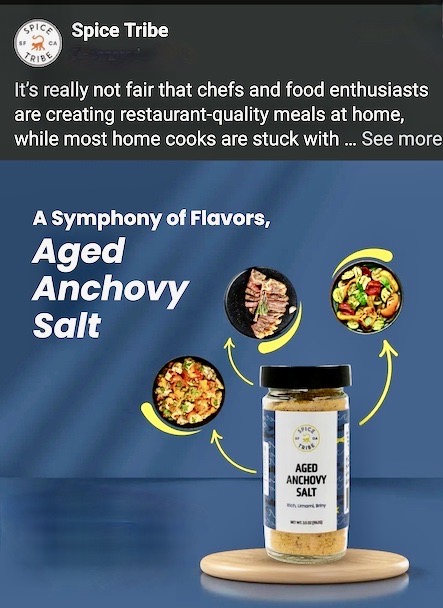
I bring you an e-mail message from Victor Steinbok on 12/25, about this ad for Spice Tribe (website here), a San Francisco-based on-line spice store dedicated to mindful cooking:

(#1) VS wrote: Facebook has offered another example of what I used to refer to as parenthetical ambiguity. Is it [aged anchovy] [salt] or [aged] [anchovy salt]. From a culinary perspective, the latter makes no sense (aging salt doesn’t change it). But that doesn’t mean there’s no built-in ambiguity.
(more…)
Posted in Ambiguity, Compounds, Constituency, Holidays, Language and food, Parsing, Semantics of compounds, Taste | 8 Comments »
December 16, 2024
An invitation on Facebook on 12/13 from linguist Jennifer Arnold, performing her musical role (crucial phrase underlined):
If you like to sing, come to the Chapel Hill Messiah open sing tomorrow evening! I’ll be in the viola section.
My response:
I had a confused moment when I thought you’d be singing the praises of the Messiah of Chapel Hill (whoever he is; I’m woefully out of touch with things, and thought I must have missed the rise of a Prince of Peace in the New South).
(more…)
Posted in Ambiguity, Compounds, Constituency, Lexical semantics, Metaphor, Music, Semantics of compounds | 4 Comments »
October 30, 2024
(Publicity for a gay porn video, entertaining in its way but absolutely off-limits for kids and the sexually modest)
🎃 🎃 🎃 three jack-o’-lanterns for penultimate October, Halloween Eve (that is, the day before the day before the day of the dead) — in my house, the day when the pussyboys go out to seek their phallic prey
Into this scene comes this morning’s e-mail from the Falcon | NakedSword Store, offering:
Hot House movie download discounts — full movies $11.95 each
With, right at the top, the crudely pun-titled video Swim Meat and its cover illustration, offering four fine pieces of swim meat, one (Johnny V’s) just barely concealed by his swimwear; plus three proudly jutting tubesteaks that I’ve had to suppress for WordPress modesty (but here you can view the uncensored cover, along with the publicity text):
(more…)
Posted in Compounds, Discourse organization, Gay porn, Holidays, Hyperbole, Language and the body, Language of sex, Language play, Lexical semantics, Metaphor, Puns, Semantics of compounds, Style and register, Taboo language and slurs | 1 Comment »
September 26, 2024
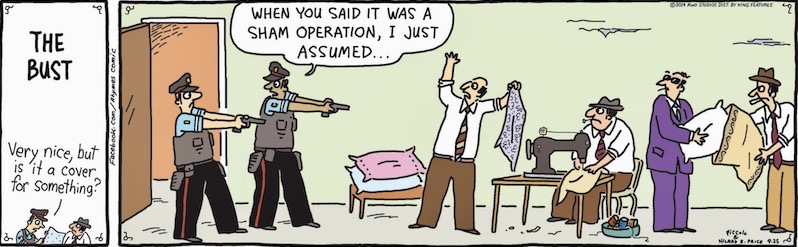
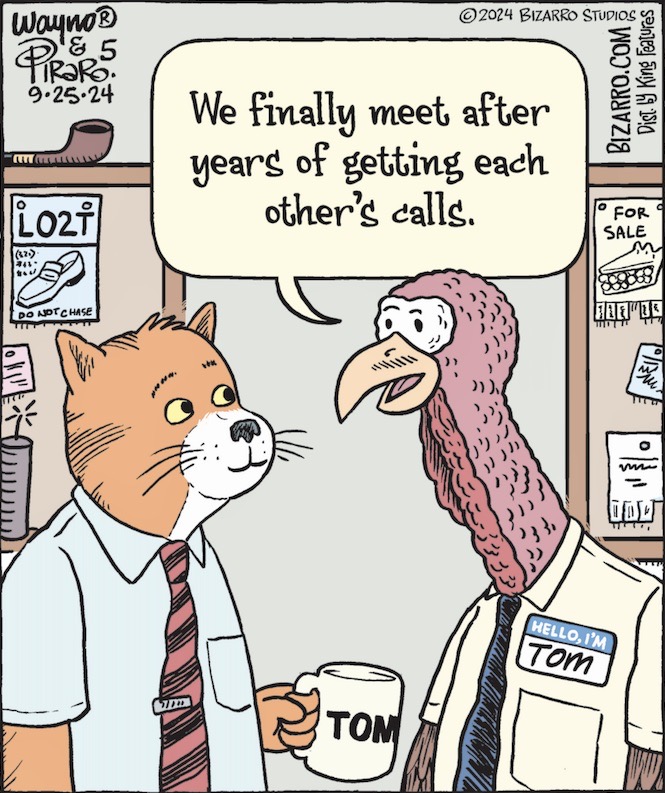
Complex ambiguities in the 9/25 comics: a Piccolo / Price Rhymes With Orange turning on the ambiguity of sham; and a Wayno / Piraro Bizarro turning on the ambiguity of tom:
(#1) sham conveying fraud, hence illegality; vs. sham for a decorative pillow cover (being manufactured in a small workshop, though note the suggestion in the title panel that the place might be a cover — ambiguity alert! — in the sense ‘an activity or organization used as a means of concealing an illegal or secret activity’ (NOAD) — but why are these pillow coverings called shams?

(#2) Personified, talking animals: two toms, a tomcat and a tom turkey, presented as characters named Tom, who work for the same company and are encountering one another over coffee, hence Wayno’s title “Breakroom Encounter” (if you’re puzzled by the odd symbols in the cartoon — Dan Piraro says there are 5 in this strip — see this Page)
(more…)
Posted in Abbreviation, Ambiguity, Beheading, Comic conventions, Compounds, Conversion, Furnishings and tools, Language and animals, Linguistics in the comics, Personification, Semantics of compounds | 1 Comment »