Archive for the ‘Compositional semantics’ Category

Hooray for constructions, positive licensing, and GKP

January 30, 2025

Yesterday, Laura Michaelis (Univ. of Colorado-Boulder co-author of, among other things, the 2020 Cambridge book Syntactic Constructions in English) alerted me to an article by Philip Miller (Université Paris Cité) & Peter W. Culicover (Ohio State Univ. & Univ. of Washington), “Lexical be“, Journal of Linguistics (2025), 1-24 — truly, hot off the press — which argues, in elegant detail, for a constructional approach to syntactic description, involving the positive licensing of constructions (rather than (negative) constraints on syntactic structures), and also honors Geoffrey K. Pullum (Professor Emeritus of General Linguistics at the University of Edinburgh).

So, yes, a fair amount of technical stuff, showing a bit of how (some) linguists approach the description of the syntax of one language and how they dispute with one another over the form of such descriptions. (I’m mostly just an observer here, but you should know that everyone I just mentioned — Michaelis, Miller, Culicover, Pullum — has been a departmental colleague or co-author of mine, so I have to be seen as a participant-observer, as we say in sociolinguistics.)
(more…)

The potluck surprise

July 23, 2024

From Sunday’s’s (7/21) New York Times Magazine, in the section “The Ethicist: Bonus Advice From Judge John Hodgman”:

Angel writes: My co-worker Nick suggested we have a baked-goods potluck at work. I got excited because I have a great baked-mac-and-cheese recipe. But Nick said it wouldn’t count. He says it must be something made with a batter or dough. I disagree!
—–
Many things are baked (potatoes, Brie, Alaska), and like macaroni and cheese, they are good. But they are not “baked goods” in common usage. … In your case, most of the cooking happens outside the oven, and the baking is just a finishing touch. That said, who cares? [and on from there]

Angel has run aground on the shoals of idiomaticity; they suppose that the meaning of baked goods is straightforwardly compositional, ‘goods that have been baked’ — the meaning of the plural noun goods as modified by the meaning of the adjective baked, using the primary senses of the two words. But that won’t fly here, because the nominal baked goods has developed a specialized use, in which it refers to not just any stuff, even not just any foodstuff, that’s been cooked in an oven, but only to breads (and similar foods) and cakes (and similar foods) from an oven. The category of baked goods is expansive, but not so broad as to embrace lasagna, roasted vegetables, baked chicken, baked beans, baked ham, etc. … or mac and cheese.

(more…)

It’s a mystery

March 2, 2024

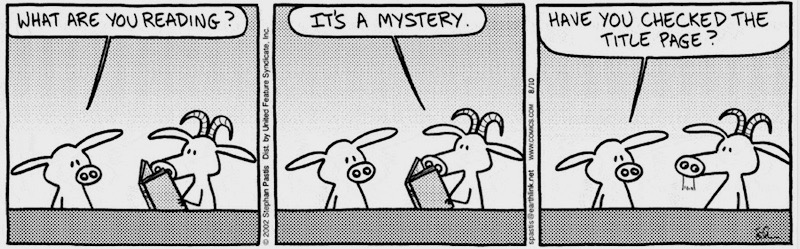
Very much a MQoS Not Dead Yet posting, as I’m barely functioning after one of those stunning drops in air pressure. Hanging around on my desktop for just just an occasion, this mystery-pun Pearls Before Swine cartoon from 2002 featuring Pig and Goat:


Pig, who has the personality of a trusting (but sometimes ignorant) child, assumes Goat doesn’t know the title of the book he’s reading — so does everything but point to the front of the book, to show that title.

Goat’s reply in panel 2, It’s a mystery, is ambiguous. Notably because mystery is ambiguous in this sentence. But so is it. And these two ambiguities are linked, by virtue of an ambiguity as to the construction they’re in. Now I’m going to cut a lot of corners in my discussion, because I’m barely able to get this posting done

(more…)

Double negatives: the big picture

January 19, 2023

In yesterday’s installment, the two kids of the Lombard family in the comic strip One Big Happy, Ruthie and Joe, advance a devious — and transparently malicious — idea about the pragmatics of conversation. As a slogan,

Two nasties make a nice.

That is, saying two nasty things about someone counts as saying a nice thing about them, yuk yuk. We-e-ell, the kids maintain, with impish speciousness, that that’s just a special case of the general principle that

Two negatives make a positive.

First thing: such a slogan is a highly abbreviated formula in ordinary language of some significant technical principle, the virtue of the slogan being that it is striking and memorable; it’s an aide-memoire. But it’s just a label, and labels are not definitions.

Second thing: the kids’ version exploits a massive ambiguity in the adjectives negative / positive, and a corresponding ambiguity in the verb make. To which I now turn.

(more…)

Reversed meanings

May 19, 2021

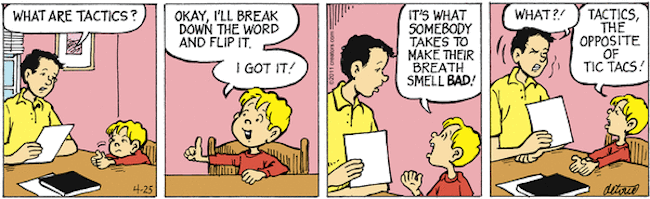
In the One Big Happy strip of 4/25, Joe is being grilled by his father on the meanings of words — “defining words” being a common task for schoolchildren — and, on being challenged by the word /tæktɪks/, whose meaning is unclear to him, he proposes to break the word down into recognizable meaningful parts, from which the meaning of the whole can be predicted. A perfectly reasonable strategy, but one that is stunningly often useless.

(#1)

Joe appears to have isolated the parts /tæk/, /tɪk/, and the plural /s/, but didn’t identify the first as any item spelled tack or the second as any item spelled tick; instead his attention was caught by the combination /tæktɪk/, so similar to /tɪktæk/, the trade name Tic Tac.

And went on to assign some meaning to the reversal of the two parts, reasoning (apparently) that reversing the order should correspond, iconically, to reversing (in some way) the meaning of Tic Tac. What would be the reverse of a breath mint? Well, the function of a breath mint is to sweeten the breath, to make it smell good —  so the reverse function would be to make the breath smell bad.

(more…)

Lemon is the vanilla of Italian ices

June 9, 2019

The 6/7 Zippy takes us to the Jersey Shore for some water ice in a squeeze cup:


(#1) At the Strollo’s Lighthouse Italian Ice shop in Long Branch NJ: Zippy (alarmed at climate change) speaking on the left, Claude Funston (who denies climate change) on the right

On the setting. On Strollo’s. On lemon as the vanilla of Italian ices. On the relevant C(ount) noun ice, the nominal Italian ice, and the compounds water ice and squeeze cup. On Italian ice and the family of similar confections.

(more…)

Angerland

September 26, 2018

The One Big Happy from 8/30, in which Ruthie hopes for semantic transparency in morphology:

Ruthie’s reading from a book, so she can see the LAND in IRELAND (in pronunciation, it’s reduced to unaccented /lǝnd/ and might not be so easily identifiable). So she hopes the IRE part will be another word she knows that will make sense in combination with LAND in the way that the first elements in, say, ICELAND and WOODLAND do.

And her dad helpfully explains IRE.


Christian Sauce

July 29, 2017

As on this advertisement, recently noticed in New Orleans by John Dorrance, who posted it in Facebook with only the comment “Seriously?”:

(#1) Available at the French Market, next to the Voodoo Sauce?

Well, yes, seriously. It’s a Hispanic man’s name Christian Sauce /krístian sáwse/, not an English compound noun Christian sauce, though commenters on John’s page (including the one who provided the basis for the caption of #1) preferred to have sport with the English compound noun, which affords a number of entertaining understandings.

Then there’s Christian Sauce, un abogado bilingüe practicing in Gretna LA, especially providing services to the Hispanic community (though not restricted to that). Of some linguistic interest with regard to both parts of his name.

(more…)

Superficial oxymorons

July 21, 2017

A John Atkinson Wrong Hands cartoon:

An assortment of expressions (almost all Adj + N) that might at first glance seem to be internally contradictory — that is, oxymorons — but which are nevertheless sensical.

It would be a useful exercise to go through these examples and show how they gain their meaning.

(Note: there is now a Page on this blog on John Atkinson cartoons.)