Archive for the ‘Pragmatics’ Category
October 15, 2022
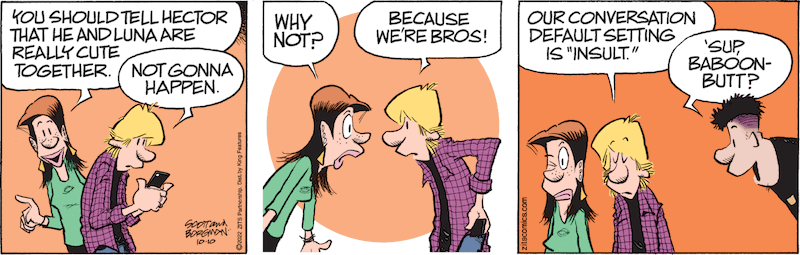
The Zits strips for 10/10 and 10/11, on bro insults: what bros do instead of complimenting one another. Because actually complimenting another guy would be kinda faggy, totally not according to the Boy Code. And girls just don’t understand this basic fact.

(#1) Not any old insults, but ritual insults, like baboon-butt, which won’t be taken seriously; there’s no injury here

(#2) And monkey-heinie and flame brain, all of them serving not as insults but as signs of male bonding — male friendship and mutual regard
(more…)
Posted in Gender and sexuality, Insults, Linguistics in the comics, Masculinity, Pragmatics | Leave a Comment »
October 12, 2022
The 10/10 Piccolo / Price Rhymes With Orange cartoon is delightful, but incomprehensible if you don’t know the proverb whose standard form is now Curiosity killed the cat:

(#1) If you see that the proverb is the key to understanding the cartoon, you’ll be able to appreciate the pun on curiosity — with one sense given explicitly in the cartoon (in curiosity shop), the other available only implicitly, through the proverb and the reference to killing in the cartoon
The two senses, from NOAD:
noun curiosity: 1 a strong desire to know or learn something: filled with curiosity, she peered through the window | curiosity got the better of me, so I called him. 2 a strange or unusual object or fact: he showed them some of the curiosities of the house.
Sense 2 gives us curiosity shop, a store (like the one in the cartoon) that offers curiosities for sale; and cabinet of curiosities, a collection of curiosities for display. And from sense 2 we get the noun curio for the sorts of thing (visible in the cartoon) on sale at a curiosity shop:
noun curio: a rare, unusual, or intriguing object: they had such fun over the wonderful box of curios that Jack had sent from India. ORIGIN mid 19th century: abbreviation of curiosity. (NOAD)
(more…)
Posted in Abbreviation, Formulaic language, Linguistics in the comics, Pragmatics, Proverbs, Puns, Understanding comics | Leave a Comment »
October 2, 2022
… paraphrasing Looney Tunes’s Foghorn Leghorn, describing a discussion of how to trap and then dispatch predatory coyotes in a suburban neighborhood of Cleveland Heights OH — in which Tim Evanson reported putting out a roadrunner (aka road runner), tied to a stake, as a lure (another Looney Tunes allusion) and I suggested as an alternative bait “the superfluous infants of the poor” (alluding to a Jonathan Swift pamphlet of 1729).
Tim and I both spoke satirically; we both wanted our satirical intent to be recognized; and we were both reluctant just to flag our suggestions with a smiley 😀 that shouts out “It’s a satire, son!” But readers often fail to discern satirical intent (especially if they don’t know what sort of person the writer is), so Tim and I jacked things up with those preposterous allusions, both of which wear their own satirical intent on their sleeves. (No actual greater road runners, Geococcyx californianus, or desperately impoverished infants are implicated in our proposals.)
(I will confess that it took me half an hour to get the two sentences of my proposal just so.)
It all began on Oakridge Dr. in Cleveland Heights yesterday, with Tim posting this photo to FB:

(#1) — TE: Very big male coyote on Oakridge Dr. this morning. A couple doors down from my house. [photo from a neighbor walking her dog; note that TE has a relatively small dog of his own, so that neighborhood coyotes are unwelcome news]
(more…)
Posted in Language and animals, Sarcasm and irony | Leave a Comment »
September 9, 2022
The 8/11/22 Rhymes With Orange, exploiting an ambiguity in the noun killer as the modifier N1 in N1 + N2 compounds, in this case in killer abs (literal ‘abs that are killers, abs that kill’ vs. figurative ‘abs that are killer / remarkable’):

(#1) In the worlds of advertisements featuring beautiful people, the health and fitness literature, and soft porn, figurative killer abs are commonplace; abs that kill, however, have (so far as I know) never once appeared on a police blotter
Wider topic: the figurative modifiers of mortal power — premodifying killer (killer abs, a killer app), postmodifying of death (the cruise of death, referring to a penetrating sexual facial expression).
Male body parts and sexual connections between men plus a ton of linguistic expressions in their social contexts, what more could I ask for?
(more…)
Posted in Address terms, Beheading, Clipping, Facial expressions, Language and the body, Lexical semantics, Linguistics in the comics, Nicknames, Penguins, Semantics of compounds, Truncation | Leave a Comment »
September 6, 2022
For Woo(l)ly Mammoth’s #82: a fresh greeting formula, a morning hummer, and a fairy woodland bouquet. To which I’m adding some carrot cake and coffee ice cream: it’s not only my birthday, it’s also National Coffee Ice Cream Day, which I’m honoring all aslant (with coffee gelato), as I do so many things. To alter a family saying (If it’s worth doing, it’s worth doing badly): If it’s worth doing, it’s worth doing eccentrically (for other occasions: If it’s worth doing, it’s worth doing outrageously).
(more…)
Posted in Ambiguity, Art, Greetings, Holidays, Homosexuality, Humor, Language and plants, Language of sex, Mammoths, Music, My life, Penguins, Phallicity, Pragmatics, Signs and symbols, Slang | 2 Comments »
September 1, 2022
🐇 🐇 🐇 (the commencement of September) The Calvin and Hobbes comic strip from 9/1/92, reprised in my comics feed on 8/30:

(#1) We can achieve intergenerational incommunicability! Yes we can!
Calvin articulates a view of word use, call it CalWord, which comes in two parts:
Endless lability. Any word can be used to convey any meaning. In the CalWord view, a word is merely substance — pronunciation or spelling — that can be put to any use. So words are the stem cells of the linguistic world. From NOAD:
compound noun stem cell: Biology an undifferentiated cell of a multicellular organism which is capable of giving rise to indefinitely more cells of the same type, and from which certain other kinds of cell arise by differentiation.
Social fencing. Socially distributed variants can serve as social fences, separating the Ins from the Outs and impeding the Outs’ ability to comprehend and communicate with the Ins — impeding, for example, one generation’s ability to comprehend or communicate with the generations after it. The fencing effect is very noticeable for lexical variants — different bits of substance for the same use (soda vs. pop, say); or, especially relevant here, different uses for the same substance (gay ‘lighthearted, carefree’ vs. ‘homosexual’ vs. ‘foolish, stupid, unimpressive’, say).
(more…)
Posted in Context, Language change, Lexical semantics, Linguistics in the comics, Morphology, Naming, Pragmatics, Semantics | Leave a Comment »
August 30, 2022
Today’s Piccolo / Price Rhymes With Orange strip is a play on specific American tv commercials (with some gentle old-age mockery folded in), so will be baffling to any reader who doesn’t recognize the Kool-Aid Man mascot or know the wall-breaking “Oh Yeah!” tv ads featuring KAM:

(#1) There is, however, a hint to the reader in the “So not kool” (with kool instead of cool) in the title panel; note also the generational disparity reinforced by the GenX so there (see my 11/14/11 posting “GenX so“)
(more…)
Posted in Ambiguity, Context, Language and food, Language in advertising, Linguistics in the comics, Logos, Mascots, Technical and ordinary language, Understanding comics, Variation | 1 Comment »
July 11, 2022
Appearing in my FB as a response to my 7/4 posting (for Fathers Day) “I am a good Boy for you, Daddy” (about Daddy – Boy relationships), this remarkable billboard (without identification or comment), featuring a pig-cop character — Mister Piggie — getting oral with an inert character Boy :

(#1) Pig Kisses Boy! Pig because he’s a cop? Pig because he’s unable to control his sexual impulses? (or, of course, both); I suppose that’s supposed to be life-saving mouth-to-mouth resuscitation, but still: ick
The text looks like a book title (or maybe a quotation from a book), attributed to some Bobby Peters we’re expected to recognize. Is the billboard advertising a book by football player and game analyst Bobby Peters? About whom I had trouble getting much information, but then that’s an alien world to me. I spent maybe half an hour fruitlessly trying to chase Bobby Peters down, and then a search on “some call him pig” turned up a Boing Boing posting “Some call him pig!” by Rob Beschizza from 3/3/22. To start with, the football Bobby Peters has nothing to do with it; it’s about a Columbus GA mayor named Bobby Peters. And there’s a 50-year history of “Some call him Pig!”.
(more…)
Posted in Address terms, Language in advertising, Language of sex, Memes, Music, Parody, Signage, Slogans, Slurs | Leave a Comment »
June 3, 2022
A little study in N + N compounds in English, their great utility and versatility (they pack a lot of content into two-word expressions), and their consequent massive potential ambiguity (so that divining the intended meaning can require vast amounts of background knowledge and appreciating details of the context in which the compound is used). You can have (great) brevity, or you can have (great) clarity, but you can’t have both at once.
From the world of commerce, the compound dog spot (which many of us will not have encountered before, or will take to be a reference to the coat pattern of Dalmatian dogs). From the comic strips, two compounds that have conventional interpretations but can also be understood in fresh and unconventional ways: from One Big Happy, dancing school; from Bizarro, cowboy.
(more…)
Posted in Ambiguity, Brevity vs. Clarity, Compounds, Context, Lexical semantics, Linguistics in the comics, Music, Pragmatics, Semantics of compounds, Snowclonelet composites | 2 Comments »
May 18, 2022
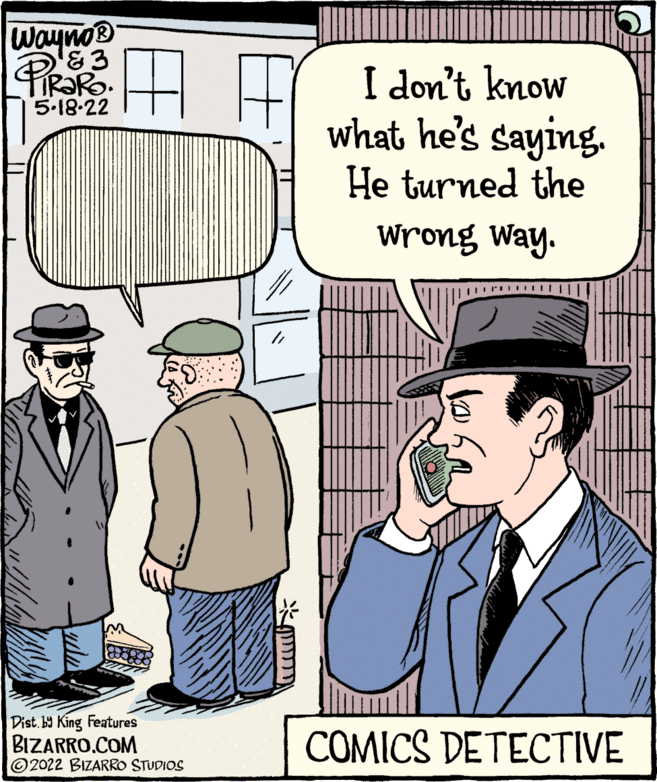
Today’s Wayno / Piraro Bizarro strip, with a detective in a pickle:

(#1) Since the readers of the strip are taking the point of view of the detective, we are in the same pickle (If you’re puzzled by the odd symbols in the cartoon — Dan Piraro says there are 3 in this strip — see this Page.)
How did this happen? Well, first, in this strip, speech balloons are treated as physical objects (containing a representation of speech) that people carry around with them and display to others. So when RH (the hood on the right) is talking to LH (the hood on the left), facing him, with his back to D (the detective), his speech balloon is also facing LH, with its back side to D, so that it can’t be read (by D, or by us).
But wait. This assumes that we are viewing things as if we were in a theater, fixed in our seats while the story unfolds in front of us on stage; what we can see (and hear) depends on how the actors orient themselves. Suppose instead that we’re watching (and listening to) a film; then the cameras (and microphones) go wherever the director wants them to, providing a constantly shifting visual (and auditory) focus on the unfolding narrative.
If the cartoon view is filmic rather than theatrical, then the speech balloons could show us whatever the cartoonist wants us to see — and that can be done even if speech balloons are treated as physical objects (rather than as meta-information). Yes, there are examples.
I know, nobody expects the filmic exposition. (And no, I won’t stop working this Pythonic gag.)
(more…)
Posted in Comic conventions, Linguistics in the comics, Point of view | 2 Comments »