Archive for the ‘Pragmatics’ Category

Don’t ask! 2

May 25, 2023

A Peanuts strip, featuring Charlie Brown and Peppermint Patty:


(#1) But wait! Patty’s Don’t ask! is not a request for Charlie not to ask about her feelings (which would directly contradict her requesting Charlie to ask about her feelings); instead, it’s an exclamation (in Yiddish English) conveying Patty’s dismay at feeling really crappy

We have been through this use of Don’t ask! previously on this blog, in the aptly named posting of 1/31/21, “Don’t ask!”:

(more…)

Who am I kidding?

May 24, 2023

(Note: in this posting I’m going to be unrelentingly careful about the way I frame descriptions of linguistic phenomena (not falling back on the descriptive language of school grammar, which would be familiar to readers but which I believe to be fucked up beyond repair). So there will be a lot of technical talk here; please try to play along, but I don’t think there’s any way to do this right without re-thinking everything from the ground up.)

This is about a perfectly common expression — Who am I kidding? — that went past me in a flash on Facebook this morning but caused me (as a student of GUS — grammar, usage, and style / register) to reflect on the pronoun case in it. On the interrogative human pronoun, appearing here in what I’ll call its Form 1, who, rather than its Form 2, whom.

The pronoun in this expression is the direct object of the verb in the expression, KID, appearing in sentence-initial position (appearing “fronted”) in the WH-question construction of English. There’s nothing at all remarkable about this: in general, both forms of this pronoun are available as syntactic objects (of verbs or prepositions) in the language, differing only in their style / register (very roughly, formal whom vs informal who), with the special case of an object pronoun actually in combination with its governing preposition, which is  obligatorily in Form 2:

Who / Whom did you speak to? BUT *To who / ✓to whom did you speak?

So there’s nothing remarkable about Who am I kidding? It’s just informal.

What’s remarkable is the unacceptability of Whom am I kidding? The stylistic discord between the formality of object whom and the informality of the idiom WH-Pro am I kidding? is unresolvable. To put it another way, the choice of the Form 1 pronoun here is part of the idiom. Just like the choice of the PRP form of the verb KID, conveying progressive aspect: Who do I kid? lacks the idiomatic meaning.

(more…)

DISNEY ON ICE

April 17, 2023

Well, the title pretty much gives the joke away. An outrageous (but phonologically perfect) pun in a Bizarro cartoon from 9/6/12:


(#1) (If you’re puzzled by the odd symbol in the cartoon — Dan Piraro says there’s just 1 in this strip — see this Page.)

What the woman and her two kids get to view is Disney on ice —

(the body of the dead-since-1966 Walt) Disney (resting) on (a block of preservative) ice (in a display case)

What she bought tickets to was an entertainment (especially aimed at children) called Disney on Ice

(an entertainment in which characters from the Walt) Disney (Company’s animated cartoons are portrayed by performers skating) on ice

(more…)

A fugitive verb

April 12, 2023

Very imperfectly caught, out of the corner of my ear, Amy Klobuchar (the senior US senator from Minnesota) being interviewed on MSNBC’s Morning Joe this morning:

was outbested by

Not yet able to recover the context (eventually the tape will be available for viewing), but it’s crucial for determining what AK was trying to convey by choosing the unusual verb outbest (rather than plain best or outdo).

(more…)

They do not act that way

March 6, 2023

From my comics backlog, a One Big Happy strip that turns on the distinction (in the philosophy of language) between descriptive statements (about what is)  and normative statements (about what should be) and shows Ruthie and Joe’s mother exploiting normative statements for her own parental ends — using one to convey injunction or prohibition: saying that this should be the case implicating that you should — or must — act to make it so.


Oh yes, there’s also the third-person reference to her addressees, framing an injunction on them specifically as a kind of normative universal — a manipulation of address terms that the kids simply fail to comprehend (in the last two panels of the strip)

Joe and Ruthie are in fact tearing through the grocery story like wild animals. Ellen Lombard, their mother, asserts that her children do not act like that, meaning this statement normatively. Conveying, in fact, that not only should her children not act like that, but that they must stop acting like that.

Send in the border collies

February 11, 2023

It starts with an elegant Seth Fleishman cartoon in the latest New Yorker (2/13&20/23), and ends up in the world of very competent dogs; in between lie my home intellectual worlds of linguistics and g&s (gender & sexuality studies). Or you could just think of it as being about border collies and Robin Queen.

First comes the cartoon:


(#1) From left to right: on the escalator, the shepherd and three of his flock; on the ground, an understandably reluctant sheep and a border collie performing its job as herder

When advance copies of the cartoon appeared on Facebook, I immediately wrote my linguistics colleague Robin Queen (at Michigan) to say that it was as if Fleishman had created this cartoon especially for her; in addition to everything else she does (see below), Robin and her partner-in-life Susan Garrett run a small farm with a flock of sheep and with border collies that they have trained to herd them (collies that Robin enters with in stockdog competitions).

(more…)

Don’t call me a “creative”

February 5, 2023

Today’s (2/5/23) Doonesbury strip  shows us artist J.J. Caucus and her husband Zeke Brenner in her studio, with J.J. fuming about being labeled a creative:


(#1) “I’m a noun, not an adjective!” But then Zeke shifts the ground from be a creative to be creative, noting (in effect) that be creative denotes a characteristic, not an identity, so “less pressure”

J.J.’s complaint is about the nouning of the adj. creative, yielding a C[ount] noun creative that apparently just means ‘creative person’, but she’s more than a creative person, she’s a professional creator, an artist. As it turns out, the C noun creative is a great deal more specific that ‘creative person’ — and in its established usage it refers to a type of professional in the advertising industry, so in fact doesn’t apply to J.J. at all. Gripe on, J.J.!

(more…)

Snow tires

January 25, 2023

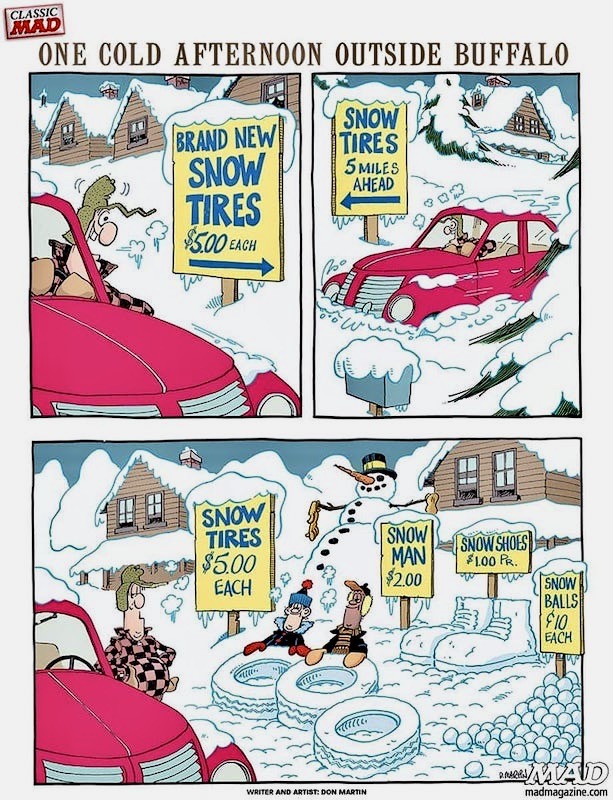
A classic Don Martin Mad magazine cartoon for the winter season, illustrating the utility and flexibility of N + N compounds in English — and also their enormous potential for ambiguity, which has to be resolved in context:

(#1)

Four examples of N1 + N2 compounds in English, all four highly conventionalized  to very culture-specific referents. In these conventionalized uses, two (snow tire, snowshoe) are use compounds (‘N2 for use in some activity involving N1’), two (snowman, snowball) are source compounds (‘N2 made from N1’). But N + N combinations are potentially ambiguous in  multiple ways; this lack of clarity is the price you pay for the great brevity of these combinations (which lack any indications of the semantic relationship between the two elements).

So: we get snow tire and snowshoe understood as source compounds in #1: ‘(simulacrum of a) tire made of snow’, ‘(simulacrum of a) shoe made of snow’.

I’ll turn to the four snow + N2 compounds in #1 in just a moment, but this presentation is now interrupted by breaking news from the snow-cartoon world, a wonderful wordless cartoon by snowman maven Bob Eckstein in the 1/30/23 issue of the New Yorker, which has in fact not yet arrived in my mailbox.

(more…)

Messages in the ABCs

October 22, 2022

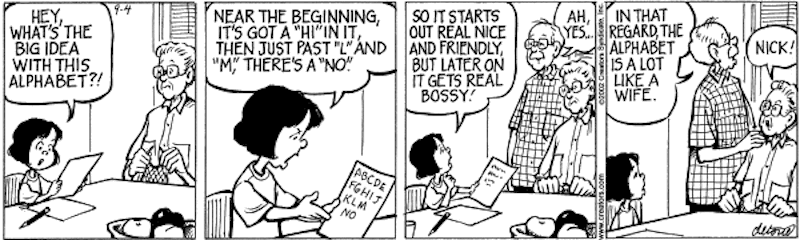
The One Big Happy in my comics feed today (released to newspapers on 9/4) shows Ruthie finding messages in the ABCs — the letters of the alphabet in their conventional order in modern English (A B C D E F G …):


friendly greeting H I  … descending to prohibitive N O

But wait! Go on a bit further and we get to T U, spelling a pronoun of friendly address in French (and sort of, in Spanish, too). Oh, you changeable ABCs, with your many moods!

(more…)

Where to door knock and cold call

October 19, 2022

… and, eventually, how to abracadabra things out of sight. Yes, it’s Verbing Day on AZ Blog!

Politics and real estate: to door knock. It started on the Rachel Maddow Show on MSNBC on 10/11, with the cite presented here in its larger context:


(#1) to door knock / door-knock ‘knock on doors’ (in political canvassing): a N + V verb, whose origin lies in a back-formation from the synthetic compound door knocking / door-knocking

The semantics / pragmatics of the synthetic compound is specialized — not merely knocking on doors, but doing so in specific sociocultural settings (political canvassing and door-to-door solicitations by real estate agents, in particular) — and this specialization is shared by the 2pbfV (two-part back-formed V)

(more…)