Archive for the ‘Phonology’ Category
April 13, 2025
[In the constant upheavals of my life and the world around me, I’m now just picking random stuff to post about, from the 60 or 70 items in my ever-expanding queue — whatever catches my fancy at the moment. Don’t try to make sense of it as a whole.]
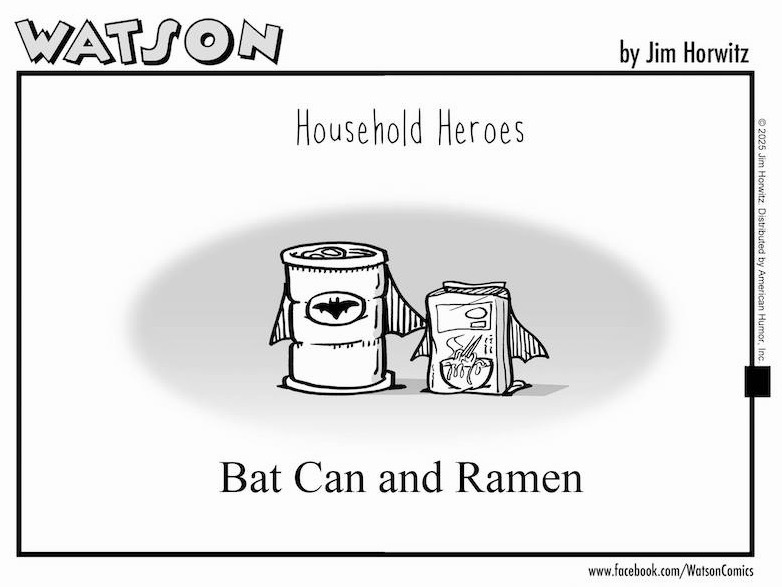
Jim Horwitz’s Watson cartoon for 4/9 (it came to me on Facebook, which has its own peculiar ways of delivering postings, today, 4/13):

Ingeniously outrageous: Batman and Robin turned into food containers
(more…)
Posted in Linguistics in the comics, Phonology, Puns, Signs and symbols | Leave a Comment »
July 24, 2024
Posted on Facebook on 7/19 by James Fell: a riff of 12 risonyms on the name Benedict Cumberbatch (on the occasion of his 48th birthday) — 12 risible names scattered over a factual, plainly told, account of BC’s life, which begins at the beginning:
Today in history, July 19, 1976, Benedict Timothy Carlton Cumberbatch was born in London, England.
and then immediately refers to BC with a preposterous risonym:
Both of Benzedrine Cloacalsplotch’s parents were actors, and his grandfather served as a submarine officer in both world wars.
I’ll reproduce the whole thing below. But first some context.
(more…)
Posted in Actors, Jokes, Language play, Names, Phonology, Poetic form, Spelling | 1 Comment »
April 22, 2024
Today, a long guest posting on intellectual history, specifically on the transmission of ideas in linguistics, in particular on the innovation and spread of linguistic terminology. This is an immensely scholarly follow-up to my 4/15/24 posting “Greek-letter variables and the Sanskrit ruki class”, in which I reproduced a 1970 Linguistic Inquiry squib of mine with that title and wrote:
and then there’s the question of the useful ruki terminology, whose history [the Indo-Europeanist Michael L. Weiss (Professor of Linguistics and Classics at Cornell)] has been trying to trace (this squib might have been the source of its spread throughout the linguistic literature)
Today’s guest post is the current fruit of Michael Weiss’s RUKIstorical investigations, with minimal intrusions in his text by comments from me.
(more…)
Posted in Historical linguistics, History, My life, Phonology, Russian, Sanskrit, Terminology | Leave a Comment »
April 15, 2024
A Linguistic Inquiry squib of mine from 1970 (LingI 1.4.549-55) that for complex reasons hasn’t been digitally available on this site; thanks to the Indo-Europeanist Michael L. Weiss (Professor of Linguistics and Classics at Cornell), I am able to reproduce the squib here so that it will be available for inspection along with (most of) my other publications; the issue of the individuation of rules — of descriptive generalizations — is still a live one (independent of the formalisms of classical generative phonology), and then there’s the question of the useful ruki terminology, whose history MLW has been trying to trace (this squib might have been the source of its spread throughout the linguistic literature; I hope to post eventually on the history of the term).
Now: the 1970 squib, page by page:
(more…)
Posted in Phonology, Resources, Sanskrit, Terminology | Leave a Comment »
February 14, 2023
 (#1)
(#1)
Today’s Wayno / Piraro Bizarro (Wayno’s title “Pupper Love”) shows a teacup chihuahua deployed in a routine medical checkup:

(#2) Doctors ask you to say ah / ahh / aah so that you’ll open your mouth fully and they can then examine the back of the mouth, including the soft palate and the tonsils (If you’re puzzled by the odd symbols in the cartoon — Dan Piraro says there are 4 in this strip — see this Page.)
We will then be taken into the world of exclamations, lexical ones (like hi and yikes) and paralinguistic ones (like uh-huh and unh-unh), and the sociophonetics of ah – aw — which happens to be a familiar topic in English dialectology, thanks to the cot–caught merger, also known as the low back merger or the LOT–THOUGHT merger.
(more…)
Posted in Dialects, Language and animals, Language and medicine, Linguistics in the comics, Paralinguistics and kinesics, Phonetics, Phonology | Leave a Comment »
December 22, 2022
Two especially satisfying examples of the elfshelfism, a riddle form presented visually:

(#1) Image: a cute furry mammal clinging to a bone. Punchline: lemur on a femur. (note: like elf and shelf, lemur and femur are (perfect) rhymes; unlike elf and shelf, however, they’re rare and remarkable nouns)

(#2) Image: a buxom woman reclining provocatively on a pile of Mexican food. Punchline: Dolly [Parton] on a tamale. (note: for most American speakers, Dolly and tamale are perfect rhymes, but for a substantial minority of American speakers, and for many others, they’re half-rhymes)
(more…)
Posted in Books, Formulaic language, Holidays, Jokes, Language and animals, Language and food, Phonetics, Phonology, Rhyme, Riddles, Toys | 5 Comments »
December 13, 2022
A little posting, something I can get done in the time I have. I should explain that since 7 pm yesterday, I have slept 14 hours (and it’s not yet 2 pm). I don’t feel feverish, don’t have a fever, do have periodic crippling joint pain and muscle cramps in my hands and arms, but mostly narcolepsy rules; as the days roll on, it is, however, becoming less ferocious and more bearable.
Meanwhile, in my waking moments, while I practice muscle relaxation, I’ve had time to think about stuff. Thoughts that have expanded today’s intended Big Posting, on name mockery and Benedict Cumberbatch, into something even more ambitious. And random thoughts inspired by stuff that’s come in my mail, including an old topic: what (American) English speakers do with the somewhat challenging pronunciation of my family name, especially that word-initial consonant cluster [zw].
(more…)
Posted in My life, Phonetics, Phonology, Spelling | 2 Comments »
July 26, 2022
… What a delicious Tweety you are!
The 7/24 Mother Goose and Grimm strip, with a police line-up of cartoon cats, for little Tweety to pick out the threatening pussy cat that he thought he saw:

(#1) The potential pussy predator perps on parade, left to right: 1 the Cat in the Hat (Dr. Seuss picture book), 2 Stimpy (Ren & Stimpy tv animation), 3 Sylvester (Looney Tunes film animation), 4 Catbert (Dilbert strip), 5 Attila (MGG strip — note self-reference), 6 Garfield (Garfield strip)
The number of domestic cats in cartoons is mind-boggling — there are tons of lists on the net — and then there are all those other cartoon felines: tigers, panthers, lions, leopards, and so on. Out of these thousands, the cops rounded up the six guys above — all male, as nearly all cartoon cats are, despite the general cultural default that dogs are male, cats female — as the miscreant. (It might be that male is the unmarked sex for anthropomorphic creatures in cartoons as for human beings in many contexts; females appear only when their sex is somehow especially relevant to the cartoon.) And that miscreant, the smirking Sylvester, is the only one of the six known as a predator on birds, though in real life, domestic cats are stunningly effective avian predators, killing billions of birds annually.
(more…)
Posted in Alliteration, Books, Child language, Comic conventions, Constituency, Gender and sexuality, Homosexuality, Language and animals, Language play, Linguistics in the comics, Movies and tv, Nonsense, Parody, Phonology, Poetry, Syntax, Understanding comics, Variation | 2 Comments »
May 1, 2022
🐇 🐇 🐇 pour le premier mai. A follow-up to yesterday’s posting “My allergic ass”, which was (mostly) about pronominal ass — possessive pronoun + ass, used of a person, to refer not to their buttocks but to that person: his ass ‘he, him’, your ass ‘you’, my ass ‘I, me’.
[Ambiguity may ensue: my ass is warm can mean either ‘my buttocks are warm’ or ‘I am warm’ (you have to figure out from context which was intended); while my ass is heart-shaped is probably about my buttocks (well, I might be Candy Man, shaped like a candy heart), and my ass is allergic is probably about me (though I might conceivably have buttocks afflicted by contact dermatitis).]
Now: through Facebook discussions, two different threads have emerged from that posting: one about material in a long citation in the 2006 Beavers and Koontz-Garboden paper on pronominal ass; the other about the source of the example — my allergic ass — that provoked my posting.
(more…)
Posted in Clothing, Compounds, Expressive language, Gender and sexuality, Homosexuality, Language and food, My life, Phonetics, Phonology, Phrasal overlap portmanteaus, Puns, Semantics of compounds, Underwear, Variation | 1 Comment »