Archive for the ‘Ordinary vs. technical lg’ Category

bedbug / bed bug

February 17, 2012

In the midst of the NYC Bedbug Panic of 2010 — see Tara Parker-Pope, “The Curious World of Bedbug Research” in the Health section of the NYT blog 8/30/10 and the full story, “They Crawl, They Bite, They Baffle Scientists”, by Donald G. McNeil Jr. in  Science Times — came two comments in the blog on spelling:

[comment #19] I understand that entymologists refer to them as bed bugs (2 words) not bedbugs, as the author of this article uses. Apparently if the animal is an actual bug, it should be 2 words. Dragonfly is an example of an insect that is not really a fly, so they merge it into one word.

FROM TPP — Yes we have heard about this from a few readers. The Webster’s New World College Dictionary, which is our definitive source when something’s not specifically addressed by the NYT stylebook, spells it as one word. So for now, it’s bedbugs in the New York Times. But I agree the argument for bedbugs as two words is compelling. [AMZ: there is no argument here, only assertion.]

(Larry Horn on ADS-L waggishly suggested that entymologists constituted an instance of folk entomology. Certainly, some confusion between entomology and etymology is common, common enough to merit an entry in Brians. The orthographic combo entymology is also reasonably common, as you can see from a Google search — apparently as an error for entomology.)

[comment #74] Bed bugs is TWO words – not one. The general rule for writing out common names of insects is as follows. If the insect name is a misnomer (e.g., the dragonfly is NOT a fly and neither is a damselfly), then the whole name is written as one word. If it is not a misnomer, then it is written as two words (e.g., house fly, which is a real fly). The bed bug is a “true” bug and therefore is two words.
(more…)

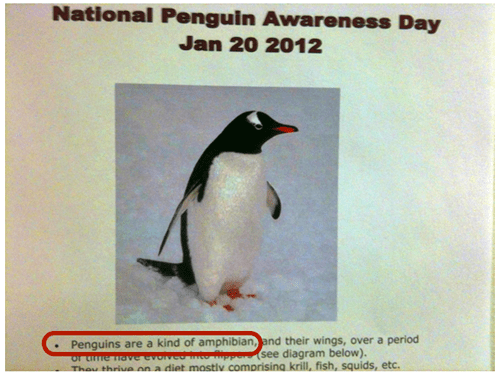
Are penguins amphibians?

February 4, 2012

Drat! I missed the January 20 event. Got this FAIL Blog entry from Elizabeth Daingerfield Zwicky only on Thursday:

Penguins are a kind of amphibian?

(more…)

Rock shrimp

November 11, 2011

A recent addition to the menu at Three Seasons in Palo Alto: a rock shrimp appetizer. Yummy. But I wondered about the name rock shrimp: was the compound subsective (so that rock shrimp are a type of shrimp) or non-subsective (so that rock shrimp are distinct from (true) shrimp, the way that rock lobsters, aka spiny lobsters, are distinct from (true) lobsters, daylilies are distinct from (true) lilies, dwarf planets distinct from (true) planets, etc.)?

I asked the owner, John Le Hung, about rock shrimp. He told me that they were not shrimp, that they tasted more like lobster than shrimp (I verified this), and that they had very hard shells, hence the name (shells hard as rock). So: non-subsective.

Then I descended into a confusing landscape of culinary and biological terminology, as with my lobster adventures of a little while ago.

(more…)

cyclical, secular

October 11, 2011

David Leonhardt in the NYT Sunday Review on October 9th, in “The Depression: If Only Things Were That Good”:

Economists often distinguish between cyclical trends and secular trends — which is to say, between short-term fluctuations and long-term changes in the basic structure of the economy. No decade points to the difference quite like the 1930s: cyclically, the worst decade of the 20th century, and yet, secularly, one of the best.

The cyclical/secular contrast is nice phonologically — though it’s always dangerous to have opposed technical terms that are phonologically similar and semantically related.

This use of secular was new to me, but then I’m not trained in economics. It seems it’s been around for over a century.

(more…)

Nation? Country?

September 23, 2011

From the front page of the September 19th New York Times, “A British Soccer Team? What’s That? Say Scots, Welsh and Irish” (by Jeré Longman and Sarah Lyall):

LONDON — The plan seems eminently reasonable: field a soccer team to represent Britain at next year’s Olympics, which after all are being held here, the home of the modern game.

But there are several problems. For one thing, there is no such thing as a British soccer team. Instead, in a country where devotion to sports is fueled by ferocious regional and political rivalries, there are instead individual teams representing Britain’s fractious, proud and fiercely competitive constituent nations — namely England, Wales, Scotland and Northern Ireland.

Two things: First, the use of Britain to stand for the UK (the United Kingdom of Great Britain and Northern Ireland). Second, the reference to England, Wales, Scotland, and Northern Ireland as the constituent nations of Britain (a form of expression that is used throughout the article).

(more…)

pedantry

May 4, 2011

My posting on argument structure in porn (with a link to my posting on “Brads”) got picked up by Boing Boing, which brought me an enormous number of site views (7,201 on Friday, 3,225 on Saturday, 2,066 on Sunday, 1,075 on Monday, 717 on Tuesday; an ordinary day gets 200-300 views) and some new regular readers (and, so far, no vacuous or trash-talking comments on this blog).

(more…)

Annals of slurs

February 27, 2011

My posting on formations in -tard elicited some Facebook comments that were facetious (reminders of leotard and custard) and some that were dismayed at the offensiveness of these formations and the noun retard from which they derive. All this stuff is indeed offensive and is so labeled by lexicographic sources.

And behind this lies a nasty jungle of technical terms, euphemisms, semantic shifts, lexical replacements, specific slurs, and generalized insults — such a tangle that there’s no easy way to even talk about the semantic domain in question, which has to do with what once was called mental defectiveness (itself a technical term covering various vernacular terms) and then mental retardation or simply retardation (with the image of slowness or being held back). The corresponding adjectival formations are mentally retarded or (later, in another euphemistic move) mentally challenged.

(more…)

Detechnicalization and retechnicalization

January 21, 2011

From the op-ed page of the NYT on January 18, “Me and My Algorithm” by Seth Freeman, which begins:

Algorithms, as you probably know, are the computer programs that infer from your profile (in the case of Facebook) and the content of your e-mails (in the case of Gmail) [or your pattern of searching and buying on Amazon.com] your interests and preferences, enabling ads to be displayed to the customers most likely to be interested in specific products.

… The algorithms are programmed, I believe, to get to know us better over time, and rather than resent the invasion of privacy I have come to feel a grudging respect for, and even a growing sense of intimacy with, my own personal algorithm. You have to admire, for example, the inventive audacity of a program that would read an e-mail someone sent me about “Holocaust deniers” and think that I might be shopping for a Holistic Dentist.

Freeman goes on in this vein with other entertaining examples.

The term algorithm has traveled a long way from its use as a technical term in mathematics to the much broader use illustrated in Freeman’s piece.

(more…)

Expressive matter/material

December 21, 2010

Dan Goncharoff posts to ADS-L on this notice from New York City Parks and Recreation:

Beginning Monday, July 19, 2010, new rules take effect for vendors who sell art, photography, reading material, or sculpture in City parks. Vendors who sell these items are referred to as “Expressive Matter Vendors.” The new rules are available at http://www.nyc.gov/parks/rules.

The relevant point is the technical expression expressive matter (a mass nominal), designed to cover a category of creative productions that has no ordinary-language label, though it hangs together for people in the culture.

Considerable NYC coverage.

Meanwhile, the related mass nominal expressive material has some history as a legal term covering creative productions (including movies, computer files, published material of all kinds, and so on, as well as the material enumerated above) that might be subject to laws governing plagiarism, pornography, privacy, search and seizure, forfeiture, and the like.

Sometimes it’s subject to countification (see here and here), as in this piece of Alabama legal code, with the relevant occurrence boldfaced:

Property subject to forfeiture may be seized by state, county or municipal law enforcement agencies upon process issued by any court having jurisdiction over the property upon a showing of probable cause; provided, however, that not more than one copy of each expressive material may be seized prior to a judicial determination, after a hearing at which all proper parties have an opportunity to be heard and present evidence, that the expressive material is obscene material or material which is harmful to minors and, in either case, subject to forfeiture under this division. (link)

That’s expressive material ‘item of expressive material’.

Portmanteau Prunus

August 7, 2010

This morning at the local farmers’ market, I picked up a couple of nectaplums, which started to become available last week. Nectaplum is a portmanteau of nectarine and plum, and the nectaplum is a hybrid of a variety of nectarine and a variety of plum.

There were also pluots (pluot = plum + apricot) on sale.

And so I was plunged into the mysteries of the genus Prunus (peaches, plums, apricots, cherries, and almonds) and the names for its bewildering collection of varieties and hybrids.

(more…)