I am reminded by Amanda Walker that today is DEC-20 Day — it’s the date, kids — causing me to recall times working at research labs that used DEC-20s as their shared workhorse machines. This DEC-20 brought me two cartoons, the first a Zippy glancingly related to Christmas, the second a Bizarro directly about Christmas in popular culture.
Archive for the ‘Onomatopoeia’ Category
Two DEC-20 cartoons
December 20, 2025From the annals of remarkable commercial names
September 27, 2025Briefly noted. From Randy McDonald on Facebook yesterday, a nighttime-atmospheric photo of the Chew Chew Grill / Chew Chew’s Diner, 186 Carlton St., Toronto ON (open 8 am to 4 pm):
All-day breakfast, hot sandwiches, and burgers in a space with booth seating and train-inspired decor
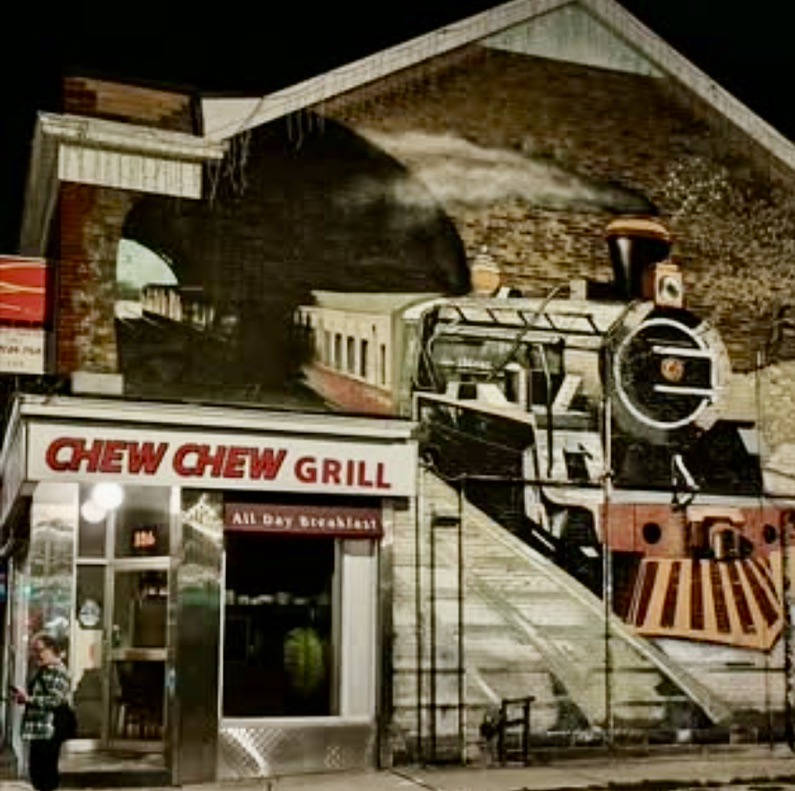
You get the remarkable name, a kind of ludic trifecta — punning (choo punning on chew), imitative (choo-choo ‘train’), and metonymical (chew in the name of an eating place) — plus the wonderful train mural, especially vivid at night.
hoozamaflazamadoozamajillions 1
April 29, 2025👨🏭 👨🏭 penultimate April: in only two days, a gaggle of rabbits, strewing lilies of the valley promiscuously, will dance around an International Workers pole; be prepared
Meanwhile, Masayoshi Yamada, Emeritus Professor of Linguistics in Shimane University, in western Honshu (author of, inter alia: A Dictionary of Trade Names and A Dictionary of English Taboo and Euphemism), has appealed to me by e-mail on 4/24 with another puzzle from cartoons in English (his last query, reported on in my 9/25/24 posting “This idiom has had the radish”, had to do with the idiom have the radish in a Zits strip). This time it’s about one of Lynn Johnston’s For Better or For Worse strips, (re)published on 6/19/24:
There are three linguistic things going on in this cartoon: the ambiguity of the verb count; the invented -illions words; and the thing MY was puzzled by, the gigantic “nonsense nonce coinage” (as he put it) hoozamaflazamadoozama modifying jillions

After some background words about the strip, I’ll take up these three things one by one, expanding on things I wrote to MY.
Annals of diminutive /li/
July 26, 2024Just two days ago, it was (piecrust) crumblies. Now, Benita Bendon Campbell has sent me e-mail connecting crumblies to (garment) greeblies — which, as it turns out, I posted about on this blog way back in 2012. My personal experience with the two terms dates to the 1960s, and is bound up with my history with my late wife, Ann Daingerfield Zwicky (1937 – 1985); Bonnie (BBC) was Ann’s best friend (and has been a close friend of mine since 1960).
Masculinity comics 5
October 8, 2021Start with the Zippy strip of 6/29; focus on the second panel:
(#1) A generic diner setting, plus Nancy‘s cartoonist Ernie Bushmiller’s three rocks, unaccountably numbered for reference (see my 9/22/17 posting “Three rocks”)

Double dactyls for boys
Snarfity-barfity, Grossout and Slapstick, those
Champions of ick, masters of pow:
Boys by the age of six, nix on the feminine,
Slam with the Stooges, shout it out loud
Onomatopoeia and program music
September 2, 2020On 8/31, e-mail from fellow shapenote singer Peter Ross, asking
whether onomatopoeia might apply to songs like the City of New Orleans, Bill Staines’s song River, the Carter family song Winding Stream, etc., where the music fits the meaning of the lyrics
These are wonderful, incredibly moving songs, and I’ll write about them below, but what Peter’s talking about is a relationship between the form of pieces of music (including their lyrics) and the images or stories the music might evoke — while onomatopoeia is a specifically linguistic relationship, having to do with an association between linguistic elements — lexical items — and their referents, turning on the phonetics of the lexical items and perceptible characteristics of the referents.
So they’re clearly related concepts, but not the same thing.
Revisiting 27: Lilo, Stitch, Bouba, and Kiki
March 25, 2019Mike Pope on Facebook, following up on my posting of the 25th “Lilo & Stitch”, with a question about the naming of the characters in the movie:
(#1) Stitch and LiloMP: Do you think the animators consciously followed a kiki/bouba paradigm?
AZ: Almost surely not consciously; they just chose names that “sounded right” to them.

In general, writers’ name choices for fictitious characters are inscrutable in detail; even if the writers have an explicit account of where the names came from, unconscious preferences for certain kinds of names can usually be seen to be at play.
One of these preferences is the bouba/kiki effect, which has to do with the visual appearance of the referents (see the images above). Also involved are effects having to do with the gender of the referents (Stitch is male, Lilo female). No doubt there are more.
Lilo & Stitch
March 23, 2019Today’s morning name. I really have no idea why. I haven’t even seen the movie and was only vaguely aware of its theme. Maybe the sound-symbolic values of the names, the contrast between the /l/s of Lilo, voiced liquids, symbolically flowing; and the /s t č/ of Stitch, all voiceless obstruents, symbolically spiky and aggressive. And the /aj/ of Lilo, long and with a low nuclear F2; versus the /ɪ/ of Stitch, quite short and with a very high F2. Lilo is female, human, and family-oriented; Stitch is male, alien, and destructive.
Wok it to the golden Lab for analysis, har-de-har-har
December 3, 20183 x 3: three cartoons of linguistic interest for the 3rd of December: a Dave Blazek Loose Parts with merged phonemes; a Wayno/Piraro Bizarro with an ambiguity; and a Zits with an onomatopoeia.
A grotesque word
November 29, 2018Tuesday’s Zippy:
 (#1)
(#1)
Another chapter in word attraction: Zippy’s (and Griffy’s) enjoyment of “funny words”. Here, gargoyle, which Zippy, absurdly, analyzes as a compound of the nouns gar (referring to a kind of sharp-toothed fish) and goyle (a rare, mostly dialectal, term for a deep trench) — so, roughly ‘fish ravine’. Turns out the actual etymology of gargoyle is entertaining enough on its own.