Archive for the ‘Naming’ Category
April 28, 2023
(This is very much a not-dead-yet posting. I’m just barely hanging on through still more medical afflictions, but now think the little time I’m able to devote to posting is better spent on upbeat things rather than intimations of mortality.)
Discovered on my desktop, a three-part Saturday Morning Breakfast Cereal from 12/19/18. Part 1, the teaser:
 (#1)
(#1)
(more…)
Posted in Linguistics in the comics, Mathematics, Naming | 4 Comments »
January 24, 2023
From my mountainous posting queue, this gem of a risonymic riff:

(#1) Bodysnatch Cummerbund, Buffalo Custardbath, Bumblesnuff Crimpysnatch, Mr. Cabbagewank — four mockings, ridiculous manglings, of the already remarkable name Benedict Cumberbatch; otherwise, the first two paragraphs are an actual news item, accurate in its details, about the 2014 engagement of actor Benedict Cumberbatch to theatre director Sophie Hunter
(more…)
Posted in Language play, Movies and tv, Names, Naming, Poetic form, Poetry, Word attraction | 1 Comment »
September 1, 2022
🐇 🐇 🐇 (the commencement of September) The Calvin and Hobbes comic strip from 9/1/92, reprised in my comics feed on 8/30:

(#1) We can achieve intergenerational incommunicability! Yes we can!
Calvin articulates a view of word use, call it CalWord, which comes in two parts:
Endless lability. Any word can be used to convey any meaning. In the CalWord view, a word is merely substance — pronunciation or spelling — that can be put to any use. So words are the stem cells of the linguistic world. From NOAD:
compound noun stem cell: Biology an undifferentiated cell of a multicellular organism which is capable of giving rise to indefinitely more cells of the same type, and from which certain other kinds of cell arise by differentiation.
Social fencing. Socially distributed variants can serve as social fences, separating the Ins from the Outs and impeding the Outs’ ability to comprehend and communicate with the Ins — impeding, for example, one generation’s ability to comprehend or communicate with the generations after it. The fencing effect is very noticeable for lexical variants — different bits of substance for the same use (soda vs. pop, say); or, especially relevant here, different uses for the same substance (gay ‘lighthearted, carefree’ vs. ‘homosexual’ vs. ‘foolish, stupid, unimpressive’, say).
(more…)
Posted in Context, Language change, Lexical semantics, Linguistics in the comics, Morphology, Naming, Pragmatics, Semantics | Leave a Comment »
August 17, 2022
Yesterday’s Wayno / Piraro Bizarro, at the grocery store:

(#1) Wayno’s title: Joint Replacement (If you’re puzzled by the odd symbols in the cartoon — Dan Piraro says there are 5 in this strip — see this Page.)
So: let’s start with elbow macaroni and go on from there.
(more…)
Posted in Ambiguity, Categorization and Labeling, Constituency, Italian, Language and food, Language and the body, Linguistics in the comics, Metaphor, My life, Names, Naming, Parsing, Syntax, Understanding comics | Leave a Comment »
July 8, 2022
Zippy’s guide to food-buying in today’s strip: packaging, monosyllabicity (hereafter 1-icity), and collectibility, in that order:

(#1) As ever, thoroughly steeped in pop / mass culture: in the 3rd panel, not just the orange-flavored drink mix Tang, but also the astronaut allusion (“That’s one small step for man, one giant leap for mankind”); it then turns out that the panel also takes us to orangutans (which are neither orange in color — ok, some reddish tones, but not orange, see #3 below — nor have a tang in their name, but but …)
(more…)
Posted in Gay porn, Gender and sexuality, Language and animals, Language and food, Linguistics in the comics, Masculinity, Names, Naming, Professional names, Publications, Quotations, Trade names | 3 Comments »
July 5, 2022
(The customary warning: male sexual parts, man-on-man sex, and street language about all of it, so not for kids or the sexually modest.)
Zach Astor, a porn name that caught my eye this morning (while I was engaged with various recent CockyBoys porn offerings, for reasons both personal and professional) — because it’s ZA, while I’m AZ. The reverse of me. (Alas, the bearer of the name isn’t from South Africa, and I’m not from either Azerbaijan or Arizona, but then nobody’s perfect.)
It turns out that ZA is (of course, being a gay porn actor) young, young enough to be my grandson, or maybe even my great-grandson; with curly hair that is sometimes mostly blond, sometimes brown with blond highlights (vs. my very fine very straight brunet-gone-gray); with a slim build (vs. my fat one); with a smooth body (vs. my hairy one); with a really big dick (a thick 8ʺ — vs. my svelte 5ʺ); and he’s a devoted top (while I’m an enthusiastic bottom). Well, we’re both gay men, both born in Pennsylvania (ZA in Philadelphia, AZ in Allentown), and both circumcised — but that’s not a lot of common ground. I should ask him if he’s thought about trying … linguistics:
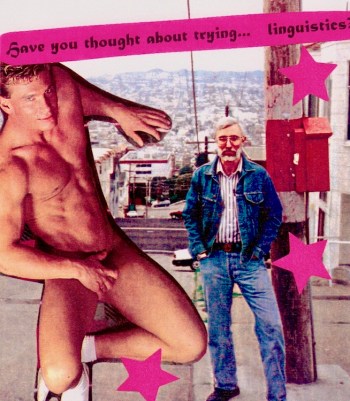
(#1) Not, as you will soon see, ZA, but a different porn actor, the one I put in this collage (set on Potrero Hill in SF) long ago
(more…)
Posted in Collages, Effeminacy, Facial expression, Gay porn, Gender and sexuality, Homosexuality, Language and the body, Language of sex, Masculinity, Naming, Narrative | Leave a Comment »
September 18, 2020
Today is the birthday of my second mother-in-law, Monique Serpette Transue (born 1912). And also of Samuel “Dictionary” Johnson (born 1709). A coincidence of dates that entertains me. When I noted this on Facebook yesterday, Ned Deily wrote:
The interwebz assert that no single word exists, in English at least, to describe people who share the same birthday anniversary. Time to invent one? A lexicographer’s work is never finished.

After a digression on what lexicographers do and another on Samuel Johnson and a note about Gilbert du Motier, the Marquis de Lafayette, I’ll make a stab at coining.
(more…)
Posted in Holidays, Innovations, Names, Naming | 9 Comments »
June 4, 2019
From an exchange on Facebook a few days ago, in which (at least) two of the participants use the term perennial to refer to plants that are green all year round, that don’t lose their leaves for a dormant season. The discussion was set off by DA (not knowing the privacy wishes of the participants, I refer to them by their initials), posting about a practice that puzzles him:
DA: I never understood why [people] bother to plant [fruit] trees that don’t bear fruit.
To which DS replied with a number of reasons for the practice, but along the way introducing perennial in the sense ‘green all year long’ (relevant materal boldfaced):
DS: They provide many other benefits, for birds, shade, soil augmentation … they hold together hills so they don’t wash away .. and much more. Besides, they can be lovely. As far as I know, there are no perennial fruit trees so they can’t be used for privacy.
(more…)
Posted in Derivation, Language and food, Language and plants, Metaphor, Names, Naming, Taxonomic vs. common | 5 Comments »
March 25, 2019
Mike Pope on Facebook, following up on my posting of the 25th “Lilo & Stitch”, with a question about the naming of the characters in the movie:

(#1) Stitch and Lilo
MP: Do you think the animators consciously followed a kiki/bouba paradigm?
AZ: Almost surely not consciously; they just chose names that “sounded right” to them.
In general, writers’ name choices for fictitious characters are inscrutable in detail; even if the writers have an explicit account of where the names came from, unconscious preferences for certain kinds of names can usually be seen to be at play.
One of these preferences is the bouba/kiki effect, which has to do with the visual appearance of the referents (see the images above). Also involved are effects having to do with the gender of the referents (Stitch is male, Lilo female). No doubt there are more.
(more…)
Posted in Language and gender, Linguistics in the comics, Naming, Onomatopoeia, Phonetics, Pop culture, Psychology of language | 2 Comments »