Archive for the ‘Derivation’ Category

investigational

June 7, 2013

Heard in television ads for cancer treatment centers, the phrase investigational drugs. From an FDA site on “Access to Investigational Drugs”:

Investigational or experimental drugs are new drugs that have not yet been approved by the FDA or approved drugs that have not yet been approved for a new use, and are in the process of being tested for safety and effectiveness.

This passage treats investigational and experimental as synonyms in the drug context — but then the site goes on to use investigational exclusively. This specialized use of investigational (as opposed to the transparent general use ‘of or relating to investigations’) seems to be fairly recent — recent enough that it’s not in the dictionaries I’ve consulted. It seems to have replaced experimental as the appropriate technical term for drugs undergoing testing, perhaps because some people in the relevant community had come to feel that experimental no longer sounded sufficiently technical, but had become part of ordinary language.
(more…)

Explorations in derivational morphology

June 6, 2013

Two finds in the 6/5 article “Mad Professors: The adjuncts are at the barricades” by Rebecca Burns in In These Times (about unions for adjunct faculty), with the crucial words boldfaced:

(1) That so many advanced degree-holders are toiling in poverty conditions flies in the face of the assumption that higher education is a path to prosperity. But low wages and precarity represent the new norm for what some adjuncts have termed “academia’s version of apartheid.”

(2) Reeling from state budget cuts, universities have turned increasingly to the cheap teaching labor provided by non-tenure track faculty. But the adjunctification of higher education also coincides with its bureaucratization.

In (1), we have the Latinate derivative precarity rather than the native English precariousness; in (2), a noun adjunctification, incorporating the verb-forming suffix –ify (on the base adjunct). Both are innovations, not in the OED or other dictionaries I’ve consulted.

(more…)

louden

May 28, 2013

From the Falcon Studios description of the gay porn flick The Guys Next Door:

The grunts and groans [of sex] louden, calling Marcus [Mojo] and Johnny [Torque] back to the scene [an orgy in progress].

That’s inchoative louden ‘become loud, become louder’. It struck me as unidiomatic; despite the parallel with soften, I would have written got loud(er). But it turns out that virtually every dictionary I looked at has it. The OED has the intransitive — inchoative — use from the mid-19th century on, but only one cite (from 1898) for the transitive — causative — use, which it marks as rare.

The inchoative or causative suffix –en is in fact extremely restricted in English — not productive, and limited to only a few sorts of base words: monosyllables ending in obstruents, from the Anglo-Saxon (rather than Latinate) stratum of the vocabulary. Even then, not all eligible bases allow derivatives in this –en; hotten is not attested (heat (up) serves this purpose), and colden is attested but marked by the OED as rare (cool and chill serve this purpose, or better, get cold(er)), and modern speakers reject it. For me, louden is like colden.

(more…)

Departments: There’ll always be an England

May 25, 2013

In the NYT on the 21st, this entertaining story by Sarah Lyall: “Common Gnomes Pop Up at Rarefied Flower Show, to Horror of Many”, where it is reported that:

it was not surprising that the staid Royal Horticultural Society‘s decision to allow garden gnomes — creatures commonly associated with the landscapes of the unrich, the unfamous and the untasteful — at the Chelsea Flower Show this year elicited a variety of responses.

… Gnomes, which are called “brightly colored mythical creatures” in the handbook governing the show, are not really part of the Chelsea aesthetic. (Nor are balloons, flags, “feather flags,” or “any item which, in the opinion of the society, detracts from the presentation of the plants or products on display,” the handbook reads.)

Four topics come up in the article: social class in the UK; the two words gnome (and gnomic etc).; conversion of proper names to count nouns; and playful gnome-related morphology.

(more…)

Define “garbage”

May 20, 2013

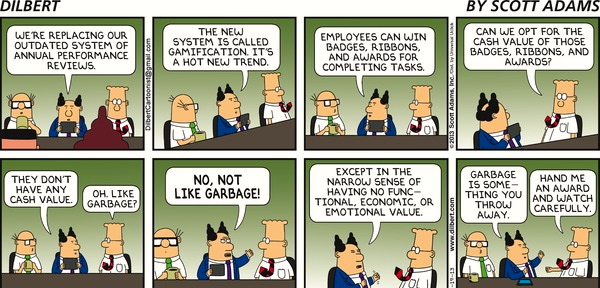
Yesterday’s Dilbert, in which Dilbert confronts his pointy-headed boss:

I’m sorry to say that gamification (a verbing in -ify from the noun game) is not some twisted invention of Scott Adams’s. And then there’s the question of what counts as garbage.

(more…)

Vocabulary surprises

May 17, 2013

For some purposes, you can function fairly well with material in another language, so long as the topic stays within domains that are familiar to you — like linguistics, say. But when you wander into other domains, especially those that are closely tied to sociocultural conventions, things get messy, even if you stick to nouns; there’s just so much to know about cultural artifacts and customs, for example, and a huge vocabulary to acquire in these areas, in the names of animals and plants, etc.

I can deal pretty well with technical material in French, for example, but I’m easily stumped when it comes to artifacts, animals, plants, and the like. By way of illustration: my daughter gave me a big box of postcards on The Art of Instruction, with images of school materials from the 1950s, from mostly French but also some German sources. The German items have no text, but the French material (from Éditions Rossignol — the name is great; rossignol means ‘nightingale’) is heavy with text. For animals and plants, much of the vocabulary is technical teminology from zoology, anatomy, or botany, and that’s fascinating, but I can’t be expected to know these expressions. However, there are also the common names for animals and plants, and they contain many surprises.

That brings me to the tadpole.

(more…)

Demonyms

May 17, 2013

In the letters section of the May 20th New Yorker, this piece:

NEW YORKIANS

In “Draft No. 4,” [April 29th], John McPhee writes that a copy editor sometimes provides a writer with a word like “a rare gold coin.” He recalls how Mary Norris, copy editing one of his pieces, suggested “Mancunians” for “Manchestrians.” McPhee goes on to rank it on a selective list of names for residents of specific locales. Readers wrote in with their own demonyms:

(more…)

Morphology for swine

May 16, 2013

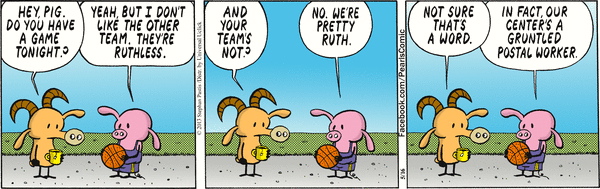
Today’s Pearls Before Swine:

Pig indulges in resurrecting “lost positives” (ruth from ruthless, gruntled from disgruntled) — there’s a site on which people nominate lost positives, often quite fancifully — but gets the morphological structure of ruthless wrong.

(more…)

pinnies

April 9, 2013

In my e-mail a little while ago, a Princeton University Store ad offering Princeton pinnies — one illustrated here:

The text:

The weather is finally starting to warm up and we have the perfect lightweight summer staple for Tigers everywhere – the Princeton pinnie! With a nice loose fit and 2-ply mesh these are sure to keep you cool in all senses of the word! Did we mention, they’re all REVERSIBLE and available in several different styles?!

The term pinnie for such a garment was new to me. But it’s been around for a while, though primarily in British usage.

(more…)

Context, jargon, and clipping

March 26, 2013

From an article in Details magazine for April 2013, p. 64, a quote given here without context:

“The house doesn’t even have a complete back. We had to be careful about the budget and determined that we could add the top of the roof in post.”

Add … in post is baffling without the context. Things get a bit clearer when I tell you that the house in question is the ominous Victorian house next to the motel on the set of the new A&E tv series Bates Motel (a prequel to the movie Psycho), and the speaker is Mark Freeborn, the production designer for the series. But that gets you only part of the way; you also have to work out that post is a clipping of post-production in the jargon of filmmaking and video production. And of course you need to know what post-production refers to as a technical term in this world.

(more…)