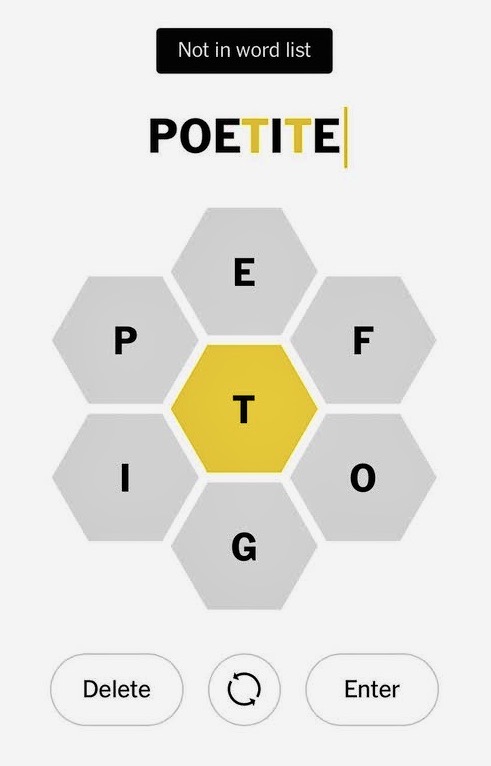
Faced with this judgment on Facebook today about the Spelling Bee puzzle from the New York Times,
Dennis Baron owlishly protested with word play incorporating a pun on concrete:
It’s the stuff concrete poems are made from.
Well played, Dennis!
Faced with this judgment on Facebook today about the Spelling Bee puzzle from the New York Times,
Dennis Baron owlishly protested with word play incorporating a pun on concrete:
It’s the stuff concrete poems are made from.
Well played, Dennis!
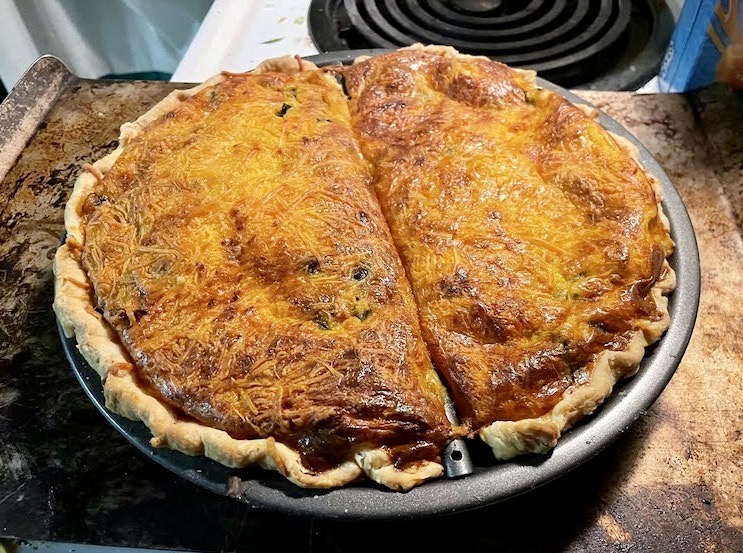
Gretel Cunningham Young (of Columbus OH, where she grew up, with my daughter Elizabeth, many years ago) on Facebook yesterday:
— GY: My goal was to make a half-vegetarian, half-carnivorous quiche, so I ordered this divided pan
Noting her reference to carnivorous quiche, plus an odd quirk in way English vegetarian is used, I reacted to her statement with some alarm (my response in an expanded and improved form here):
— AZ: But I don’t think I want to get near a carnivorous (‘meat-eating’) quiche, lest I be devoured by it. vegetarian quiche has the adjective vegetarian ‘(of food or diet), plant-based, excluding meat’, not the noun vegetarian ‘(of people) a vegevore, someone who eats only plant-based food; a non-carnivore, someone who does not eat meat’. A quiche that’s a vegetarian would not be a threat to me (as a being made of meat), but it would nevertheless be creepy, in a cannibalistic sort of way. The meaty correspondent to vegetarian quiche ‘quiche for vegetarians’ would be quiche for carnivores.
An Ellis Rosen cartoon that came by on Facebook recently:
(#1) The hybrid creature the pomeranian-nimbus, being taken for a walk, on a leash, by its owner — so being presented as an extraordinary dog, a cloud canine; note that the woman’s dog recognizes the p-n as a dog, and appears to want to play with it (see the wagging tail)
(The name of the dog breed is standardly capitalized, because it’s a proper name denoting a creature originating in the geographical region of Pomerania, and I’ll use Pomeranian from here on.)
The compound Pomeranian-nimbus is a copulative N1 + N2 compound (like Swiss-American or hunter-gatherer), denoting a thing or things of both the N1 type and the N2 type. But in fact the creature is not just a mix of Pomeranian dog and nimbus cloud, but is actually a nimbus Pomeranian ‘Pomeranian dog that is (also) a nimbus cloud’ (your standard N + N compound in English is semantically modifier + head) — rather than a Pomeranian nimbus ‘nimbus cloud that is also, or at least resembles, a Pomeranian dog’. A nimbus Pomeranian, or, more compactly, a nimbopomeranian, a nimpom for short.
In human beings, the mouth is the only bodypart that comes equipped with teeth. Well, there are fables of the fearsome vagina dentata and even — top men, beware! — of the occasional anus dentatus. Now the wonderful world of prehistoric nature brings us a penis dentatus. Or so we learn from the latest WIRED.
From WIRED Science, “An Ancient Penis Worm With Rings of Sharp Teeth Has Been Discovered in the Grand Canyon: The 500-million-year-old fossil, containing a species named in honor of the krayt dragons in Star Wars, is a much larger ancestor of phallic marine worms that can be found on the seabed today” by Marta Abba on 8/19/25:
Penis worms are marine creatures with a distinctly phallic appearance. There are more than 20 known species living across the world’s oceans today, as well as a number of extinct ones, like this new discovery. The researcher who made the find was searching for fossils in the Grand Canyon and named the species Kraytdraco spectatus in honor of the huge burrowing krayt dragons that appear in the Star Wars universe. Details of the discovery were published in the journal Science Advances.
In memoriam John Robert Ross (May 7, 1938 to May 13, 2025). The news of Haj’s death came in my morning e-mail on Wednesday 5/14, right next to a Bizarro cartoon with a cowboy joke / restaurant joke, turning on an absurd pun on ranch dressing that Haj (who was a walking library of jokes) would have appreciated, and so with a synchronicity that Haj would have delighted in.
J.R. Ross was an outsized figure in linguistics, whose ideas (beginning with his 1967 MIT dissertation, Constraints on Variables in Syntax) altered the field. Haj Ross was a literally outsized person physically, a large, blocky man (he really did play football for Yale as an undergraduate) with a big presence. And Haj, no surname needed, had an outsized personality — endlessly imaginative, enormously funny, astonishingly empathetic and gentle, “big and sparkly” (me on Facebook), with “an amazing facility for the intricacies of English” (John Beavers on FB) and “an innocent sense of wonder about language, poetry, and the world” (Susan Fischer on FB). And resolutely counter-cultural (often barefooted, and rarely standing on ceremony), also attuned to all the Zen-inflected frequencies on your radio dial.
He was a good friend of mine, and an inspiration to me, from 1963 on. So this posting is hard to write. I will collect myself and pick out some facts, some assortment of outrageous anecdotes, a small selection of his poetry and artwork, and even (since, like Haj, I’m hopelessly a linguist) a note about a neglected feature of his work on syntax that I think is important in the intellectual history of the field. I will do all that in another posting, I hope tomorrow.
Today I’ll start the way Haj often started his public presentations. With a joke, that Bizarro cartoon (remember the cartoon?). From which a Google AI Overview search then led me, goofily, into a strange dusty canyon of verse, Jim Ross’s self-published Pull Up a Chair: Cowboy Poetry. Truly, Haj would have loved that.
This morning my attention was caught by a Comcast Business tv commercial offering virtual walk-throughing — the PRP of the verb + particle idiom walk though, as in You can walk through the sample office, here in its gerundive use. The standard form (virtual) walking through has the PRP inflection on the head of the verb + particle combination, the verb, which is the first element in the combination, so is internal to it.
It’s been a while since I noted a general tendency for idiomatic verb + particle (V+Prt) to get its inflection on the second element, at the end — to externalize the inflection, as here. I’ll go back to an earlier posting of mine, then add some notes on things that might facilitate externalization of inflection in V+Prt Vs.
🎁 Boxing Day 🎁 — also St. Stephen, with his feets uneven — coming a day late, because life has been very difficult for me, and postings have piled up so high I’m not sure I can ever get to them, so I’ve picked something I know I can get done, so that this dark, rainy, and excruciatingly painful low-air-pressure day will not be a total loss
I bring you an e-mail message from Victor Steinbok on 12/25, about this ad for Spice Tribe (website here), a San Francisco-based on-line spice store dedicated to mindful cooking:
(#1) VS wrote: Facebook has offered another example of what I used to refer to as parenthetical ambiguity. Is it [aged anchovy] [salt] or [aged] [anchovy salt]. From a culinary perspective, the latter makes no sense (aging salt doesn’t change it). But that doesn’t mean there’s no built-in ambiguity.
From Chris Ambidge (one of the Wardens of the Spheniscid Zarchives) on Facebook this morning:
(#1) [CA > AZ:] Arnold! Have you considered … penguin slippers? Keeping Feathers McGraw underfoot might be the best way to make sure he doesn’t get into mischief
From the Coddies website:
Coddies® Wallace & Gromit Feathers McGraw slippers:
Silent but villainous, Feathers McGraw is the ultimate plush slipper icon!
Slip into the soft embrace of Wallace & Gromit’s Feathers McGraw himself with Coddies’ new plush slippers, designed to capture the essence of Aardman’s criminal mastermind. They fit like a glove – not unlike the red rubber glove perched atop Feathers’ head – a disguise so brilliant in its simplicity that it once outwitted Wallace and even the local law enforcement.