Archive for the ‘Understanding comics’ Category
November 26, 2022
Today’s Wayno / Piraro Bizarro is a Psychiatrist cartoon — they’re a Bizarro specialty — that is incomprehensible if you don’t recognize the figure of the patient and know about this patient’s history with psychiatry (cardboard box??):

(#1) Incredibly, it’s also significant that this is today’s Bizarro, and that today is 11/26/22 (If you’re puzzled by the odd symbols in the cartoon — Dan Piraro says there are 6 in this strip — see this Page.)
Significant, in that your appreciation of the joke will be heightened some if you understand that today is a notable anniversary associated with the figures in the cartoon.
And your appreciation might be heightened a bit more if you recognize who the therapist in the cartoon is (based on).
All of this is so in-jokey arcane that the actual cartoon distributed by Cartoon Kingdom includes a bottom line explaining the significance of the date, which is then a key to unraveling everything else. But the patient, you have to recognize the patient.
Who is not just a character in a cartoon (in this cartoon, the way the therapist is), but a character from a specific comic strip, drawn in the style of that strip, so that the patient looks “cartoony” in a way the therapist does not.
(more…)
Posted in Comic conventions, Holidays, Linguistics in the comics, Understanding comics | 6 Comments »
October 27, 2022
Today’s Wayno / Piraro Bizarro strip, yet another in their long line of Psychiatrist cartoons (today with Dr. Sigmund Freud as the therapist and Baron Victor Frankenstein as the patient) — a conventional form that, in the hands of an ingenious cartoonist, can be used as the vehicle for almost any joke:

(#1) The Baron makes a Freudian slip; Wayno’s title: “Unexpected Insight” (if you’re puzzled by the odd symbols in the cartoon — Dan Piraro says there are 6 in this strip — see this Page.)
Doctor Doctor, this is no whim
I got a bad case of having created him
No pill’s gonna cure my ill
I got a bad case of having created him
Freudian slip, Frankensteinian slip: master, monster.
Yes, yes, a pile of bits and pieces jumbled together here (and full appreciation of the cartoon calls for lots of further background knowledge), so there’s plenty to talk about — and was, even before I introduced Robert Palmer into the mix. So grab your torches and pitchforks and let’s advance on this assemblage of oddly fitting parts.
(more…)
Posted in Comic conventions, Errors, Linguistics in the comics, Movies and tv, Parody, Pop culture, Understanding comics | Leave a Comment »
October 12, 2022
The 10/10 Piccolo / Price Rhymes With Orange cartoon is delightful, but incomprehensible if you don’t know the proverb whose standard form is now Curiosity killed the cat:

(#1) If you see that the proverb is the key to understanding the cartoon, you’ll be able to appreciate the pun on curiosity — with one sense given explicitly in the cartoon (in curiosity shop), the other available only implicitly, through the proverb and the reference to killing in the cartoon
The two senses, from NOAD:
noun curiosity: 1 a strong desire to know or learn something: filled with curiosity, she peered through the window | curiosity got the better of me, so I called him. 2 a strange or unusual object or fact: he showed them some of the curiosities of the house.
Sense 2 gives us curiosity shop, a store (like the one in the cartoon) that offers curiosities for sale; and cabinet of curiosities, a collection of curiosities for display. And from sense 2 we get the noun curio for the sorts of thing (visible in the cartoon) on sale at a curiosity shop:
noun curio: a rare, unusual, or intriguing object: they had such fun over the wonderful box of curios that Jack had sent from India. ORIGIN mid 19th century: abbreviation of curiosity. (NOAD)
(more…)
Posted in Abbreviation, Formulaic language, Linguistics in the comics, Pragmatics, Proverbs, Puns, Understanding comics | Leave a Comment »
September 30, 2022
🐅 🐅 🐅 tiger tiger tiger for ultimate September; tomorrow the inaugural rabbits of October will bound in
In today’s Wayno / Piraro Bizarro, set in the Schmancy auction house — think Christie’s or Sotheby’s — a Mötley Crüe cruet POPped (phrasal overlap portmanteaued) to Motley Crüet (somehow the first röck döt got lost in the compression process):

(#1) Wayno’s title: “Tinny Aftertaste”, combining the metal of heavy metal with the taste of a cruet’s contents (If you’re puzzled by the odd symbols in the cartoon — Dan Piraro says there are 4 in this strip — see this Page.)
To understand this, you need to know about fancy-schmancy auction houses and how they operate; about cruets and their function in dining; and about heavy metal music and the heavy metal band Mötley Crüe and their reputation for vulgarly outrageous behavior, which clashes with the civility of oil-and-vinegar dressings for salads, so yielding the humor of anomalous juxtaposition.
(more…)
Posted in Language and food, Linguistics in the comics, Music, Names, Phrasal overlap portmanteaus, Spelling, Understanding comics | 2 Comments »
August 30, 2022
Today’s Piccolo / Price Rhymes With Orange strip is a play on specific American tv commercials (with some gentle old-age mockery folded in), so will be baffling to any reader who doesn’t recognize the Kool-Aid Man mascot or know the wall-breaking “Oh Yeah!” tv ads featuring KAM:

(#1) There is, however, a hint to the reader in the “So not kool” (with kool instead of cool) in the title panel; note also the generational disparity reinforced by the GenX so there (see my 11/14/11 posting “GenX so“)
(more…)
Posted in Ambiguity, Context, Language and food, Language in advertising, Linguistics in the comics, Logos, Mascots, Technical and ordinary language, Understanding comics, Variation | 1 Comment »
August 18, 2022
Today’s Wayno / Piraro Bizarro, requiring a boatload of popcultural knowledge to understand:

(#1) The easy part: these are three anthropomorphic peanuts, M, M, F from left to right, and they are sitting at a bar, with drinks in front of them (If you’re puzzled by the odd symbols in the cartoon — Dan Piraro says there are 3 in this strip — see this Page.)
Somehow the meeting of these three exemplifies the N1 + N2 compound N wingnut / wing-nut / wing nut (which has 4 senses in NOAD, plus a bunch more you can imagine). But how?
(more…)
Posted in Ambiguity, Language and food, Language of sex, Libfixes, Linguistics in the comics, Logos, Mascots, Masculinity, Metaphor, Metonymy, Portmanteaus, Signs and symbols, Snowclonelet composites, Understanding comics | 4 Comments »
August 17, 2022
Yesterday’s Wayno / Piraro Bizarro, at the grocery store:

(#1) Wayno’s title: Joint Replacement (If you’re puzzled by the odd symbols in the cartoon — Dan Piraro says there are 5 in this strip — see this Page.)
So: let’s start with elbow macaroni and go on from there.
(more…)
Posted in Ambiguity, Categorization and Labeling, Constituency, Italian, Language and food, Language and the body, Linguistics in the comics, Metaphor, My life, Names, Naming, Parsing, Syntax, Understanding comics | Leave a Comment »
July 28, 2022
The captioning contest in The New Yorker‘s 8/1/22 issue:
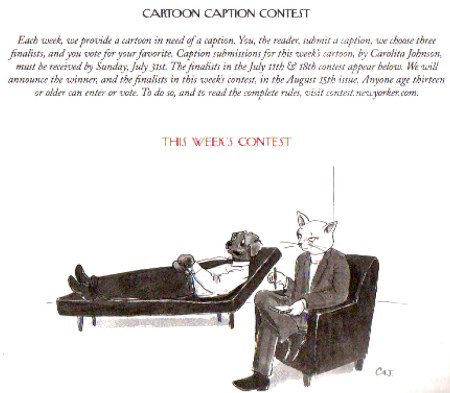
(#1) Dog as Patient, Cat as Therapist, both presented very clearly as male — but still I understood it as a gender cartoon, with a penetratingly critical feminist pussy wielding an aggressive masculine persona (think Marlene Dietrich in a tuxedo, but with Susan Sontag’s sharp tongue) against the feckless hound pouring out his smug superiority towards “the little ladies”, as he calls them; I’m perfectly aware that very few other people would see things this way, and I expect the caption entries to be about the conventional natures of cats and dogs
So when I saw Johnson’s captionless Psychiatrist cartoon, I found it bitingly funny just as it stood. And wondered about CAJ.
Oh my.
(more…)
Posted in Comic conventions, Effeminacy, Gender and sexuality, Linguistics in the comics, Masculinity, Understanding comics | Leave a Comment »
July 26, 2022
… What a delicious Tweety you are!
The 7/24 Mother Goose and Grimm strip, with a police line-up of cartoon cats, for little Tweety to pick out the threatening pussy cat that he thought he saw:

(#1) The potential pussy predator perps on parade, left to right: 1 the Cat in the Hat (Dr. Seuss picture book), 2 Stimpy (Ren & Stimpy tv animation), 3 Sylvester (Looney Tunes film animation), 4 Catbert (Dilbert strip), 5 Attila (MGG strip — note self-reference), 6 Garfield (Garfield strip)
The number of domestic cats in cartoons is mind-boggling — there are tons of lists on the net — and then there are all those other cartoon felines: tigers, panthers, lions, leopards, and so on. Out of these thousands, the cops rounded up the six guys above — all male, as nearly all cartoon cats are, despite the general cultural default that dogs are male, cats female — as the miscreant. (It might be that male is the unmarked sex for anthropomorphic creatures in cartoons as for human beings in many contexts; females appear only when their sex is somehow especially relevant to the cartoon.) And that miscreant, the smirking Sylvester, is the only one of the six known as a predator on birds, though in real life, domestic cats are stunningly effective avian predators, killing billions of birds annually.
(more…)
Posted in Alliteration, Books, Child language, Comic conventions, Constituency, Gender and sexuality, Homosexuality, Language and animals, Language play, Linguistics in the comics, Movies and tv, Nonsense, Parody, Phonology, Poetry, Syntax, Understanding comics, Variation | 2 Comments »