Archive for the ‘Linguistics in the comics’ Category
March 27, 2019
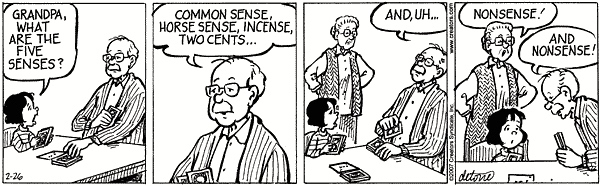
The 2/26 One Big Happy, riffing on /sɛns/, in idioms with sense (common sense, horse sense, nonsense), in incense, and in cents (also in an idiom, two cents):
 (#1)
(#1)
Which, of course, leads us inevitably to the psychedelic days of 1967, with their whiff of incense and peppermints (plus some pot).
(more…)
Posted in Dialects, Idioms, Language and culture, Lexicography, Linguistics in the comics, Music, Phonetics, Phonology, Rhyme | 5 Comments »
March 25, 2019
Mike Pope on Facebook, following up on my posting of the 25th “Lilo & Stitch”, with a question about the naming of the characters in the movie:

(#1) Stitch and Lilo
MP: Do you think the animators consciously followed a kiki/bouba paradigm?
AZ: Almost surely not consciously; they just chose names that “sounded right” to them.
In general, writers’ name choices for fictitious characters are inscrutable in detail; even if the writers have an explicit account of where the names came from, unconscious preferences for certain kinds of names can usually be seen to be at play.
One of these preferences is the bouba/kiki effect, which has to do with the visual appearance of the referents (see the images above). Also involved are effects having to do with the gender of the referents (Stitch is male, Lilo female). No doubt there are more.
(more…)
Posted in Language and gender, Linguistics in the comics, Naming, Onomatopoeia, Phonetics, Pop culture, Psychology of language | 2 Comments »
March 23, 2019
Today’s morning name. I really have no idea why. I haven’t even seen the movie and was only vaguely aware of its theme. Maybe the sound-symbolic values of the names, the contrast between the /l/s of Lilo, voiced liquids, symbolically flowing; and the /s t č/ of Stitch, all voiceless obstruents, symbolically spiky and aggressive. And the /aj/ of Lilo, long and with a low nuclear F2; versus the /ɪ/ of Stitch, quite short and with a very high F2. Lilo is female, human, and family-oriented; Stitch is male, alien, and destructive.
(more…)
Posted in Language and gender, Linguistics in the comics, Morning names, Movies and tv, Narrative, Narratophilia, Onomatopoeia | Leave a Comment »
March 21, 2019
From Karen Chung on Facebook a while back, this complex pun in the 9/25/15 Bizarro, illustrating (among other things) a nice contrast in accentual patterns: front stress (or forestress), the default for N + N compounds, in MOVING sale; back stress (or afterstress), the default in Adj + N nominals, in moving SALE:

(#1) (If you’re puzzled by the odd symbols in the cartoon — Dan Piraro says there are 5 in this strip — see this Page.)
So the hinge of the pun is the ambiguity of moving: as N, (roughly) ‘the act or process of changing residence’; or as Adj, (roughly) ‘causing strong emotion, esp. of sadness’ (both senses are ultimately semantic developments from the simple motion verb move, intransitive or transitive; but they are now clearly distinct lexical items). Then from the difference in syntactic category follows the difference in accentual pattern.
(more…)
Posted in Ambiguity, Common vs. proper, Compounds, Derivation, Linguistics in the comics, Movies and tv, Names, Phonology, Pop culture, Semantics, Syntactic categories, Variation | 3 Comments »
March 20, 2019
… in a One Big Happy cartoon (in auditorium) and in the title of a 1998 movie (the nickname Paulie): in American English, unrounded [ɑ] for rounded [ɔ], collapsing the distinction between the phonemes /a/ in cot and /ɔ/ in caught.

(#1) Discomfort in the low back region: Polly on the left, Paulie on the right
(more…)
Posted in Eggcorns, Linguistics in the comics, Movies and tv, Names, Nicknames, Phonetics, Phonology, Taboo language and slurs, Toys and games | 2 Comments »
March 19, 2019
From a recent chain of postings on Facebook, a 1/9/14 Bizarro strip rendered en français:

(#1) (If you’re puzzled by the odd symbols in the cartoon — Dan Piraro says there are 5 in this strip — see this Page.)
Il faut mettre l’œil avant le scarabée, sauf si le participe passé est placé devant le serpent. (more or less literally) ‘It is necessary to put the eye before the beetle, except if the past participle is placed in front of the snake.’
(more…)
Posted in Linguistics in the comics, Spelling, Writing systems | 4 Comments »
March 14, 2019
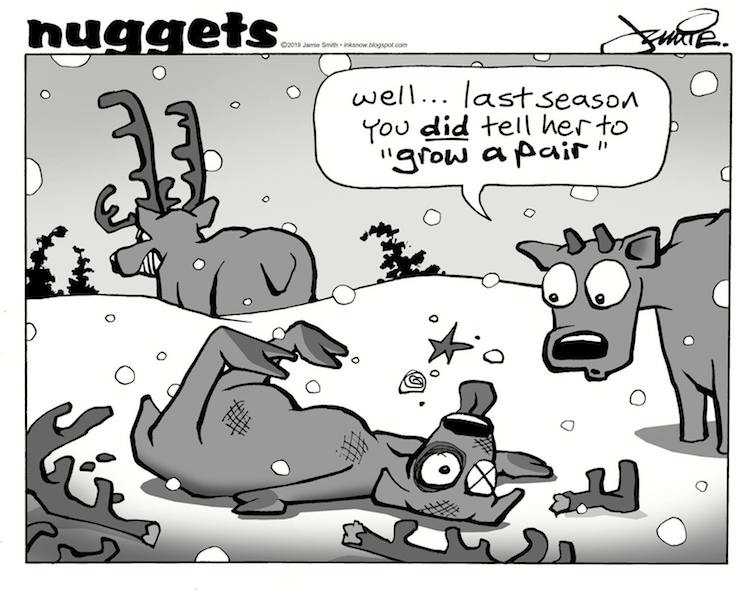
From Chris Waigl on the 10th, this bulletin from Alaska, the 2/24 Nuggets cartoon by Jamie Smith (inksnow.blogspot.com) in her local paper, the Fairbanks Daily News-Miner:
 (#1)
(#1)
[Chris:] [Since the cartoon is set in Alaska] the animals depicted presumably are caribou (NOT reindeer). Note that in caribou, females have antlers, often quite elaborate ones.
Also [since it’s illegal to kill caribou cows, but legal to hunt bulls,] the Alaska Department of Fish and Game has a remarkable multi-page illustrated leaflet about sexing caribou in the wild [here]
Ok: the idiom grow a pair; antlers on female caribou/reindeer; the distinction between caribou and reindeer; and as a bonus, an Ink & Snow blog posting “Bear Den” from 3/10 on the use of trademarked characters in cartoons.
(more…)
Posted in Art, Collages, Gender and sexuality, Idioms, Language and animals, Language and the body, Language and the law, Linguistics in the comics | 1 Comment »
March 13, 2019
Yesterday’s Wayno/Piraro Bizarro cartoon:

(#1)(If you’re puzzled by the odd symbols in the cartoon — Dan Piraro says there are 7 in this strip — see this Page.)
You need to recognize that the cartoon takes place in a garage and you need to know that detailing is a kind of car care. And you need to recognize that Nick is the Devil (note horns and tail). That’s all pretty easy.
Then you need to know what detailing a car has to do with the Devil — and for that, if you don’t know the saying The devil (or Devil) is in the detail(s), you’re just stuck. You’ve missed a devil of a pun (on detail).
(more…)
Posted in Linguistics in the comics, Names, Proverbs, Puns, Understanding comics | Leave a Comment »
March 11, 2019
In my comics feed yesterday (presumably originally in print on 2/11), a One Big Happy in which Ruthie uses a doll to take on the personality of Tina Turner covering the Creedence Clearwater Revival hit “Proud Mary” — “Rollin’ on the River”:

(#1) Ruthie burlesquing “Rollin’ on the River” as “Roland B. McRiver”
Background: the CCR song, the Tina Turner version, Tina Turner herself, the Tiny Tears doll — a ton of pop culture. And then Ruthie’s burlesque, which reproduces, in its mangled way (Joe: “Make her stop. PLEASE!”), all three verses of the original and its chorus.
(more…)
Posted in Linguistics in the comics, Mishearings, Music, Parody, Pop culture, Toys and games | 2 Comments »
 (#1)
(#1)