Archive for the ‘Linguistics in the comics’ Category
August 8, 2019
Two recent One Big Happy strips about the cartoon’s kids in the process of acquiring — internalizing, rehearsing, and displaying — two sociocultural complexes of beliefs, attitudes, and behaviors.
Ruthie is learning to fit into modern American commercial culture, where she is urged to judge products not on their intrinsic qualities (such as the taste and nutritional values of breakfast cereals) but on their symbolic associations as pushed in their marketing (cartoon characters as the representatives of breakfast cereals in commercials).
Meanwhile, Joe is learning normative masculinity in modern America, absorbing the lesson that successful manhood requires the stringent rejection of everything feminine — both anything associated with girls and also anything associated with the conventional role of the mother as taming boys, civilizing them.
(more…)
Posted in Gender and sexuality, Language and food, Language in advertising, Linguistics in the comics, Masculinity, Movies and tv | Leave a Comment »
August 4, 2019
From The Economist of July 27th. Yes, it’s grammatical, but it’s fiercely hard to parse — you might feel the need to get out pencil and paper to graph the thing — and it’s also a big show-stopper flourish: stop reading the news to admire how clever we are!
In this case, the magazine has committed a nested clausal comparative (NCC), somewhat reminiscent of nested relative clauses (also known in the syntactic literature as self-embedded relative clauses) like those in the NP with head the rat modified by the relative clause that the cat that the dog worried ate:
[ the rat ]-i
… [ that [ the cat ]-j [ that [ the dog ] worried ___-j ] ate ___-i ]
(where an underline indicates a missing (“extracted”) constituent, and the indices mark coreferential constituents). Both nested relatives and NCCs require the hearer to interrupt the processing of one clause to process another clause of similar form.
(more…)
Posted in Comparison, Formulaic language, Language play, Linguistics in the comics, Processing, Semantics, Syntax | 4 Comments »
August 2, 2019
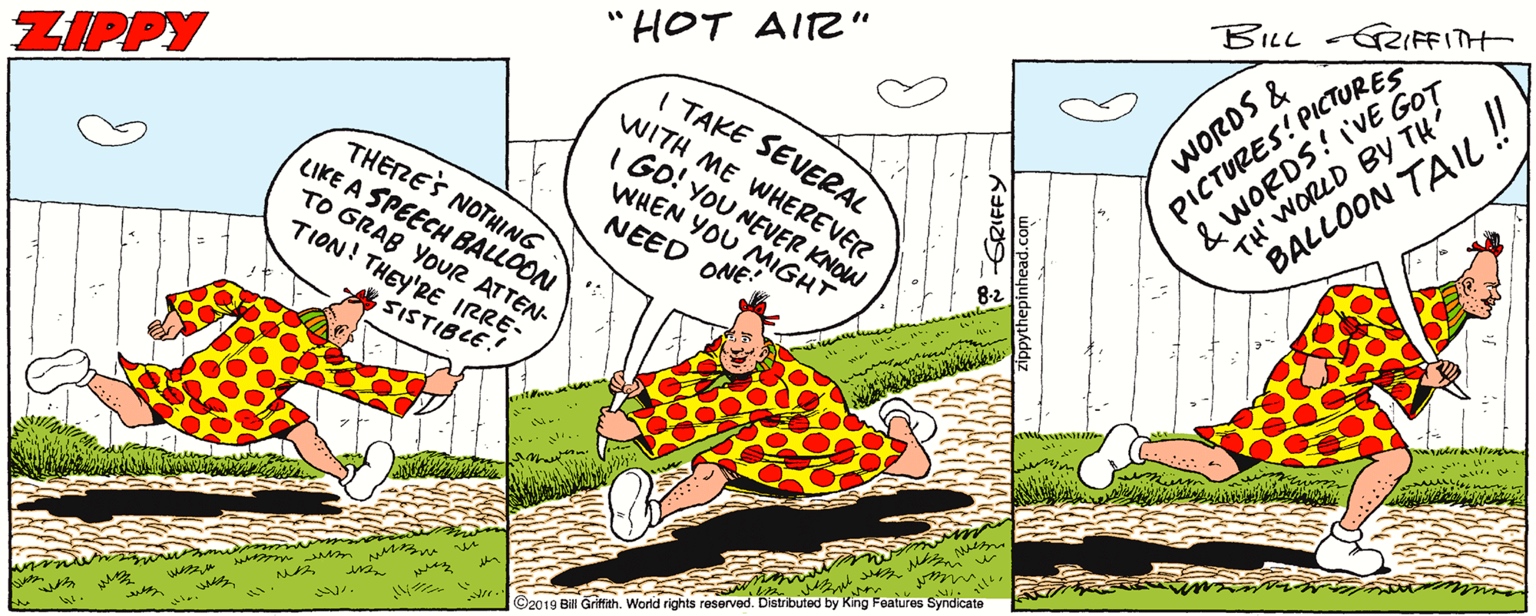
That’s today’s advice from Zippy:
 (#1)
(#1)
Zippy is a long-time fan of speech balloons, their history, their uses, their attractions. In fact, speech balloons are a fairly frequent explicit theme in cartoons — cartoons about cartooning.
And then there’s the theme of things you shouldn’t go out without — from a certain amount of cash or your identity papers, to makeup or condoms, to American Express products or (if you’re hitchhiking in space) a towel.
(more…)
Posted in Comic conventions, Gender and sexuality, Language in advertising, Language of sex, Language play, Linguistics in the comics, Movies and tv | 1 Comment »
August 1, 2019
In the August 5th & 12th New Yorker, this droll cartoon by John McNamee:
 (#1)
(#1)
To understand the cartoon, you must, first of all, recognize the figures of a bull and a bullfighter. Crucial cultural knowledge, but not (I think) especially challenging. Then there are the other details — the two of them are seated in a livingroom, the bull is having a dainty cup of tea, the bullfighter is showing the bull patches of the color red. And then there’s the caption: how does it knit some or all of these things into a joke?
(more…)
Posted in Art, Folk beliefs, Idioms, Linguistics in the comics, Understanding comics | 8 Comments »
July 30, 2019
(I posted a version of this under the heading “The opossum” on July 30th, but by a WordPress glitch the link to that posting was later re-directed to the next posting in line, “Ralph at the Port Authority” (here), so that my earlier posting disappeared completely. I lamented this loss on Facebook, and eventually archivist and quote investigator Garson O’Toole magicked up a Google Cache version of the text for me. Thanks to Garson, here’s a reconstituted version.)
(Totally baffled addendum. WordPress has published this revised posting with the date 7/30, though it was actually posted on 8/1.)
A very sweet One Big Happy from 6/30: Ruthie and her grandfather:
 (#1)
(#1)
A granddad joke — well, actually, two of them in sequence, the first sledgehammer simple (a classic dad joke), the second delightfully subtle (a meta-joke in which the audience response becomes a crucial part of the joke).
(more…)
Posted in Categorization and Labeling, Humor, Jokes, Linguistics in the comics, Names, Puns, Routines and rituals, Words and things | Leave a Comment »
July 26, 2019
In the July 29th New Yorker, two cartoons about things for American lawns, each requiring one key piece of knowledge for understanding: Bob Eckstein showing a moment of silence; Farley Katz featuring a distressed bird.
 (#1)
(#1)
 (#2)
(#2)
Both cartoons are complex — several things are going on at once, including allusions to American political life — but you can’t get anywhere with them unless you recognize the repeated images in them: the shuttlecocks of the game badminton in the Epstein, the plastic lawn flamingos in the Katz.
(more…)
Posted in Language and animals, Language and sports, Linguistics in the comics, My life, Phallicity, Social life, Understanding comics | 3 Comments »
July 24, 2019
In a recent comics feed, the 6/27 One Big Happy, with an exchange between Grandma Rose and the grotesquely smiling Avis
 (#1)
(#1)
In panel 2, the baggage of emotional baggage is a conventional metaphor, one no longer requiring the hearer to work out the effect of the figure and so now listed in dictionaries. But then Rose immediately brings it back from dormancy to life in a long riff of creative metaphor (in panels 2-4), composed on the spot and calling up a complex and vivid scene for the hearer.
We use the same term, metaphor, for both phenomena, and the mechanism is the same in both — but one is a historical phenomenon (whose figural character is usually out of the consciousness of speaker and hearer), while the other is a phenomenon of discourse production and comprehension in real time.
(more…)
Posted in Ambiguity, Figurative language, German, Language and the body, Linguistics in the comics, Metaphor, Puns, Spanish | 3 Comments »
July 20, 2019
Appearing in my Facebook feed a couple of days ago, passed on by Joelle Stepien Bailard, this self-portrait of Swedish-speaking Finnish artist Tove Jansson:

(#1) Tove Jansson (1914-2001), Self-portrait in a fur hat (1941)
From my 10/19/14 posting “Tove Jansson tomorrow”:
Another multiple talent who doesn’t usually get pegged as Artist (without qualification), like many others I’ve written about on this blog (Edward Gorey, for instance). Charming but complex [Moomintroll] books for children (a favorite in our household when my daughter was young), among other things.
(more…)
Posted in Art, Categorization and Labeling, Gender and sexuality, Linguistics in the comics | Leave a Comment »
 (#1)
(#1)