Archive for the ‘Linguistics in the comics’ Category
December 31, 2020
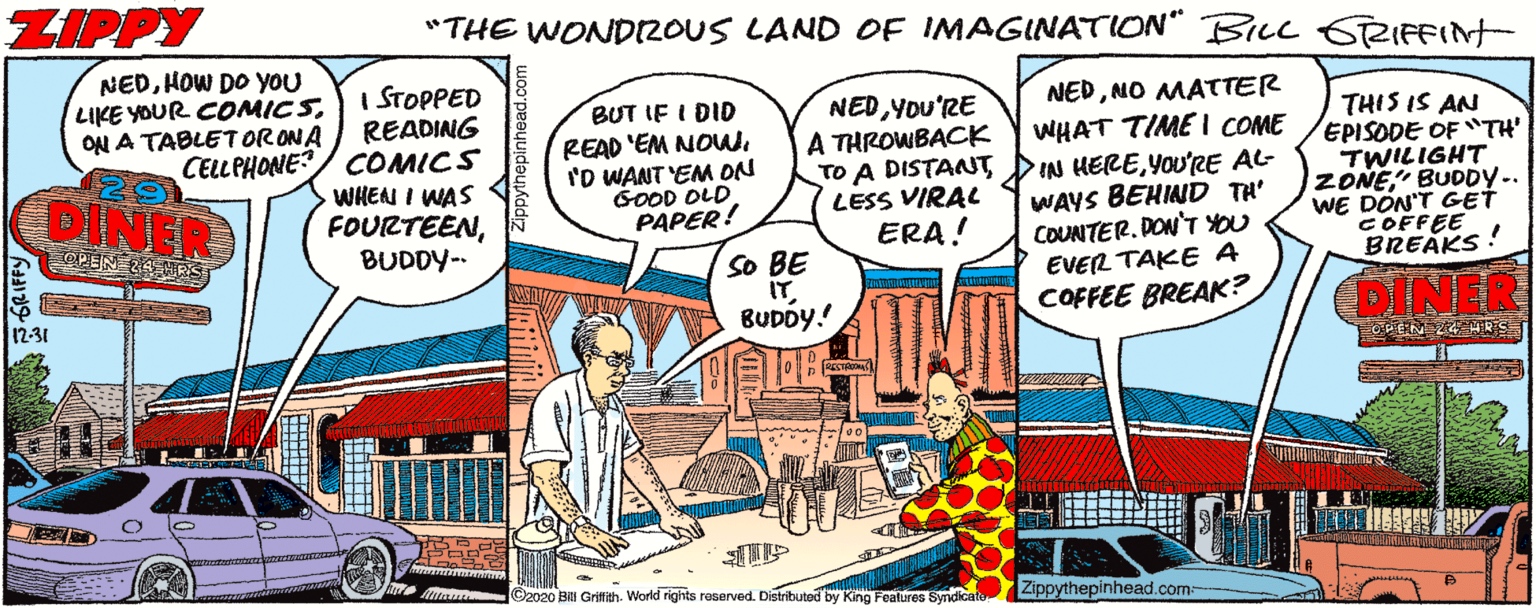
Today’s Zippy takes us to the 29 Diner in Fairfax VA, where a Twilight Zone wrinkle has apparently established itself:
 (#1)
(#1)
It seems that Ned lives in that liminal world, where there are no coffee breaks (and presumably no bathroom breaks either). The place is open 24 hours, so maybe no sleep either.
(more…)
Posted in Diners, Linguistics in the comics | Leave a Comment »
December 31, 2020
In the most recent (1/4&11/21) New Yorker, this E.S. Glenn cartoon with still another variant of the Desert Island meme:
 (#1)
(#1)
Somehow they started out paddling a lovers’ swan boat — note the heart — in the pond of a park but ended up beached on a desert island in the Pacific (or whatever tropical spot cartoon desert islands are located in). Yes, he should have let her ask for directions.
(more…)
Posted in Comic conventions, Linguistics in the comics | 2 Comments »
December 30, 2020
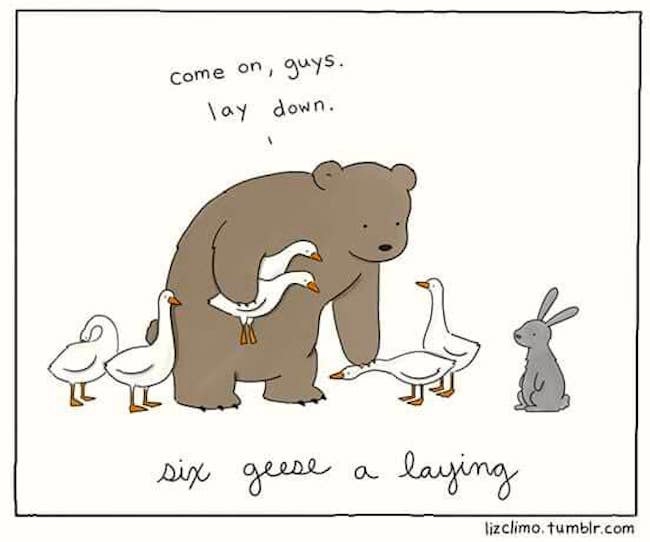
Liz Climo’s cartoon for today, 12/30, the 6th day of Christmas (“Six geese a-laying” — that is, laying eggs):
 (#1)
(#1)
Prescriptively incorrect, but extraordinarily widespread, lay down (in an imperative to the geese to lie down).
(more…)
Posted in Holidays, Inflection, Linguistics in the comics, Usage advice, Variation | 4 Comments »
December 29, 2020
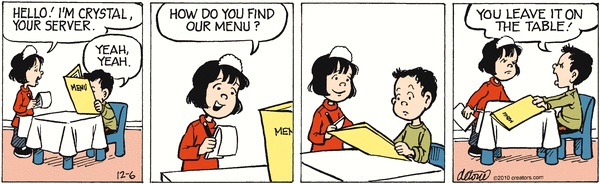
Ambiguity days: Ruthie (playing a restaurant server) to the neighbor kid James (playing a customer) in the 12/6 One Big Happy strip:
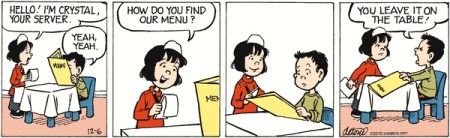
Ruthie has one understanding of (EX) How do you find our menu?, James another, and this difference is reflected in (at least) three (tightly linked) places in the question: in the meaning of the verb find; in the meaning of the present tense; and in the meaning of the interrogative adverb how.
(more…)
Posted in Ambiguity, Linguistics in the comics | Leave a Comment »
December 29, 2020
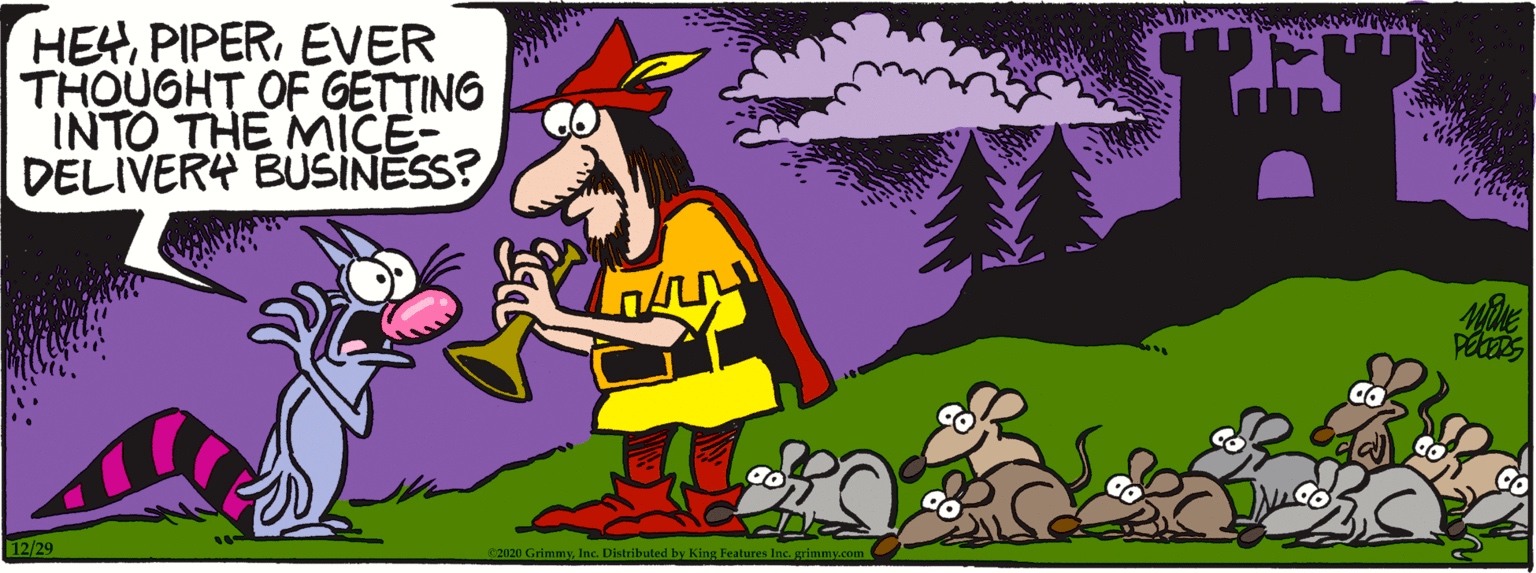
Today’s Mother Goose and Grimm cartoon has the cat Attila appealing to the Pied Piper for his help in the mice-delivery business:

mice-delivery business is a N+N compound with first element mice delivery — itself a N+N compound, with first element mice. And mice is quite clearly a plural form.
It then turns out that compounds of the form mice + N (with a clearly plural first element) have a certain degree of fame in linguistics.
(more…)
Posted in Compounds, Linguistics in the comics, Morphology, Semantics of compounds | Leave a Comment »
December 25, 2020
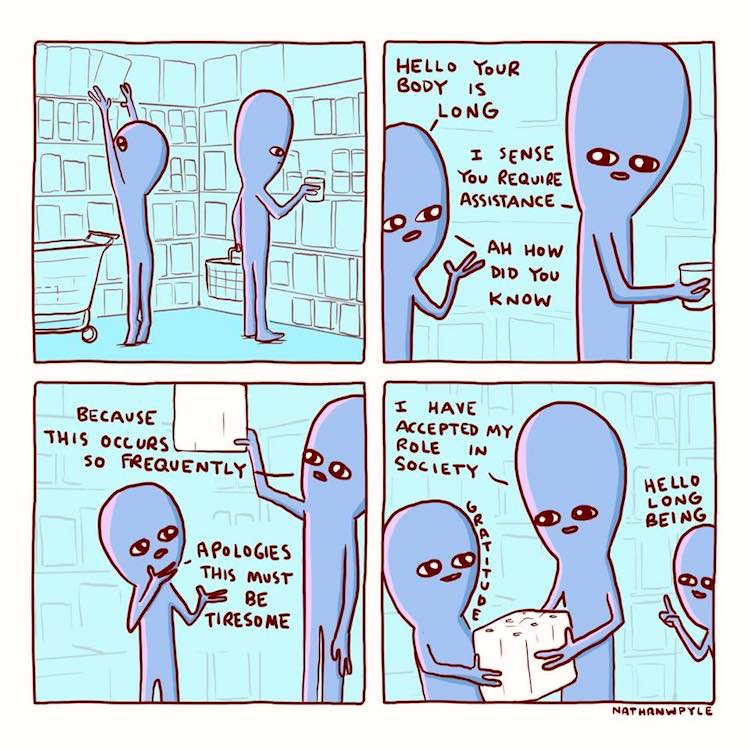
A recent Strange Planet cartoon by Nathan Pyle has the aliens not quite getting the English distinction between long and tall:
 (#1)
(#1)
— while introducing the subsidiary theme of tall people graciously accepting the social function of fetching items for their shorter companions (as someone who’s lost 3 inches in height over the years, I am grateful to those who’ve been willing to take on this role).
(more…)
Posted in Lexical semantics, Linguistics in the comics, Semantics | 4 Comments »
December 25, 2020
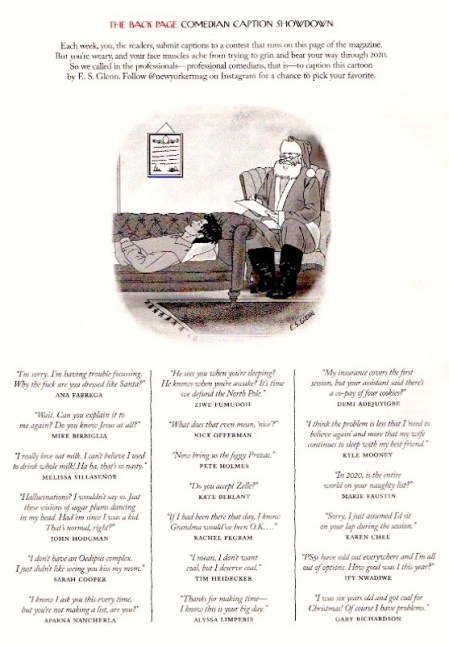
In place of the usual last page with a simple captioning contest, the 12/28/20 New Yorker — the Cartoon Issue — has a cartoon by E. S. Glenn (a Santa Psychiatrist cartoon, for the season), with no fewer that 19 captions proposed by professional comedians:
Posted in Comic conventions, Linguistics in the comics | 1 Comment »
December 25, 2020
In the most recent (12/28/20) New Yorker — the Cartoon Issue — a Colin Tom Desert Island strip, in which the castaway is importuned by messages in a bottle:

Water, water everywhere
Nor any drop to drink;
Bottles, bottles everywhere
But nothing but a CLINK!
(more…)
Posted in Comic conventions, Linguistics in the comics | Leave a Comment »
December 22, 2020
The grilling of the One Big Happy kids on their social / cultural knowledge as evidenced in their language use continues in the 11/30 strip (previous episode: my 12/20/20 posting “What question are you asking?”):

(#1) Note the context. One person could ask another whether they used sarcasm, just as chat or small talk, but that’s not what’s going on in the strip. This is some kind of test — note the dad’s laptop — and Joe is perfectly aware of that, though he has no idea what’s being tested.
Then there’s something of a trap in the question “Do you use sarcasm?” It’s perfectly possible to know how to use sarcasm without knowing that the contemptuous verbal practice you’re engaging in is in fact called sarcasm: you know how, but you don’t know what it’s called. As turns out to be the case for Joe: he can wield sarcasm just fine — he uses a sarcasm-devoted linguistic form in Like I know what X is, conveying that you don’t know what X is and expressing contempt for someone who expects that you should.
(more…)
Posted in Linguistics in the comics, Movies and tv, Pragmatics, Sarcasm and irony | 3 Comments »