Archive for the ‘Linguistics in the comics’ Category

Peter Mark’s clogged drain

August 13, 2021

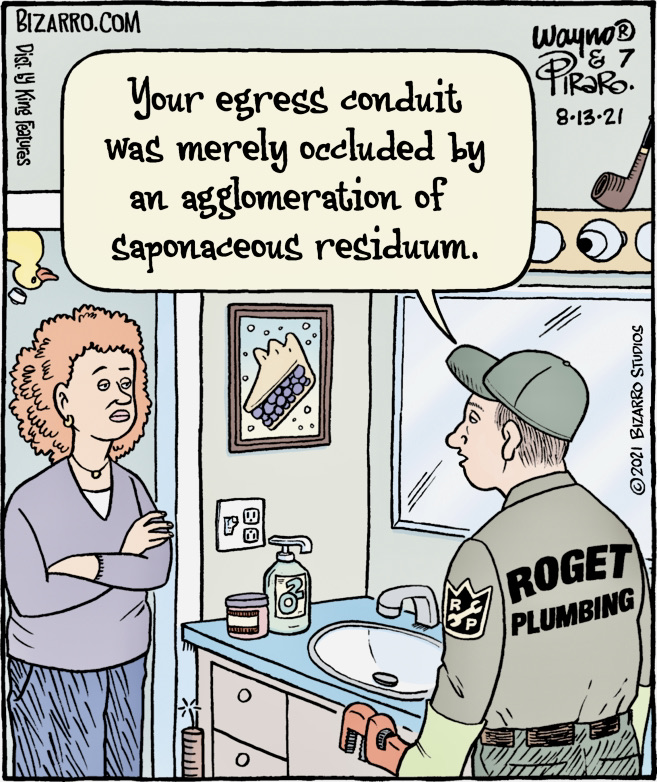
Today’s Wayno/Piraro Bizarro, with a plumber who really knows how to sling synonyms:


(#1) (If you’re puzzled by the odd symbols in the cartoon — Dan Piraro says there are 7 in this strip — see this Page.)

Hard to believe that any actual person ever uttered egress conduit for drain pipe, or saponaceous residuum for soapy residue — or, better, soapy gunk. So the plumber’s report on an ordinary household repair is absurd; it’s as if he’d been seized by a terrible fit of technicalism that left him unable to resist thesaurisizing.

(more…)

The Desert Islanders get visitors

August 12, 2021

… in two cartoons recently in The New Yorker: a Frank Cotham from the 8/9 issue, with a swarm of visitors; and a Felipe Galindo / Feggo in the cartoon caption contest at the “choose from the top three candidates” stage in the 8/16 issue, with a visit from a vagrant polar bear on an ice floe.

(more…)

The khan con

August 10, 2021

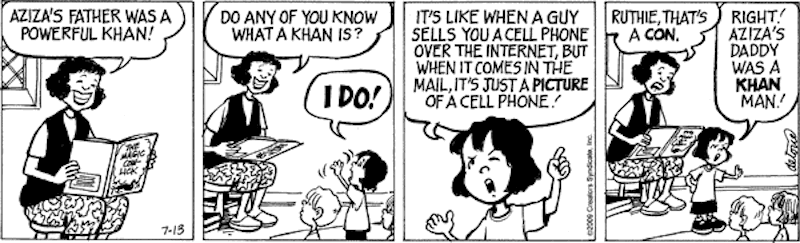
The One Big Happy strip from 7/15, in which the Library Lady reads from the children’s book The Magic Cowlick, about Aziza, whose father was a powerful khan, and asks about the infrequent lexical item khan, which Ruthie takes to be the (to her) more familiar slang noun con (< confidence man), homophonous with khan for most Americans:


(#1) But then we have some vowel issues; compare the Library Lady’s pronunciation of khan in the first panel with her pronunciation of con in the last panel

(more…)

Pastoral rituals

August 6, 2021

A Scott Hilburn cartoon from 10/3/13 with an uncomplicated (but imperfect) pun (vowsvowels) as its centerpiece, a pun that’s satisfying because the result is absurd, juxtaposing the world of a nursery rhyme with the world of church ceremonies:


(#1) The link between the worlds (made explicit in the caption) is in the nonsense-syllable refrain from the nursery rhyme (E-I-E-I-O), which happens to consist of the names of three vowel letters (with two repeated)

World 1 (the depicted ceremony, with an exchange of vows / vowels). From Wikipedia:

A wedding vow renewal ceremony or wedding vow reaffirmation ceremony is a ceremony in which a married couple renew or reaffirm their marriage vows.

Most ceremonies take place in churches and are seen as a way for a married couple to renew their commitment to each other and demonstrate that the vows they took are still considered sacred; most Christian denominations, such as the Lutheran Churches, Catholic Church, Methodist Churches, and Anglican Churches offer services for a reaffirmation of marriage.

The ceremonies have been popular in Italy for decades, and have existed in United States since the 1950s, but only became popular there after the 1970s.

World 2 (the pastoral setting, with an old man and a variety of animals on a farm, alluded to by the dress of the old man and his wife and by those vowels from the nursery rhyme). Wikipedia has a nice entry on the nursery rhyme; early versions lacked the refrain entirely and just focused on the animals, one by one; and then some later refrains had consonant-initial syllables (or riffed on o-hi-o). So it seems appropriate to treat E-I-E-I-O as just nonsense syllables — commonly used as fillers in nursery rhymes, folk songs, popular songs, rock music, and jazz singing, as in:

fa la la la LA, hey diddle diddle, heigh-ho heigh-ho, ti-yi-yippee, na na na, do-wah diddy diddy, ob-la-di ob-la da, rama lama ding dong

(The Wikipedia entry then just disregards the form of the refrain completely; it has a history, but not really an etymology, because it has no semantic content.)

Pastoral rituals. My title, with another — a different — pun, exploiting an ambiguity in pastoral. From NOAD:

adj. pastoral: 1 [a] (especially of land or a farm) used for or related to the keeping or grazing of sheep or cattle: scattered pastoral farms. [b] associated with country life: the view was pastoral, with rolling fields and grazing sheep. [c] (of a work of art) portraying or evoking country life, typically in a romanticized or idealized form. 2 (in the Christian Church) concerning or appropriate to the giving of spiritual guidance: pastoral and doctrinal issues | clergy doing pastoral work. ORIGIN late Middle English: from Latin pastoralis ‘relating to a shepherd’, from pastor ‘shepherd’.

The ambiguity in the title is between sense 2 in World 1 — the clergyman officiating at the renewal ceremony is doing pastoral work (the work of spiritual guidance) — and sense 1b in World 2 — Old McDonald and his entourage are part of pastoral life (the life of farms and related enterprises).

(You might wonder why such grossly different senses are listed in the same dictionary entry. The reason is entirely historical; the two trace back, by very different routes, to Latin pastor ‘shepherd’. The 1 senses of pastoral come pretty directly from that, by widening and metonymy (from sheep; to grazing animals; to locations where such animals are kept (on farms, in the country); to country life generally. The 2 sense of pastoral involves a metaphor — a minister is metaphorically a shepherd — that is prominent in the texts and teachings of the early Christian Church, turning on the analogy: the relationship of a minister to his congregation is as the relationship of a shepherd to his flock. But now pastoral-1 and pastoral-2 are clearly distinct lexical items.)
 

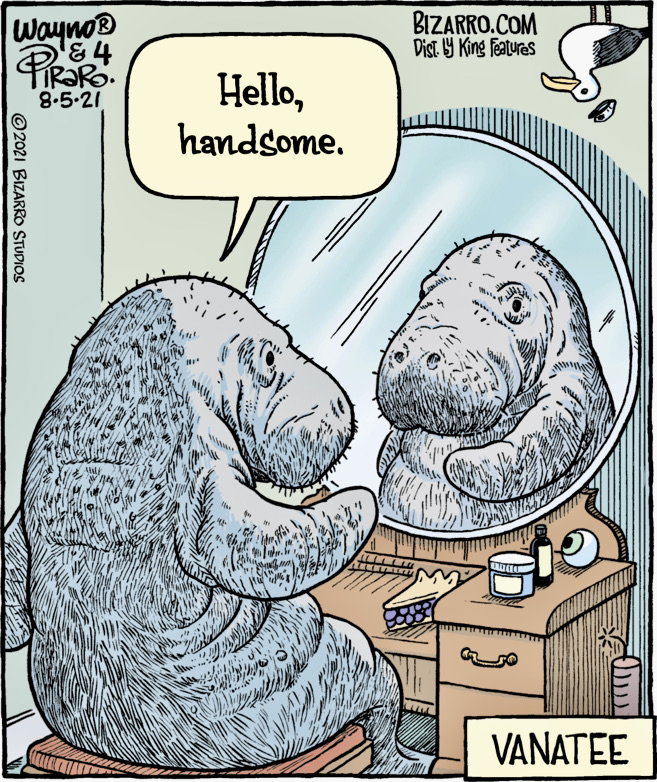
The mirror of the manatee

August 5, 2021

In today’s Wayno/Piraro Bizarro — Wayno’s title: “The Mammal in the Mirror” (a play on the song title “Man in the Mirror”) — a manatee primps at his vanity, yielding the vanity + manatee portmanteau vanatee, and crossing genders as well as words (masculine manatee — “Man in the Mirror”, addressing himself as handsome, bristly body — at a conventionally highly feminine item of furniture, a vanity table, for applying makeup in the bedroom):


(#1) (If you’re puzzled by the odd symbols in the cartoon — Dan Piraro says there are 4 in this strip — see this Page.)

I’ll start with the two contributors to the portmanteau and follow them where they lead, which is many surprising places.

(more…)

Twirly and girly

August 3, 2021

The One Big Happy from 6/5, in which Ruthie struggles, eggcornishly, to rationalize an unfamiliar name with familiar parts:

Mary, Susan, whatever.

Meanwhile, I now have “Honey Bun” from South Pacific in my head:

(more…)

Beware the bucephalic serpent bearing a wheel of cheese

August 2, 2021

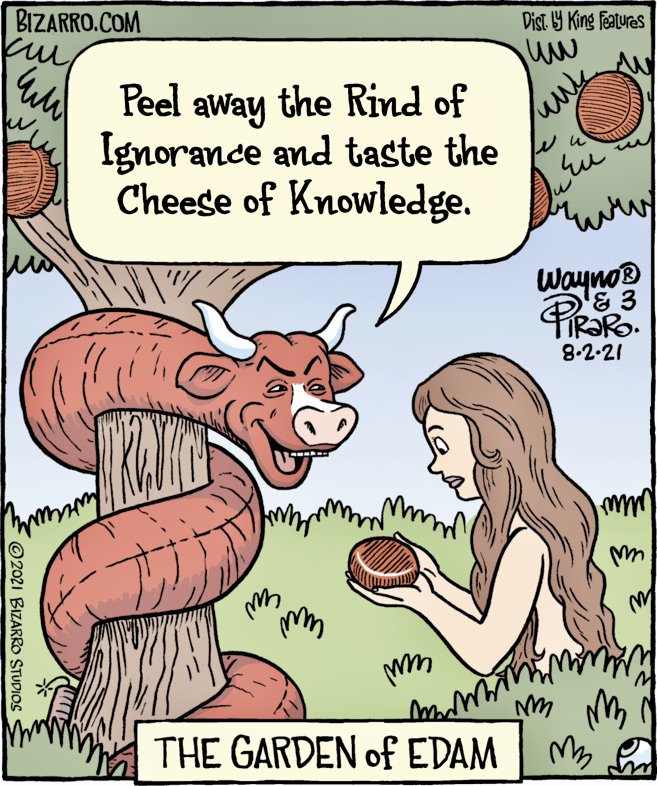
Today’s Wayno/Piraro Bizarro, with a fresh reading of Genesis:


(#1) (If you’re puzzled by the odd symbols in the cartoon — Dan Piraro says there are 3 in this strip — see this Page.) She found the tree with its serpent and cheeses on the Rindr site, a decidedly sketchy place

The story is about Adam, Eve, a serpent, and a piece of fruit (in Genesis in the KJV, it’s simply the fruit — in the Hebrew original, the generic term peri — but twice in Milton’s Paradise Lost it’s specifically an apple, Latin malus; the story is complicated, but I’m pretty sure Hebrew peri didn’t embrace cheese of any sort), and it’s always an apple in popular tellings of the story in English.

Then there’s the pun, which on the face of it is just the difference between the /n/ of Eden and the /m/ of Edam — a very high frequency pairing in imperfect-puns, especially after a vowel in syllable offsets, where the nasal is likely to be realized entirely as nasalization of the preceding vowel, with no closure for the nasal stop (making these two words potentially identical phonetically).

(more…)

A bit of Climo and a peek at Farazmand

August 1, 2021

🐇🐇🐇 Cartoonists Liz Climo (who specializes in animal characters) and Reza Farazmand (who has several animal characters), very briefly, in books recently arrived at my house. Climo already has a Page on this blog; she views her animal characters with affection; friendship and the actual physical characteristics of her animals are major themes in her work. Farazmand is new to this blog; his animal characters are essentially people in animal guise; his work is wry, tending toward the dystopian.

(more…)

Buzzcut portrait 3: the gay dinosaur

July 29, 2021

(Sexually edgy topics — what do you expect from gay dinosaurs? — so you might want to exercise caution.)

Yesterday it was a rainbow FAGGOT in block letters (in the posting “Today’s garment faggotry”); today it’s all visual: a rainbow tyrannosaurus, a poignant symbol of gay obsolescence:


(#1) Yesterday I was standing in front of a bookcase, at the helm of my indoor walker; today I’m in my work nest with my Window on the World (on my plants, birds, and squirrels) behind me, sitting in my outdoor walker, which doubles as a sturdy chair (photo by Kim Darnell)

Behind me is a crocheted FUCK square, a tribute to Jesse Sheidlower and The F Word; and a postcard tribute to the male art of Tom of Finland. Just above them, not visible here, is a copy of Jump, Paradise Cove, 1987, a Herb Ritts photograph of four men disporting themselves on the beach (see my 9/9/16 posting “Herb Ritts”). Otherwise, it’s reference works on one side, my work table (with visible mouse, on its rainbow-Z mousepad) on the other.

On the shirt, see sense 2 in this NOAD entry:

noun dinosaur: 1 a fossil reptile of the Mesozoic era, in many species reaching an enormous size. … 2 a person or thing that is outdated or has become obsolete because of failure to adapt to changing circumstances.

Sigh.

(more…)

Tripping over the signature

July 23, 2021

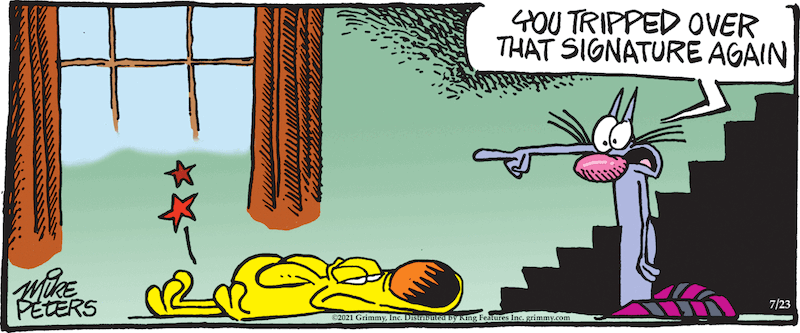
Yes, I’m not dead yet, but I’ve had grave difficulties in getting even a tiny posting together. So here’s today’s (7/23) Mother Goose and Grimm cartoon, from the meta-cartoon world:

We’ve seen piles of cartoons in which speech balloons play a role as physical objects in the cartoon’s world: people point at their contents, they act as actual balloons carrying someone away, etc. Now it’s the artist’s signature.

(more…)