Archive for the ‘Linguistics in the comics’ Category

Holy Romaine Empire

October 11, 2025

🏳️‍🌈 👨‍❤️‍👨 🏳️‍🌈 National Coming Out Day, and also J&A Day, Jacques and Arnold’s wedding-equivalent anniversary (some explanation of that cooccurrence in an appendix to this posting)

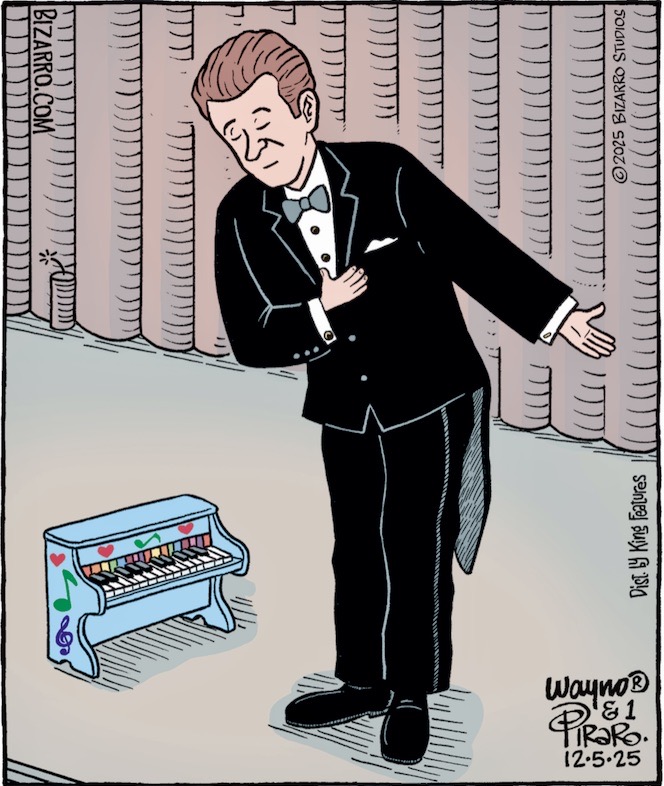
The 10/8 Wayno / Piraro Bizarro strip, posted here because it’s sweetly bizarre (true to the strip’s title), complex, and cleverly goofy (like the one in my 10/9/25 posting “The flannel frontier”); something to enjoy for a moment in the midst of terrible times:


(#1) A phonologically perfect pun (Caesar the salad punning on Caesar the emperor), the pun-like Holy Roman Empire (a German political entity) playing on Roman Empire (governed by the Caesars of Rome), and a phonologically imperfect pun (romaine the salad green punning on Roman) (if you’re puzzled by the odd symbols in the cartoon — Wayno says there are 4 in this strip — see this Page)

(The two salad puns are Wayno’s; Holy Roman Empire as a pun-like play on Roman Empire is an invention of the Roman Catholic church in Germanic lands in the early Middle Ages.)

The cartoon shows a Caesar (with laurel leaves) appearing before his people, cradling a humongous bowl of salad and waving a pair of salad servers like a weapon (Julius Caesar is often portrayed in Western art as wielding a sword). Next to him, a soldier utters a variant of the ceremonial greeting Hail Caesar! — celebrating not Caesar, but his salad.

(more…)

The flannel frontier

October 9, 2025

The 10/7 Wayno / Piraro Bizarro strip, posted here because it’s sweetly bizarre (true to the strip’s title), multifariously playful, cleverly goofy. Something to enjoy for a moment in the midst of terrible times.


(#1) It’s all about the original Star Trek tv series (if you have somehow missed learning about the show, the cartoon will be incomprehensible to you); the top-level joke is in the title: the flannel frontier, a silly pun on the final frontier — but there’s a lot more (if you’re puzzled by the odd symbols in the cartoon — Wayno says there are only 2 in this strip — see this Page)

(more…)

The duck drops down

October 6, 2025

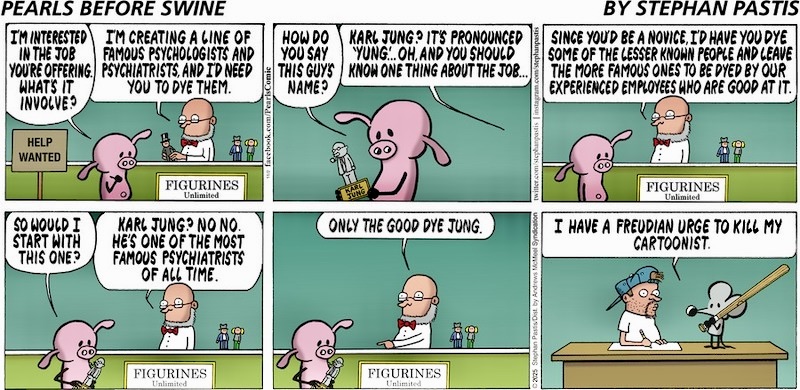
Say the secret word, and a prop duck made in the image of Groucho Marx drops down, to riotous applause and blaring horns — and you get prize money. That was American tv’s You Bet Your Life from 1950 to 1961 (roughly, my teenage years). And then in a Pearls Before Swine comic strip from 2006:


(#1) Another self-referential strip by Stephan Pastis (it’s one of his specialties) — the secret word is the idiomatic (originally biblical) phrase (cast) pearls before swine —  turning on shtick that disappeared from live tv about 65 years ago (but apparently lives on in pop-cultural consciousness, or at least in Pastis’s)

(more…)

October’s song: amid rueful jesting, they slip into death

October 5, 2025

A comic poem and a cartoon for October.

(more…)

Can I help?

October 1, 2025

🐇 🐇 🐇 rabbit rabbit rabbit for the new month, which is coming in locally with October showers (a tiny amount of rain, but always an excitement in what is still the dry season in this part of the world)

And now I turn to a William Haefeli cartoon from the New Yorker issue of 9/22/25 (this is only a bit behind the times; I have promised follow-up postings to first installments going all the way back to January, and my life is now spectacularly more difficult than it was before, so I’m just taking random shots). This cartoon:


(#1) All about the complexities in offers of help — from anyone, from someone who shares your household, from your spouse (or equivalent partner), or specifically from your same-sex partner, or (since this is Haefeli) even more specifically from your gay male partner; and also about the division of labor in households of all sorts

The cartoon is in face exceedingly rich, readable at several different levels. It is, in fact, funny even if you eliminate all the rich social specificity Haefeli has built into it.

A thought experiment: replace the highly socially located characters in #1 by cute indistinguishable cartoon creatures not identifiable by species or sex. One is engaged in some neutral task, like sorting unidentifiable objects; the other, standing by and observing, asks (in a way that presupposes that the observer doesn’t already know how to do the task):

Can I do something to help that won’t take you twenty minutes to show me how to do?

(This is an offer to help, couched indirectly, as a question, and also hedged, with a precondition on the offer.)

It’s still funny — because all tasks require skills, which must be learned (by observation or instruction, and then by practice), but there’s a wide range of complexity and difficulty for these skills, and at the upper end of the range, it could take a significant amount of time for a new helper to pick up the skill, so the observer conveys that their offer is conditional on the learning time being short; 20 minutes would be too great an investment for them. We then have some wry mockery of the observer’s attitudes — that they’ll do it, but only if it’s not too much trouble. They want the credit for offering, but don’t want to commit much to the task.

In real life, I have often had the experience, in difficult times, of having someone turn up offering to give me whatever help is needed, but then when asked to do some specific task, demurring on the grounds that “Oh, I couldn’t do that!” I have an especially unpleasant memory of my stepmother-in-law arriving in Cambridge MA (in the middle of a bitter winter, from Florida), after our daughter Elizabeth was born, to help out with the baby. Almost anything that would have helped us — doing some cooking, getting groceries, taking clothes to the laundromat, whatever — was greeted with “Oh, I couldn’t do that!”. After a few days she went back to Florida and out of our lives for a while, to our great relief.

But now in the social context. As soon as you add some social context, the cartoon becomes much richer.

First, the task is cooking, which is famously complex and time-consuming. And look at that kitchen! Crowded with pots and pans and, everywhere, ingredients. Conveying that helping out is likely to be no small undertaking.

Second, the the cartoon is about a cook and their housemate, so the division of household labor now comes to the fore: how does it come about that one person does all the cooking while the other merely observes, sometimes extending a conditional offer of help?

Third, domestic cooking in our sociocultural context is “women’s work”, so we would guess that the cook is female and the observer male, that these roles are assigned by gender-normative conventions, with the result that the observer is being cast as normatively masculine: pointedly not doing women’s work, because that would be feminine. But he might, um, lend a hand to the little lady. As a favor. If it wasn’t too much trouble. Then the cartoon is a poke at the pretensions of the observer.

But, wait! Fourth, the couple in the actual cartoon are both men. Whatever their relationship, if they are at least housemates, tasks have to get done, and somebody’s got to take the cook role. The roles have to be negotiated. And the cartoon is, again, a poke at the pretensions of the observer.

And then, in fact, the cartoon comes from Haefeli-land, a place of urban (very likely, NYC) upper middle class couples, many of them gay men. So fifth, the men in the cartoon are in fact a gay couple — and they are differentiated as two different types of gay men: the observer presenting himself as normatively masculine in appearance, the cook as deviating from these norms (earring, fashionable haircut, ponytail). Which, by playing on the norms (real men don’t cook), makes the cartoon an actual swipe at the pretensions of the observer.

The cartoon might have been titled “Sympathy for the Cook”. See, in this light, an earlier Haefeli cartoon:


(#2) Again, the cook

Real life is, of course, immensely complicated, and roles and presentations are distributed in all sorts of ways, at different times, in different contexts, for different purposes. This is literally the cartoon version.


The Venus bear trap

September 26, 2025

In today’s Bizarro cartoon, a hybrid portmanteau, a portmanteau name for one kind of hybrid referent, a referent with an assortment of features drawn from the referents of the contributing expressions; think of triceradoodle (referring to a hybrid of a triceratops and a poodle cross) = triceratops + doodle ‘a poodle cross’ (to be illustrated below):


(#1) Venus flytrap + bear trap = Venus bear trap: the appearance of a giant Venus flytrap leaf, with the bait of a foothold bear trap (if you’re puzzled by the odd symbols in the cartoon — Wayno says there are only 2 in this strip — see this Page)

To come: details about the two contributing referents, the Venus flytrap and the (foothold) bear trap; then a factor that makes this portmanteau especially rich and satisfying, in contrast to the less complex (but far more preposterous) triceradoodle.

(more…)

Monsters

September 25, 2025

In the new issue of the New Yorker (9/29/25), two monsters stalk the cartoons in its pages: Joe Dator’s hysterically creepy Wine That Breathes (It’s alive!) and Michael Maslin’s Cyclops waiter at work in an intimate little urban restaurant otherwise located in the waiter’s home territory, the hills of ancient Greco-Roman mythology.

(more…)

The risks of pedantry

September 20, 2025

This Chris Hallbeck cartoon came by me on Facebook this morning — a strip packed with matters of science (paleontology, specifically), lexicography and usage (the senses of the noun dinosaur, and the contexts in which they’re used), and pragmatics (the way in which the noun is used in interactions, especially in language about language; in the enforcement of language norms; and, oh alas, in the relevance of things said to the interests of those participating in the speech context):


A Maximumble cartoon from 5/24/14, whose humor turns crucially on the pragmatic foolishness of the (now deceased) professor (in the face of a ravening monster, he stops to insist, irrelevantly in the context, that his companion must use the proper terminology, while the companion flees to safety); and which is based on the usage of the noun dinosaur — for a member of a clade of prehistoric reptiles bearing the zoological taxonomical label Dinosauria; versus, in non-technical American usage, for any dinosaurid creature, resembling the prototypical dinosaurs (many people have seen a family resemblance)

(more…)

Putain ouais!

September 9, 2025

(Swearing in French, and English, so not to everyone’s taste)

Today’s Bizarro strip, in which Wayno shows us what goes on in a lower education classroom:


MonkeyJack (as I’l call him) asks the question, expecting the answer, in chorus: Fuck, yeah! To which he will tell them all to shout it out the way he does, loud and clear: Putain ouais! (if you’re puzzled by the odd symbols in the cartoon — Wayno says there are 4 in this strip — see this Page)

But then there’s Wayno’s title, a play on higher education (sometimes known as tertiary or post-secondary ed): this semi-technical term has higher ‘closer to the high end, the top of something’ (of formal education here, so referring to university education); and it’s opposed to K-12 education, referring to school education, that is, primary and secondary ed. Though lower ‘closer to the low end, the bottom of something’ is the opposite of spatial higher, lower education seems rarely if ever used to refer to K-12 ed.

Then lower education becomes available for play, using one of the other senses of low. And if we’re going down there, might as well go raunchy, so we get low as a rough synonym of louche ‘disreputable, sordid’, the opposite of high ‘morally or culturally superior’ — and lower education, an education in the seamier side of things, in vulgarity, like swear words. And swear words in French, ’cause everyone knows everything’s dirtier in French.

And that’s today’s quick linguistic joke. Meanwhile, life has been amazing in some ways (people said the most wonderful things about me on my 85th birthday) but almost unmanageably difficult in most ways. I am hanging on.


Cartoons for 9/1/25

September 1, 2025

🐇 🐇 🐇 rabbit rabbit rabbit to bring September in (also to bring in the first fall month in the northern hemisphere) and, this year, to celebrate (US) Labor Day (recognizing the union movement and honoring workers) — so that I bring you (cartoon) rabbits in hard hats:


(#1) Lola and Bugs Bunny, in an HBO Max series from 2023, Bugs Bunny Builders: Hard Hat Time

Which takes me to September cartoons from the New Yorker, beginning with a scene-setting item from 2022:

(more…)